Quick answer. A task you have moved from day to day three times or more will not be fixed by putting it on tomorrow again. When you hit the third postponement, stop and pick one of four things: do it now if it fits in ten minutes, break it into a concrete first step, give it a real date and time, or send it to the backlog until you know whether you want it. Deleting it counts as an answer too. What does not work is leaving it in circulation: every old task takes up a slot you needed for today.
In this guide
- Why the same task comes back every morning
- The five reasons a task never gets done
- The three-postponement rule
- How to break a task that will not start
- Where each one goes once you decide
- The Friday review
- How Monkway does it
Why the same task comes back every morning
Moving a task to tomorrow takes one second and costs nothing. That is exactly why it keeps happening. The postponement leaves no mark anywhere, so "call the accountant" can live on your list for six weeks without anything raising a hand.
Two things are usually going on at once. The first is arithmetic: most people underestimate how long something will take, even after missing similar deadlines before. Buehler, Griffin and Ross described this in 1994 as the planning fallacy, and it is stubborn — past experience corrects us far less than it should.
The second is how the task is written. Most stuck tasks have no obvious first move. You read them in the morning, you cannot see where to grab them, and you move them. Laziness has little to do with it: as written, the task cannot be started.
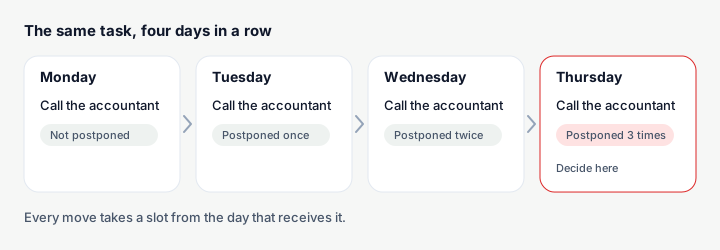
There is a third, quieter effect: old work crowds out new work. If your day holds seven things and three are carry-overs from last week, you started the day with four slots. Which is why this problem and how many tasks to plan per day are the same problem seen from two sides.
The five reasons a task never gets done
Before deciding what to do with a task, it helps to know why it got stuck. It is nearly always one of these five, and each one calls for a different exit.
| Reason | How you spot it | What to do today |
|---|---|---|
| It does not fit | It takes two hours and your gaps are twenty minutes | Break it up, or give it a day with a real gap |
| It is not written | The title has no verb and no ending: "report", "car thing" | Rewrite it starting with a verb, in one sentence |
| It depends on someone else | It has been waiting weeks for a reply that never comes | Replace it with "ask X again" on a set date |
| It is specifically unpleasant | You skip it even on days with plenty of room | Put it first, before you open your inbox |
| You no longer want it | Reading it you think "I should", not "I want to" | Backlog, or out |
The last two deserve a note. In his 2007 review of procrastination, Piers Steel found that task aversiveness and impulsiveness are among the factors most strongly associated with putting things off. In short: unpleasant tasks get postponed more, and not because you lack character. Knowing that, the sensible fix is to take the decision away from yourself by scheduling them first, before the morning is spent.
The fifth reason is the one most people skip past. A task you no longer want does not improve with waiting. If the sentence that comes to mind when you read it starts with "I really should", it usually belongs to an earlier version of your life.
The three-postponement rule
You do not need a system to catch this. Counting the moves and acting on the number is enough.
| Times postponed | What it usually means | What to do with it |
|---|---|---|
| 1 | An odd day, nothing more | Nothing. Put it back and move on |
| 2 | It is starting not to fit where you put it | Check whether the day you give it has real room |
| 3 | The problem is in the task, not in your week | Stop and decide: split, schedule, backlog or delete |
| 5 or more | You already made the decision, you just never wrote it down | Delete it, or park it with a review date |
| 10 or more | It has been taking up space for months | Delete it. If it mattered, it will come back on its own |
Three is not a magic number, but it works well as a threshold for a practical reason: one is noise, two can be bad luck, and three is a pattern. It is also the point where most people stop reading the task and start skipping over it with their eyes, which is worse than deleting it.
What the rule really does is turn a feeling ("this has been sitting there forever") into a number you can look at. If your system does not count postponements, count them yourself — a tally mark next to the title will do.
How to break a task that will not start
When the reason is that the task does not fit or is not written properly, the exit is always the same: find the ten-minute first move. Not the most important one, or the most logical one. The smallest one you can start today with no preparation.
| Stuck task | Ten-minute first step |
|---|---|
| Do my tax return | Download the three documents into one folder |
| Find a flat | Write down three neighbourhoods and a maximum price |
| Get in shape | Put the running clothes next to the bed |
| Fix the car | Look up two garages and note the phone numbers |
| Write the report | Write only the outline, five lines |
| Call the tax office | Check the phone hours and put them in the calendar |
| Clear out the storage room | Take out one box and sort only that one |
There is a second step almost nobody takes, and it changes the outcome a lot: saying when and where. Peter Gollwitzer has been studying what he calls implementation intentions since the nineties — plans shaped as "if X happens, then I do Y". His 1999 review in American Psychologist describes consistent effects from naming the moment and the place instead of stopping at a general intention.
Translated to your list: "write the outline" sits still; "Thursday at 9:00, at the kitchen table, I write the report outline" gets done. If your app lets you put a time on a task, that time is half the task already. The same holds for habits, which is why well-placed reminders beat willpower.
Where each one goes once you decide
Deciding does not mean doing. It means getting it out of limbo. There are five possible destinations and all of them are legitimate.
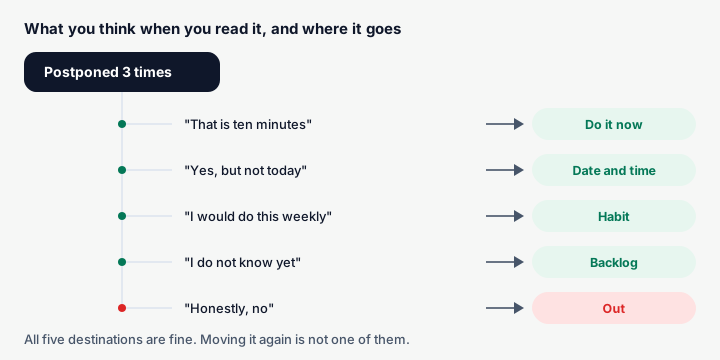
| When you read it you think… | It goes to | What you get |
|---|---|---|
| "That is ten minutes" | Do it now, before you read any further | It leaves the list permanently |
| "Yes, but not today" | A specific date, with a time if you can | It stops weighing on today and shows up when it should |
| "I would do this every week" | A habit | It comes back on its own, no remembering needed |
| "I do not know if I will do it" | The backlog | Out of your head without deciding right now |
| "Honestly, no" | Out | You get the slot and the attention back |
The backlog is the destination most people need and fewest people have. Without a place for the undecided, everything doubtful ends up dumped on tomorrow, which is a way of asking the future to decide for you.
The third row also gets overlooked. If something returns to your list every week and you do it every week, it is no longer a one-off — it is a habit without a name. Turning it into a habit takes it out of the decision queue and puts it into the routine, where it stops costing anything. If you have never done that, how to track habits covers the mechanics.
The Friday review
All of the above needs a fixed slot or it does not happen. Fifteen minutes on Friday afternoon is enough, and Friday beats Sunday: you decide with the week fresh and without Monday's pressure.
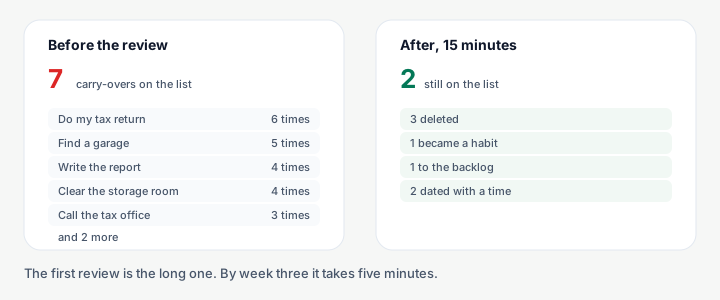
- Look only at what was postponed. Do not review the whole list. Filter or search for anything with three or more moves.
- Sort by age, not by importance. Oldest first — it is usually what you want least and what takes up the most room.
- One decision per task, no going back. Now, date, habit, backlog or out. If you hesitate for more than twenty seconds, it goes to the backlog.
- Count how many you delete. If you delete four or five every Friday, the problem is in what you write down, not in what you do.
- Spread the survivors with the daily limit on. If Tuesday is already full, the task does not go on Tuesday.
The first review stings a little because there is a backlog of backlog. By the third week it usually takes five minutes. If you want to fold it into something wider, it sits well next to the weekly planning you already do.
How Monkway does it
Monkway keeps this count for you, so it does not depend on you remembering.
- Every task records how many times you moved it. The card shows "Postponed 3 times" under the title. It is the number almost no list shows, and the one that warns you earliest.
- Moving is explicit. From the task actions you get "Move to tomorrow" and "Move to another day…", with immediate undo. Nothing slides overnight on its own.
- On the third move, the app stops you. A card appears saying "Falling behind" with the title and how many times it has been postponed, offering to delete it or keep it. It is a reminder that there is a decision waiting.
- If you actually do it, it offers to make it a habit. When you write down and complete the same thing on three different days as a one-off task, "Turn this into a habit?" appears with the number of days. It stops passing through your list every week.
- Anything undecided goes to the Backlog. You jot it down in two seconds without choosing anything. When you know what it is, you press Decide and pick today, another day, or turn it into a habit. Progress shows how many things you are still leaving undecided.
- The day has a ceiling. Today adds habits and tasks together and shows the load, so as you spread the carry-overs you can see when a day will not take any more.
- What was a goal rather than a task goes into a journey. A journey groups the habits and tasks of one effort and measures progress and consistency, instead of showing up every Monday as an impossible line.
The idea behind all of it is simple: postponing should leave a trace. Once it does, the third time no longer slips by.
Frequently asked questions
How many times can I postpone a task before worrying?
Three. One is a bad day and two can be bad luck, but by the third the pattern is clear and it is worth deciding instead of moving it again.
Is it bad to delete tasks without doing them?
No. Deleting is as valid a decision as doing, and usually more honest. If it genuinely mattered, it will come back within days.
What do I do with tasks that depend on someone else?
Stop holding them as your task. Replace them with "ask X again" on a specific date, and let that be what shows up in your day.
What if I am carrying ten tasks at once?
Sort them oldest to newest and decide only the first three. The rest stay as they are until next Friday; trying to clear everything in one go usually ends with abandoning the clean-up.
Is a long to-do list better than just the day?
Just the day, with a separate place for everything else. A long list in view makes you choose worse, because your attention goes to the easy items before the ones that mattered.
When should a repeated task become a habit?
Once you have done it on three different days and you know it will be back. As a habit it stops asking for a decision every week, and you can watch real consistency without relying on a streak.
Does putting a time on a task actually help?
Yes, quite a lot. Naming when and where you will do something is one of the highest-effect, lowest-cost adjustments, and it stops the task waiting for "whenever I can".
What if what I am carrying is a whole project?
Then it is not a task, which is why it never finishes. Break it into one daily habit and a few dated tasks, or set it up as a goal with its pieces — that is what guided journeys are for.
Start with the three oldest
You do not need to reorganise anything to feel the difference. Find the three oldest tasks on your list and decide each one now: do it, split it, date it, park it or delete it. Two out of three usually go.
If you would rather the app kept the count and warned you on the third move, Monkway is free to start, on iPhone and in the browser. And if what you see when you look at your list is that the day was already too full before the carry-overs, the step before this one is stopping procrastination with small steps.