Quick answer. To restart a habit you dropped, come back with a smaller version than the one you used to do: the one you could finish on your worst day, even if it feels too small to count. Start today rather than on Monday, and give it a real slot with a time and a place. Stop looking at the streak, which resets to zero and pushes you to quit again, and look at how many times you did it over the last 30 days. If this is your third restart and it collapses the same way, change the size or the slot, because that is where the problem is.
In this guide
- Why it broke, and why that matters less than you think
- Come back at half of what you used to do
- The day to restart is today, not Monday
- What to track instead of the streak
- What to do with the old habit and its history
- Signs your restart is going wrong
- How Monkway handles it
Why it broke, and why that matters less than you think
Almost nobody drops a habit on the day they miss it. They drop it three or four days later, after deciding several times in a row that today is not the day either. A single miss does little damage: Lally, van Jaarsveld, Potts and Wardle followed 96 people for twelve weeks in 2010 and, while studying how habits form in the real world, observed that missing one opportunity did not meaningfully disturb the automaticity curve. What disturbs it is no longer showing up.
That changes the question you come back with. Instead of hunting for what happened on that one Tuesday, look for the condition that made the habit depend on a perfect day. It is usually one of six.
| Why it collapsed | How you recognise it | What to change on the way back |
|---|---|---|
| It was too big | You did it on weekends and almost never on weekdays | Cut it down to the ten-minute version |
| It sat in an impossible hour | It fell apart at the same time of day every time | Move it to a different slot, not a different minute of the same slot |
| It started alongside four others | Nearly all of them died the same week | Come back with one habit only |
| It broke during a trip or a move | It worked until one specific, obvious date | Leave the habit alone and rebuild the context |
| You could not say what it was for | Explaining it in one sentence is hard | Decide whether it comes back at all |
| You measured it with the streak | You quit the day after breaking it | Change the metric before you restart |
That last row is the most common and the most expensive. A counter that returns to zero turns one miss into a clean slate, and a clean slate looks a lot like quitting. There is more on that in our piece on streaks without quitting.
Come back at half of what you used to do
The working rule is simple: the habit you restart with has to fit your worst day of the month, not an average one. If you used to run 45 minutes, come back with ten. If you used to study two hours, come back with one 25-minute block. This is not a symbolic step or a punishment. Bad days are the ones that decide whether a habit survives, and on a bad day only small things survive.
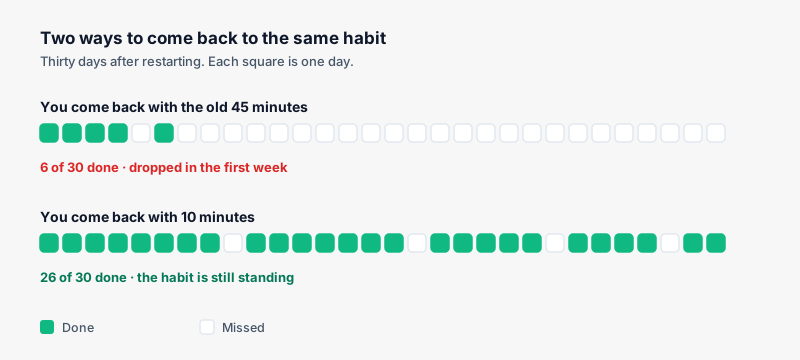
Good days need no protection. If the habit is ten minutes and your evening is free, you will do thirty anyway. What does not work is setting forty-five and doing zero.
| The old habit | The version you restart with | When to scale back up |
|---|---|---|
| Run 45 minutes | Walk or jog for 10 minutes | After two weeks without missing one |
| Read 30 pages | Read 2 pages | When you also do it on heavy workdays |
| Study 2 hours | One 25-minute block | When you finish the block wanting more, three days running |
| Gym 4 days a week | 2 fixed days, same time | When you have missed neither of them for three weeks |
| Journal every night | Three sentences before bed | When they come out easily and you want more room |
| Cook every day | Cook on Sunday for three days | Once Sunday is solid |
There is a trap here. Many people shrink the habit but keep the old standard in their head, so ten minutes feel like a failure next to forty-five. If that happens, write the small version down as the real habit and forget the big one for a month.
The day to restart is today, not Monday
Landmark dates do help. Dai, Milkman and Riis described the fresh start effect in Management Science in 2014: after a temporal landmark, such as a Monday, the first of a month or a birthday, people pursue aspirational behaviour more often. The problem is how we use it. If today is Wednesday, waiting for Monday means five days of an open decision, and an open decision collapses on its own.
Use the landmark if it is one or two days away. If it is further off, start today with the minimum version and let Monday be the day you scale up.
The second thing that helps is writing a plan rather than an intention. Gollwitzer summarised in American Psychologist in 1999 that plans with a concrete when and where get carried out more often than general intentions. In practice that means turning "start reading again" into "two pages on the sofa, after dinner, before I pick up my phone".
If you are coming back after a long break rather than a bad week, the order of those first weeks matters more than the content; we cover it in how to get back into a routine after vacation.
What to track instead of the streak
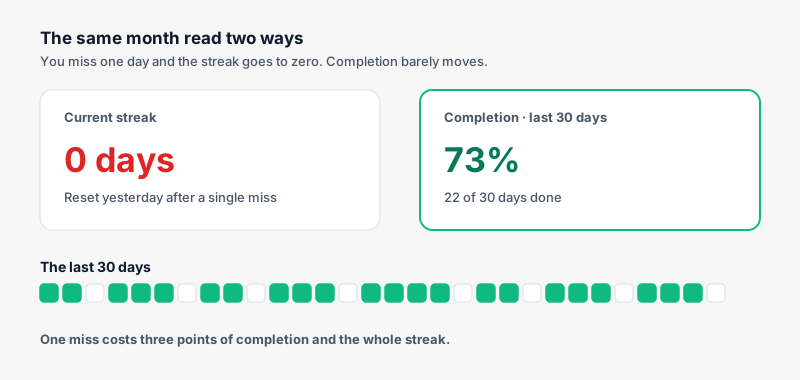
When you restart, the streak is the worst number you can have in front of you. It starts at zero on the day you are most fragile, and it cannot tell somebody twenty days into a 90% month from somebody who has not shown up in weeks. You need a measure that survives a miss.
| Measure | What it tells you | When it misleads |
|---|---|---|
| Current streak | Consecutive days completed up to today | Drops to zero on one miss and takes your mood with it |
| Best streak | Your historical ceiling | Says nothing about the month you are in |
| Completion over 30 days | How many of the possible times you did it | The first week still means nothing |
| Consistency | How the effort spreads across weeks | Moves when you add or remove habits, even if your effort is identical |
| Days skipped on purpose | The ones you chose not to do | If they are half the month, the habit is what needs to go |
The practical threshold sits in the 30-day completion figure. Under 40%, the habit is not alive: it shows up occasionally and takes a slot without giving anything back. That is the moment to shrink it, move it or pause it, rather than dragging it along for two more months. And if what you are missing is the record itself, start with how to track habits, because measuring badly is a quiet way of quitting.
Be careful with round numbers too: the famous 21 days comes from no serious study, and the 66-day average in Lally's work came with a very wide range between people. We unpack it in how long it takes to form a habit.
What to do with the old habit and its history
The temptation is to delete it and create a clean new one with no trail of misses. That is usually a bad idea. That history is the only thing telling you whether the habit fell apart on Tuesdays, broke in the fourth week, or only worked while you were at home. Lose it and you run the same experiment blind.
| Situation | What to do with the old habit | Why |
|---|---|---|
| Same habit, smaller | Resume it and edit the frequency | You keep the history that explains why it collapsed |
| A different, related habit | Create a new one and archive the old | Mixing a 45-minute run and a 10-minute walk in one line ruins the completion figure |
| Not coming back this quarter | Pause it, do not delete it | It stops cluttering today and is still there if you change your mind |
| You no longer want it | Delete it | A habit you will not do only makes the app unpleasant to open |
Pausing has a less obvious benefit: a paused habit stops counting towards your day, so today's list reflects what you will actually do again. Dragging six dead habits around makes an empty day look full.
Signs your restart is going wrong
The first two weeks give fairly clear signals. It is worth reading them before the collapse repeats, because most of them are fixed with a small adjustment.
| Sign | What it means | What to do this week |
|---|---|---|
| You only do it on Saturday and Sunday | It depends on having free time | Shrink it until it fits an ordinary Tuesday |
| You have restarted it three times this year | The size or the slot does not fit your life | Halve it again and move it to another hour |
| You do it but never tick it off | The record is far from the moment | Set the reminder at the real time, or tick from the widget |
| You tick it without doing it | The habit exists to look good, not to happen | Swap it for the one you would actually do |
| It occupies your head all day | It has no assigned slot | Anchor it to something you already do without thinking |
| Other things collapse when it comes back | Your day was already full | Lower your daily maximum and remove something |
That last one deserves a pause. A returning habit lands on top of everything else, so if your day was already tight, it pushes something out without you deciding which. Look at the total before you look at the habit: how many tasks to plan per day and how many habits to start at once cover the numbers.
How Monkway handles it
Monkway is built so that one miss does not take the habit down with it. These are the pieces you use when restarting.
- Skip today instead of failing. Every row in the day has "Skip today". The day is recorded as a deliberate skip rather than a hole, so the month still reads honestly.
- Pause and Resume. The Habits screen has three tabs: Active, Paused and Achieved. Anything you pause disappears from Today and keeps its full history; when you are ready, you press Resume and it picks up where it was.
- Completion instead of streak. Each habit's detail shows Streak, Best streak, Completion and the Last 12 weeks together. On a restart, the column that matters is Completion, and the twelve weeks show the pattern: if it always breaks in the same stretch, willpower is not the variable.
- The weekly review surfaces the weak ones. Weekly review has a "Weak habits" section with the rule "Under 40% over 30 days", and each one comes with Keep, Pause and Archive. That is exactly the decision this article is about, prepared for you once a week.
- Progress tells you which is worst. The "Your weakest habit" block shows the weak spot with its completion and current streak, over 30 days, 90 or the year. Use it to pick which one to restart first.
- Resizing costs you nothing. In Edit habit you change Frequency between Daily, Fixed days, N per week or Monthly, and set a Time. Going from daily to three per week is an adjustment, and the history stays put.
- The daily limit protects the restart. Progress → Pace has Limits, with "Maximum things per day" and a suggested value based on your closures over the last 28 days. Schedule something on a full day and the app warns that the day "is already at the limit" and offers to move it.
- When what returns is a long goal. If the dropped habit belonged to something bigger, such as an exam or getting back in shape, journeys are the place: they group the habits and tasks of one push and measure progress. The method is in how to break a long goal into habits and the catalogue is in guided journeys.
One more thing: if what failed was remembering, reminders are set per habit and at the hour you would really do it, not the hour you wish you would. We go through it in how to set habit reminders.
Frequently asked questions
How many days off before it counts as dropped?
There is no official number and you do not need one. Look at completion over the last 30 days: under 40%, the habit is no longer working, even if you did it yesterday.
Do I have to start the streak again from zero?
The streak resets on its own, but it does not have to be your measure. Use 30-day completion, which climbs from the first day you show up again and does not punish a single miss.
Should I delete the old habit and create a new one?
Only if what you are restarting is genuinely a different habit. If it is the same thing in a smaller version, resume the one you had: its history is what tells you when and why it collapsed.
How many dropped habits can I restart at once?
One. If you have several, start with the one you miss most and wait until it has been stable for three weeks before touching the next.
What if I dropped it because it bored me?
Then consistency is not the issue. Change the content before you come back, such as a different route, book or time of day, or leave the slot free for another habit.
How long until I am back at my old level?
It depends on the habit, and it is usually quicker than you expect if the break lasted weeks. Scale up after two straight weeks of the small version, not on a calendar date.
Is skipping a day any better than missing it?
Yes, when it is a decision rather than an excuse. A deliberate skip keeps the record free of noise; if you end up skipping half the month, the signal is that the habit should go.
What if I restart and it collapses again within a week?
Look at what time it collapses and what it competes with. The fix is almost always moving it to another slot or removing something else from the day, rather than trying harder.
Start with one, today
Pick the dropped habit you miss most, write it down in the version you would do on your worst day, and give it a time today. Leave the others paused until this one has stood for three weeks.
If you want a missed day to stop erasing your progress, and the app to show you completion over the last 30 days instead of a streak at zero, Monkway is free to start, on iPhone and in the browser.