Quick answer. Split the goal into three layers. On top, the goal itself, with a target date and one sentence about why you want it. In the middle, two or three fronts: the parts of the goal that move independently. At the bottom, the only layer that reaches your day: one habit per front plus a few dated tasks. The sorting rule is short. Anything that has to happen many times becomes a habit; anything that happens once and is finished stays a task. Everything else is written down above and takes no room today.
In this guide
- Why a long goal does not fit in a day list
- The three layers: goal, fronts, pieces
- How to pull the fronts out of a goal
- What becomes a habit and what stays a task
- How many pieces a goal can carry
- Three weeks in: how to tell the split was right
- Three goals actually broken down
- How Monkway does it
Why a long goal does not fit in a day list
"Pass the exam." "Launch the business." "Get in shape." Written that way, none of the three can be done today. Put one in tomorrow's list and tomorrow you will see a line you cannot tick, and by the third time you postpone it without reading it.
The size of the line is what breaks. A goal that runs for months has no obvious next step. It has twenty, and every time you look you decide again which comes first. That decision costs more than almost anything else on the list, so you avoid it.
There is a second reason, and it is distance. A nine-month goal sends no signal for weeks. With no signal you cannot tell whether you are on track, and once you cannot tell, you stop looking.
Locke and Latham summarised thirty-five years of research on this: specific and difficult goals produce higher performance than vague ones of the "do your best" kind. Part of that effect comes from a specific goal telling you what to do now. "Pass the exam" says nothing about this afternoon. "Two hours of the syllabus before lunch" does.
Breaking the goal down fixes both problems at once. It tells you what to do today, and it gives you a signal every day.
The three layers: goal, fronts, pieces
A split that holds has three levels, and each level is measured by a different thing.
| Layer | What it is | Where it lives | How it is measured |
|---|---|---|---|
| Goal | The result you want, with a date | Outside the day, on its own page | Progress and days left |
| Front | A part of the goal that moves on its own | Inside the goal | Whether it moved this week |
| Piece | A specific habit or task | In today's list | Done or not done |
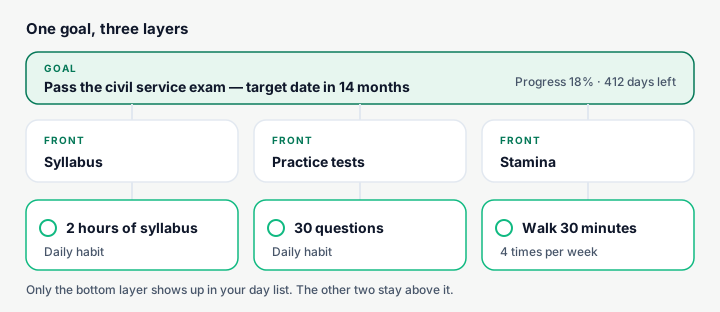
The middle layer is the one almost everyone skips, and the one that prevents the most common mistake: pulling twenty loose tasks out of a goal with no idea which ones matter. If the goal is a professional exam fourteen months out, the fronts might be syllabus, practice tests and stamina. Syllabus moves by reading and summarising. Practice tests move by answering questions. Stamina moves by sleeping properly and getting out of the chair, because nine months of sitting still has a bill attached. Each front has its own pace and its own signal.
How to pull the fronts out of a goal
Ask yourself one question: which two or three things all have to go well for this to work? Each answer is a front. Then three rules so you do not overdo it:
- If two fronts always move together, they are one front. "Study the syllabus" and "write summaries" are not two fronts. They are the same thing.
- A front counts only if you can say in one sentence how you would know it went well this week. If you cannot, it is still an intention.
- A front you cannot touch is not a front. "Hear back from the company" does not depend on you. That is a waiting task with a date to check again.
Two fronts is uncommon, three is normal, four usually means you are mixing two separate goals. If you end up with five, you have two goals running at once and the day will not stretch that far.
What becomes a habit and what stays a task
Now the sorting. Every line under every front ends up in one of these five places.
| Part of the goal | How you recognise it | What it becomes | How it is measured |
|---|---|---|---|
| Has to happen many times | Shows up in different weeks | Habit at its real frequency | 30-day completion rate |
| Happens once and is done | Has a clear end | Task with a date | Done or overdue |
| Comes back, with a long gap | Once a month, or every fortnight | Monthly habit, or N per week | Times completed |
| Depends on someone else | You cannot start it yourself | A "check again" task with a date | Days waiting |
| You do not know yet if it is needed | No idea when or how | Backlog, inside the goal | Days undecided |
The first row is the important one. A habit is the part of the goal that has to be repeated many times, which is why it is measured over a long window instead of a single day. Missing one Tuesday means nothing. Missing eleven days out of thirty means something.
One detail decides whether a goal's habit survives: the hour. A habit with no moment and no place stays a wish. Gollwitzer and Sheeran reviewed 94 studies on this point and found that deciding in advance when, where and how you will act meaningfully improves the odds of actually doing it. Applied here: "study more" is not a habit. "Two hours of syllabus from 9:00 to 11:00 at the library" is.
With tasks the mistake runs the other way: writing down a task that is really a whole front. "Sort out the website" does not happen in a day. When a goal's task has been sitting there for three weeks, it is usually missing a smaller step that does fit in one evening. The full rule for deciding those is in tasks you keep postponing.
How many pieces a goal can carry
This is where most plans break. The split can be perfect and still not fit in your day.
The arithmetic is simple: one habit per front, plus two or three dated tasks in view. And all of that lands on top of whatever you already had before the goal existed.
| Fronts | Habits from the goal | Dated tasks in view | Room it takes in a day of seven |
|---|---|---|---|
| 1 | 1 daily | 2 | 2 of 7 |
| 2 | 2 daily | 3 | 4 of 7 |
| 3 | 2 daily and 1 at three per week | 3 | 5 of 7 |
| 4 or more | Does not fit alongside anything | — | Merge fronts or postpone one |
The last row is a real warning. With four active fronts the goal eats the whole day and leaves no room for the life you already had: the shopping, the bank, the kids. Two weeks in you miss a day, then two, and you end up dropping the entire goal when the problem was the allocation.
If the total comes out above nine things a day, the number to change is the goal's, not the rest. The criteria for setting that maximum are in how many tasks to plan per day, and for the habit side, in how many habits to start at once.
Three weeks in: how to tell the split was right
Three weeks is the first point where the numbers say anything. Before that, novelty hides the allocation mistakes.
| What you see | What it means | What to change |
|---|---|---|
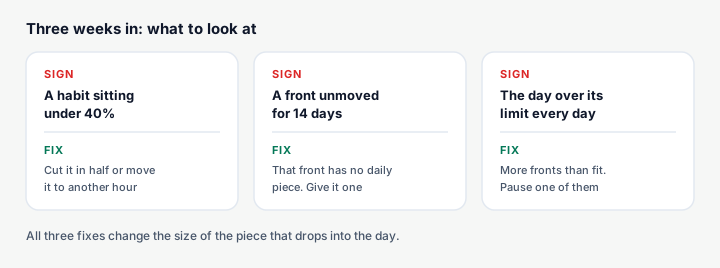
| A habit under 40% | It is too big, or it sits at a bad hour | Cut it in half, or move the hour |
| Habits high, goal not moving | The habits do not touch the goal | Change the piece, not the effort |
| A front unmoved for 14 days | That front has no daily piece | Give it a habit, or postpone it whole |
| Goal tasks postponed three times | A smaller step is missing | Split them into what you can do today |
| The day over its maximum every day | More fronts than fit | Pause one front completely |
The second row is the uncomfortable one. You can hold three habits at 90% and watch the goal sit still: twenty-one days of reading the syllabus, zero practice tests done, and the exam is all practice tests. That calls for a different piece, not more consistency.
Do not expect a habit to hold itself up after three weeks. Lally and colleagues followed people starting a new habit over twelve weeks and found that the time until the behaviour became automatic had a median of 66 days, with a very wide range. At three weeks you are still pushing, and that is normal. What you can judge already is the size of the piece. The detail of that study is in how long it takes to form a habit.
Three goals actually broken down
Three complete examples, with their fronts, the habit from each front, and the dated tasks of the first few weeks.
| Goal | Fronts | Habit from each front | Dated tasks |
|---|---|---|---|
| Pass a professional exam in 14 months | Syllabus, practice tests, stamina | 2 h of syllabus daily; 30 questions daily; walk 30 min four times a week | Finish unit 4 by the 12th; pay the exam fee; full mock on Sunday |
| Start a small business in 6 months | Product, customers, money | 1 h on the product daily; 3 customer conversations a week; review the numbers on Fridays | Register the business; minimum page live by the 20th; put a price on the first offer |
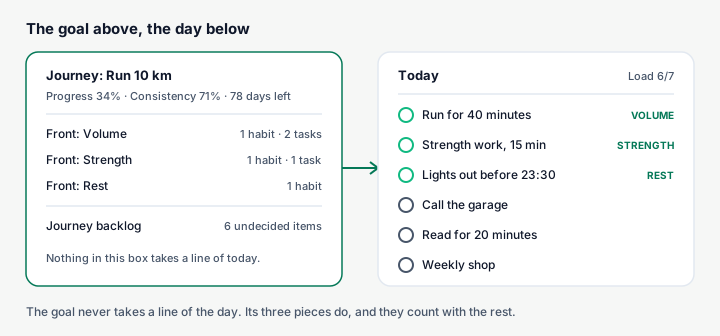
| Run 10 km in 4 months | Volume, strength, rest | Run four times a week; 15 min of strength work three times a week; lights out before 23:30 | Buy shoes; sign up for the race; test 8 km on day 60 |
The same pattern shows up in all three: one front looks like it belongs to another subject and is the one holding the rest up. In the exam it is stamina, in the business it is money, in the race it is rest. They are the first to go, because they show nothing in the short term, and they are what gets the goal to month eight.
If your goal is an exam, the split between syllabus, review and practice tests is covered in how to build study habits. If you already have the long list and the missing part is spreading it across days, carry on with how to plan a realistic week.
How Monkway does it
In Monkway the three layers exist as they are: the goal is a journey, the fronts live inside it, and the pieces are the habits and tasks that show up in Today.
- One journey per goal. You give it a name, one sentence under "Purpose" and a target date. Its habits, tasks, backlog and notes live inside. The journey page shows Progress, 30-day consistency and "N days left".
- Fronts live inside the journey. Every habit and every task can carry a Front, so you see the goal split into its two or three parts without creating three separate journeys.
- The goal never drops into the day. Today shows only today's habits and tasks, each tagged with its front. The journey stays above and takes no line.
- The load counts the pieces. At the top you see "Load 6/7", counting habits and tasks together. Try to schedule something on a full day and you get "That day has 7 of 7. Schedule it anyway?" with an option to move it. You set the maximum yourself in Progress → Pace.
- Progress → Pace has a By journey view. It shows how much of your day each goal is taking and which one has gone without closures. That is the fast way to spot the stalled front.
- The journey backlog holds what is not due yet. You jot things down inside the goal without deciding anything, then decide later: today, another date, or turn it into a habit.
- The weekly review flags stalled journeys. Once a week it shows overdue tasks, weak habits (under 40% over 30 days), journeys with no closure in 14 days and old backlog items, with one action for each.
If you would rather start from something already built than split your own goal from scratch, the guided journeys come with their fronts and habits already allocated, and everything can be changed once you are inside.
Frequently asked questions
How many habits should a long goal have?
One per front, so usually two or three. More than three habits for a single goal leaves no room for the rest of the day and tends to end with the whole block abandoned.
Can I run two long goals at the same time?
You can, as long as the two together stay under four daily pieces. In practice that means two fronts in each, or three in the main one and one in the second.
Where do I put the parts of the goal I do not know how to do yet?
In a backlog inside the goal, written down and undecided. Never in tomorrow's list: that is what makes tomorrow impossible before it starts.
How soon should I see the goal moving?
Within two or three weeks you can tell whether the pieces are the right size; the goal's own progress takes longer, depending on its date. If no front has moved after three weeks, review the split before carrying on.
What if the goal has no date?
Give it one anyway, even a rough one. With no date there are no days left, and with no days left any week looks like a fine week to do nothing.
Is a daily habit better than three times a week?
Daily for anything short that always fits, three a week for anything that needs time or recovery. A daily habit you can only really do four days a week drags your completion rate down for no good reason.
What do I do when a front is finished?
Close it and decide whether the space stays free or goes to a front that was waiting. It is the best moment to add the one that did not fit at the start.
What if I miss several days in a row?
Restart only the habit from the main front and leave the others paused for a week. Coming back with all three pieces at once after a break is the fastest way to fail again.
Start by writing down the fronts
Take your goal and answer one question on paper: which two or three things all have to go well for it to work. Under each, write a piece that fits into tomorrow. That is the whole plan, and it takes ten minutes.
If you want the goal to stay above with its progress and days left, and only the pieces that fit to drop into the day, Monkway is free to start, on iPhone and in the browser. And if the arithmetic shows your day was already full before the goal existed, the step before this one is putting habits and tasks in the same app so you can see the real number.