Quick answer. To keep a journal for one habit, write a short note right after you do it or skip it, not at the end of the day. Log the same things every time: what you did, how it went as one word or a number, and what made it easy or hard. One to three lines is enough. Once a week, read the last seven days of notes and change one thing about the habit based on what you see.
What you'll find
- What a one-habit journal is for
- What to write in each note
- When to write the note
- Examples by habit
- What to write on the days you miss it
- How to read your notes once a week
- How Monkway does it
- Frequently asked questions
This content is educational and is not medical or psychological advice. If you keep a journal for a habit linked to an injury, sleep, eating or your mood, and you notice pain, fatigue or low mood that lasts for weeks, talk to a healthcare professional.
What a one-habit journal is for
A general journal tries to capture your whole day. A one-habit journal captures one thing: how running, reading, meditating or studying is going. That changes what you write and how long it takes.
The main benefit is that you can compare. If every note is about the same habit and uses the same details, after two or three weeks you start to see patterns. You see which days are harder, what time works best and what gets in the way. In a general journal those clues get lost among everything else.
The second benefit is size. A one-line note takes thirty seconds to write. That makes it much easier to keep going.
Writing down your progress has research behind it. A meta-analysis by Harkin and colleagues, published in Psychological Bulletin in 2016, reviewed 138 studies and found that monitoring progress helps people reach their goals, especially when that progress is physically recorded. A habit journal is a simple way to do that.
| General journal | One-habit journal | |
|---|---|---|
| What it covers | The whole day: events, ideas, feelings | One behavior and what surrounds it |
| Length of each entry | Half a page or more | One to three lines |
| When you write | Usually at night | Right after you do or miss the habit |
| What it's for later | Remembering and sorting thoughts | Spotting patterns and adjusting the habit |
| Common failure | Dropped because it asks too much | Becomes empty routine if you never read it |
If you want to write about your life in general, there's a separate guide on how to start journaling. This article is about something narrower: using short notes to make one specific habit work better.
What to write in each note
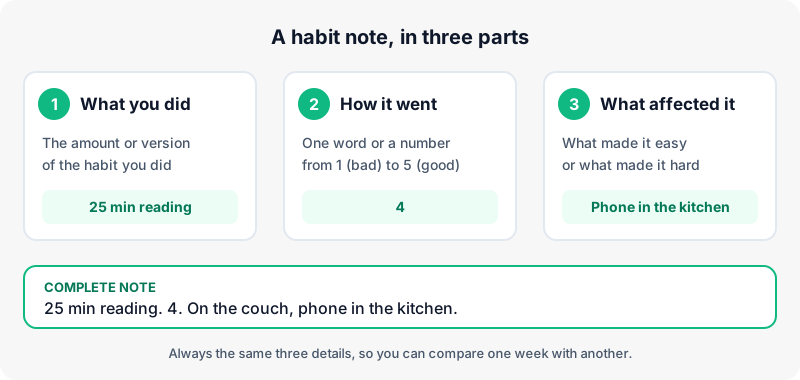
The rule is simple: the same three details in every note. If you write about your mood one day and the weather the next, you can't compare anything later.
These three details work for almost any habit:
- What you did. The amount or the version of the habit. "20 minutes", "12 pages", "short version".
- How it went. One word or a number from 1 to 5. "Easy", "a drag", "3".
- What affected it. Whatever made it easy or hard. "After dinner", "tired", "phone in another room".
That's a complete note. For example: "25 min reading. 4. On the couch, phone in the kitchen."
You can add a fourth detail if your habit calls for it. If you run, you might log distance. If you study, the topic. But only add what you'll actually look at later. Every extra detail makes the note longer and easier to skip.
| Detail | Example | What you'll use it for |
|---|---|---|
| What you did | "30 min", "short version", "2 miles" | Checking whether the habit's size is realistic |
| How it went (1-5) | "2", "4" | Spotting days or times that are harder |
| What affected it | "after work", "in a rush" | Finding the cause of bad days |
| Time (optional) | "7:40 am" | Choosing the best time slot |
| Place (optional) | "at home", "at the library" | Knowing where it comes easiest |
What to leave out: long reflections, judgments about yourself ("I'm hopeless") and lists of resolutions. None of that compares well, and it makes the note heavy.
When to write the note
Write it right after you do the habit. At that moment you remember clearly how it went and what happened. If you leave it for the evening, the habit blends into the rest of the day and the note loses detail.
It's also easier to remember. The end of a habit is a clear cue: you close the book, finish the run, end the meditation. If writing the note is tied to that moment, it becomes the last step of the habit.
If you can't write it then, because you're out or in a hurry, log just a number from 1 to 5. Fill in the rest in the evening if you feel like it. A number beats nothing.
| Timing | Pros | Cons |
|---|---|---|
| Right after the habit | You remember well, tied to a clear cue | Your phone isn't always at hand |
| In the evening, all at once | One moment a day | Details fade and mix with the rest of the day |
| The next day | None to speak of | Most of the useful detail is gone |
| Only when something goes wrong | Fewer notes overall | You never see what works on good days |
If you keep forgetting, attach it to the habit as one more step. It works like habit stacking: "when I close the book, I write the note."
Examples by habit
The three details adapt to each habit. Here are real-sized one-line notes so you can see the length.
| Habit | Example note | What to look for when rereading |
|---|---|---|
| Running | "3 miles, 3, heavy legs, went out late" | Whether going late or short sleep changes the score |
| Reading | "15 pages, 4, in bed, no phone" | Where and when you read the most pages |
| Meditation | "10 min, 2, noisy at home" | Whether place or time changes the score |
| Studying | "Chapter 4, 45 min, 3, drifted at the end" | How long you last before focus drops |
| Drinking water | "6 glasses, 4, bottle on the desk" | What reminds you to drink and what doesn't |
| Writing | "300 words, 3, no plan beforehand" | Whether planning first changes the result |
Notice that none of these goes past one line. Some people like to write more on days when the habit teaches them something new. That's fine, as long as the other days stay short.
If your habit is reading or meditation and you're just starting out, these guides may help too: how to build a reading habit and how to meditate every day.
What to write on the days you miss it
Write on those days too. Notes from missed days are the most useful, because they tell you what got in the way.
A missed-day note has a slightly different shape:
- What happened instead. "Worked late", "exhausted", "forgot".
- When you noticed. "At 10 pm", "the next morning".
- What you'd change. Only if something concrete comes to mind. "Do it before lunch."
Example: "No. Meeting until 8 pm. Noticed in bed. Try mornings on Tuesdays."
You don't need to justify yourself or write about how missing it made you feel. It's data, the same as the good days. If the same cause shows up three or four times, you have something concrete to change. To dig deeper, see how to find out why a habit keeps failing.
How to read your notes once a week
Writing without reading is why these journals fizzle out. Reading is what turns notes into changes.
Do it once a week, on the same day. It takes five to ten minutes. Follow these steps:
- Gather the last seven days of notes for that habit. Only that one.
- Look at the 1 to 5 scores. Find the lowest and highest days.
- Compare what affected the low days with what affected the high ones.
- Pick one change for next week. The time, the place, the size, or what you do right before.
- Write that change down in a new note so you remember it.
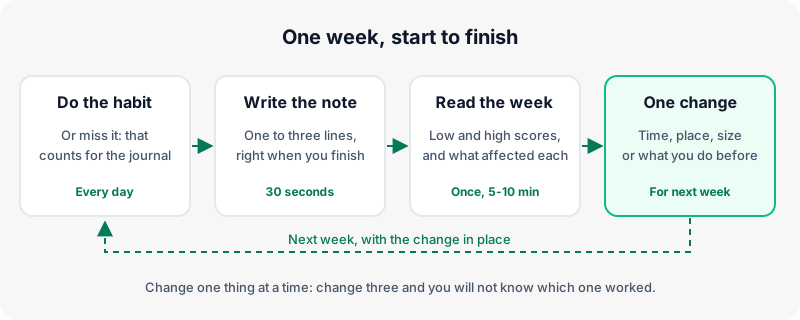
One change at a time matters. If you change three things and the week goes better, you won't know which one worked.
| What you see in the notes | What it may mean | What to try |
|---|---|---|
| Low scores on the same weekdays | You have less energy or time on those days | A short version on those days only |
| "Forgot" several times | There's no clear cue | A reminder, or tie it to another routine |
| Notes getting shorter or empty | The journal asks more than it gives | Cut it down to one detail, the score |
| High scores always in the same place | That place makes it easy | Do the habit there whenever you can |
| Amount dropping week after week | The habit is too big for now | Lower the target and raise it slowly |
If you already do a weekly review of everything else, fold this reading into it. There's a guide on how to do a weekly review in 15 minutes.
How Monkway does it
In Monkway every note can be assigned to a habit and a day. That gives you a journal for each habit without opening another notebook.
- Writing the note on iPhone. In Today, tap the habit. Its sheet opens with two buttons: "+ Note" to write today's note, and "Notes", with the count so far, to see earlier notes for that habit. Type a line and tap "Save".
- Writing the note in the browser. Each habit row in Today has a "Note" action. You can also open the habit and type in the "Write today's note…" field of its detail panel, where you also see its streak, completion rate and the last twelve weeks.
- Reading only one habit's notes. On the Notes screen, the "Habit" filter shows only the notes for that habit, ordered by day. "Without habit only" shows loose notes, and "All notes" puts them together.
- Searching for a word. The "Search notes…" field finds, for example, every time you wrote "tired" or "late". It's the quickest way to check whether a cause keeps coming back.
- Mood next to the habit. In Today you'll find "Log mood", a 1 to 5 scale you can refine across five areas: motivation, calm, clarity, satisfaction and connection. If you log it, Progress shows how it moves alongside your habits, without cluttering the note.
- Attachments when you need them. On the Notes screen in the browser, a note can hold up to five images or PDFs. Useful for a screenshot of a run or a page from a book.
The weekly reading fits inside the weekly review, which shows you the habits that are slipping. That's the moment to open their notes and choose your one change.
Frequently asked questions
How much should I write each day?
One to three lines. What you did, how it went and what affected it is enough. If a note takes you more than a minute, it's longer than it needs to be.
Is paper or phone better?
Paper works if the notebook lives where you do the habit. A phone has two advantages: it's always with you, and you can filter and search the notes later. Choose whichever you'll have at hand right when you finish.
Can I journal several habits at once?
Yes, but start with one. Once writing the note feels effortless, add another. If each note is linked to its habit, you can still read them separately later.
What if I forget to write for a few days?
Pick up again with today's note and don't fill in past days from memory. Reconstructed notes tend to be less reliable. If it happens often, tie the note to the end of the habit or set a reminder.
Do I need to write how I feel?
Only if it helps you understand the habit. A 1 to 5 score for how it went is usually enough. If you want to track your mood in general, log it separately so it doesn't blur with the habit.
How long do I need to keep the journal to see anything?
Two or three weeks of notes usually show clear patterns. How long a habit takes to settle varies a lot between people: in the study by Lally and colleagues in 2010, it ranged from 18 to 254 days. Keep the journal while it's useful and drop it once the habit runs on its own.
Does this work for breaking a bad habit?
Yes, with the same format. Note when the urge showed up, what triggered it and what you did. There are more ideas in how to break a bad habit.
Start with one note today
Pick the habit that's hardest for you right now. Next time you do it, or don't, write one line with the three details. Keep it up for a week and spend ten minutes reading them on Sunday.
If you'd like those notes tied to their habit, easy to filter and search, you can try Monkway for free, on iPhone and in the browser.