Quick answer. To find out why a habit keeps failing, stop asking whether you have enough willpower and look at your data. First, check which weekdays you miss and what time the habit was set for. Then, for two weeks, write one line on each day you miss with the real reason. Finally, count the reason that comes up most and change only that: the time, the size, the days or the thing that triggers the habit. Missed days almost always follow a pattern, and the pattern tells you what to fix.
What you'll find here
- Why a failing habit is rarely about willpower
- Where to look first: the pattern of your misses
- The most common causes and how to spot them
- How to note why you missed without making it a chore
- When the problem is the habit and when it is the day
- Change one thing at a time and measure for two weeks
- How Monkway handles it
Why a failing habit is rarely about willpower
When a habit keeps slipping, the first explanation that comes to mind is "I have no discipline". It feels true, but it is useless. It doesn't tell you what to do differently tomorrow.
A habit is a behavior you repeat in a similar context. Wendy Wood and David Neal described this in 2007 in a review of how habits and goals interact: habits are set off by cues around you, like a place, a time or something you just did. If the cue doesn't show up, neither does the habit.
That changes the question. Instead of "why can't I do this?", you ask "what is different about the days I miss?". That one has an answer. Maybe you leave work late that day. Maybe the time you picked clashes with dinner. Maybe the habit takes thirty minutes and that day you have ten.
A new habit also takes a while to run on its own. In the study by Phillippa Lally and colleagues at University College London, participants took a median of 66 days to make a new behavior automatic, with wide variation between people. During that time the habit leans heavily on the context. Missing now and then is normal. Missing the same way every time is a clue.
Where to look first: the pattern of your misses
Before changing anything, look at where the misses land. Four weeks of history already shows a lot. Twelve weeks shows almost everything.
The clearest way to see it is a grid: one column per week and one row per weekday. If a whole row is nearly empty, the problem is that day, not the habit.
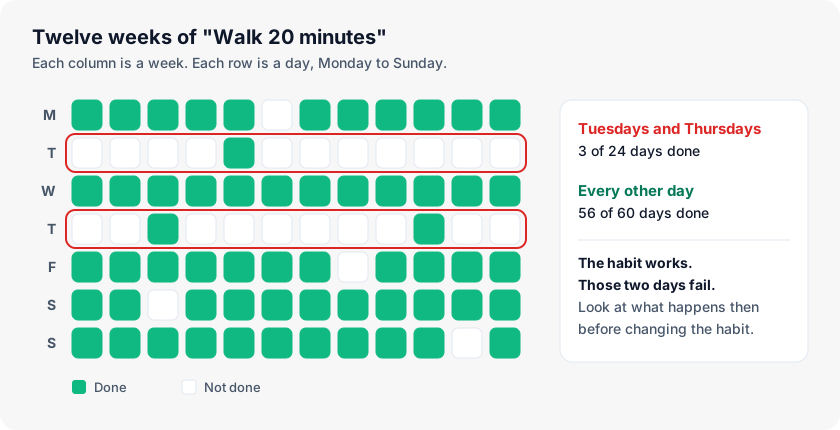
In the example, "Walk 20 minutes" gets done almost every day except Tuesdays and Thursdays. Rebuilding the whole habit would be a mistake. The useful move is to look at what happens on those two days: a late meeting, a school run, a different shift.
These are the patterns that come up most and what they usually mean:
| Pattern in the grid | What it usually means | What to try first |
|---|---|---|
| One or two weekdays almost empty | Something fixed on those days clashes with the habit | Drop those days with a fixed-days schedule |
| Misses only at the weekend | The habit relies on your workday routine | A different time or trigger for Saturday and Sunday |
| Misses only on weekdays | You get there with no time or energy | A shorter version for workdays |
| Misses scattered with no order | The habit has no clear moment | Tie it to something you always do |
| Fine at first, then a drop from one date | Something changed that week: schedule, season, health | Check what happened and adapt the habit |
| Whole weeks missed in a row | Trips, exams, busy periods at work | Pause or skip those weeks instead of failing them |
Look at the time too. If the habit has a set time and you always do it late or not at all, that time doesn't suit you. Even if it looks like the right one on paper.
The most common causes and how to spot them
The pattern tells you where you miss. To know why, you need the reason behind each miss. In the experience of a lot of people who track habits, the reasons tend to fall into a handful of causes.
| Cause | What it looks like | Typical note | What to change |
|---|---|---|---|
| Wrong time | You do it late or never at that time | "Still on the train at 7 pm" | Move the time or remove it |
| Too big | You rarely start and rarely finish | "Didn't have half an hour" | Cut the amount in half |
| No clear trigger | You remember when it's too late | "Forgot" | Tie it to something you already do |
| Low energy | You miss at the end of the day | "Got home wiped out" | Move it to a time with more energy |
| Full day | You miss on days with lots of tasks | "Had a million things" | Lower your daily maximum |
| Days that don't fit | You always miss the same days | "Tuesdays are my class night" | Fixed days without those days |
| You don't really care | You avoid it even with time to spare | "Didn't feel like it", again and again | Consider dropping it |
Watch out for "Forgot". It is the most common note and the least useful one if you leave it there. Forgetting almost always means the habit has no specific moment. In 1999 Peter Gollwitzer reviewed the evidence on implementation intentions, plans shaped like "when X happens, I will do Y", and found they help turn intentions into action. If you keep forgetting a habit, give it a "when". There are examples in the piece on habit stacking.
If the reason that keeps coming up is tiredness or low mood that lasts for weeks, that is no longer about how the habit is set up. This content is educational and does not replace medical or psychological advice. If tiredness, sleep or mood are affecting you over time, talk to a professional.
How to note why you missed without making it a chore
A miss note only works if it takes less than ten seconds. If it turns into a journal, you'll stop by the third night.
A few simple rules:
- One line. No explaining or justifying.
- Write it the same day, while you still remember.
- Name the specific reason, not the general one. "Dinner with my parents" works. "Bad day" doesn't.
- Note the days you managed anyway, too. "Did it in my lunch break" shows you a time that works.
- Don't reread them daily. Read them all together after two weeks.
| Note that doesn't help | Note that helps | Why |
|---|---|---|
| "Bad day" | "Meeting ran until 8 pm" | Says what took the slot |
| "Couldn't" | "Went to run, but it was pouring" | Separates the habit from the context |
| "Nothing again" | "Remembered in bed" | Points to a missing trigger |
| "I'm hopeless" | "Had 12 tasks today" | Swaps guilt for a fact |
| (blank) | "Did it at noon and it was easy" | Reveals a better time |
After two weeks you'll have five to ten lines. Read them in one go and count how many say the same thing in different words. If six out of eight are about the time, you know what to change.
When the problem is the habit and when it is the day
Before changing a habit, check whether it fails alone or along with everything else. Those are two different problems.
If on the same day you miss three habits and leave four tasks undone, the habit isn't to blame. The day had more in it than it could hold. If you miss that one habit and everything else goes fine, the problem is the habit.
| Signal | Where the problem is | What to do |
|---|---|---|
| You miss this habit and the rest goes fine | In the habit: time, size or trigger | Change one thing about the habit |
| On days you miss it, you miss several things | In the day: too much on it | Lower the number of things per day |
| You miss several habits on the same weekday | In that weekday | Drop that day from the less important habits |
| You miss everything for weeks | In the season: life change, stress, health | Keep three habits and pause the rest |
| You only miss this one and don't even mind | In the habit itself: maybe you don't want it | Decide whether it stays |
The second row is very common. Plenty of people try to fix a habit when what they have too much of is tasks. If that sounds familiar, the article on how to tell if your day is overloaded helps you check it with numbers.
Change one thing at a time and measure for two weeks
Once you know the cause, it is tempting to change everything at once. New time, half the length, different days and a new reminder. If it improves, you won't know what worked. If it doesn't, you won't know what failed either.
Change one thing and leave it for two weeks. Two weeks is too short to know whether the habit has settled, but long enough to see whether the pattern of misses changes.
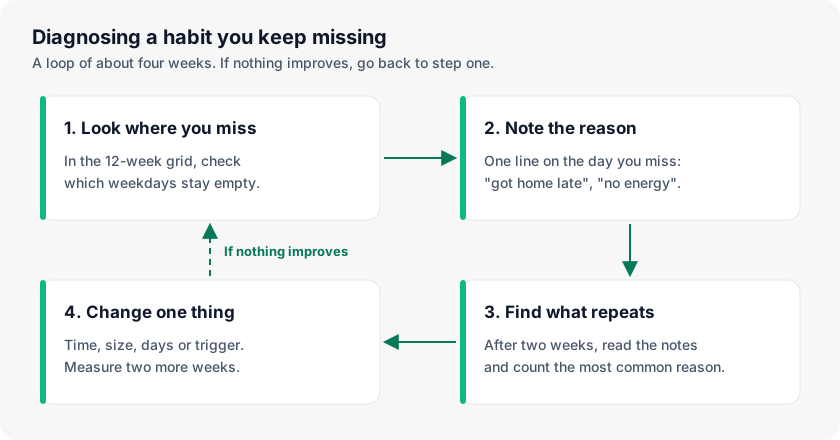
Which change to try for each cause:
- Wrong time: move it to a moment when you've done it before without effort. Your notes from good days tell you when.
- Too big: cut the amount in half. Ten minutes you actually do beat twenty you skip.
- No trigger: attach it to something fixed. "After I brush my teeth" works better than "in the evening". A reminder at the right moment also helps; see how to set habit reminders.
- Days that don't fit: switch from daily to fixed days and drop the ones you always miss. If your days change every week, use a number of times per week instead.
- Full day: lower the total number of things in your day before touching the habit.
If it improves after two weeks, keep the change. If not, go back to your notes and try the second most common cause.
When the answer is that you don't really want it
Sometimes the notes say the same thing over and over: "didn't feel like it", "left it for tomorrow", "had time but no". With time, with energy and on an ordinary day, you still don't do it.
That is a diagnosis too. Many habits end up on the list because someone recommended them or because they sounded good on a Sunday. It's fine to drop them.
Ask yourself one question: if it disappeared from your list tomorrow, would you miss it a month from now? If not, how to decide which habit to drop walks you through the full call. If yes but not right now, pausing it is better than failing it every day. When you come back, restarting a habit you dropped is easier than it looks.
How Monkway handles it
In Monkway, the three parts of this diagnosis already live inside each habit.
Noting the reason. In Today, every habit has a Note action. You can also tap the habit to open its detail, where there's a Write today's note… field and a Save button. The note stays linked to that habit and that day. If there's a fair reason the habit doesn't apply that day, use Skip today: a skipped day doesn't count as a miss.
Seeing the pattern. The same detail shows Streak, Best streak, Completion and Last 12 weeks. That grid is laid out by week, Monday to Sunday, so a day you always miss shows up as an empty row. In Progress, the Habits tab lines up the last 12 weeks of every habit one under the other, and Summary shows The habit you keep least so you know where to start.
Reading the notes together. In Notes you can filter by Habit and see every note for a single habit. There's also a search box, Search notes…, handy for counting how often "late" or "tired" comes up. If you also use Log mood, you can look at your mood on those days next to the misses.
Changing one thing. From Edit habit you set the Frequency (Daily, Fixed days, N per week or Monthly) and the Time. If the real problem was a full day, Maximum things per day warns you when you add more habits and tasks than fit.
Once a week, the weekly review shows you the habits that are slipping, so the diagnosis doesn't depend on your memory. The step-by-step is in how to do a weekly review in 15 minutes.
Frequently asked questions
How many weeks of data do I need to know why I miss a habit?
Four weeks is enough to see patterns by weekday. Two weeks of notes usually gives you enough reasons to spot the one that repeats. Before that, a couple of odd days can mislead you.
What if I miss a habit and don't know why?
Write down what you were doing at the time the habit was due. You don't need to know the reason in the moment. When you read several notes together, the reason usually shows up on its own.
Is it normal to keep missing a habit I care about?
Yes. While a habit is new it depends a lot on context, and any change to your day can knock it over. What matters is whether the misses repeat under the same conditions.
Should I change the time or the amount first?
Check your notes. If they talk about not having time, cut the amount. If they talk about being somewhere else or remembering too late, change the time.
What if I always miss on the same weekdays?
Remove those days. Switch the frequency from daily to fixed days and keep only the days you already manage. A five-day habit you complete gives you more than a seven-day one you miss twice.
Is skipping a day the same as missing it?
No. Skipping means deciding in advance that the habit doesn't apply that day, for a reason you know. Missing means it was due and didn't happen. Keeping them apart gives you an honest completion rate and a cleaner diagnosis.
When should I stop trying to fix a habit?
When you've tried two different changes, two weeks each, and the pattern stays the same. At that point the question becomes whether you really want it. Pausing or dropping it is a good answer too.
Start with the habit you miss most
You don't need to analyze every habit. Pick the one you miss most, look at which days stay empty and write one line every time it fails for two weeks. That gives you more to work with than any fresh resolution.
If you want the 12-week grid and each habit's notes in one place, Monkway is free to start, on iPhone and in the browser. And to keep tracking the habits that already work, see how to track habits.