Quick answer. To tell if your day is overloaded, count what is scheduled for today (habits due plus tasks dated today) and compare it with what you usually finish on an ordinary day, not with what you wish you finished. If today's count is above that number, the day is already overloaded before it starts. If it reaches 80% of your number, it is on the edge: it fits, but it has no room for a single surprise. The feeling of being swamped arrives too late to act on, so run the count in the morning and cut what does not fit before you touch the first thing.
In this guide
- The feeling arrives late, the number does not
- The count that answers this in thirty seconds
- What your real number is, and why it is not the average
- Six signs the day is coming in overloaded
- What to cut when it does not fit
- Weeks get overloaded too
- How Monkway handles it
The feeling arrives late, the number does not
Overwhelm is a poor detector. It shows up mid-afternoon, once you have started five things and finished none, and by then you can only push through or give up. The question "is my day overloaded?" is worth asking in the morning, and in the morning the feeling misleads you, because the day is still whole.
You also plan badly on purpose, and that is not your fault. Buehler, Griffin and Ross described the planning fallacy in 1994, in the Journal of Personality and Social Psychology: people predict they will finish tasks sooner than they actually do, even while remembering past occasions when they ran late. Your morning self hands out the day as if nothing were going to go off script.
So you need a rule that does not depend on how you feel: count, compare against a number, decide. Thirty seconds, before the coffee.
The count that answers this in thirty seconds
A day's load is two things added together: the habits due that day and the tasks dated that day. Nothing else. The "maybe if I get a chance" ones are out, and so is everything sitting in your head with no date.
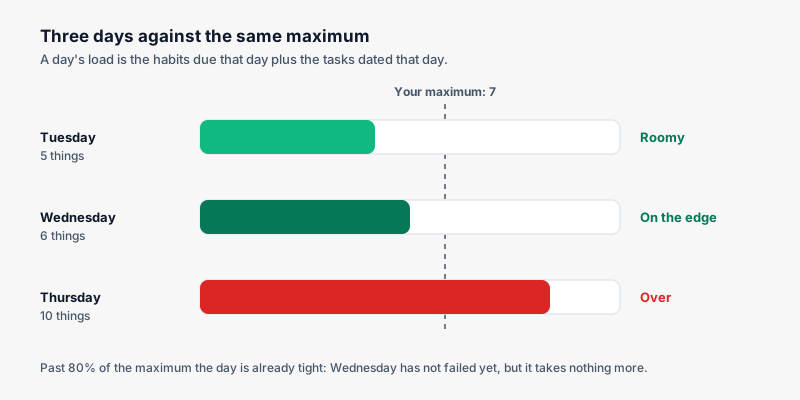
The count is worthless if you pad it with things that are not today's. Here is the line:
| Counts towards today's load | Does not count | Why |
|---|---|---|
| Habits due today | Paused or archived habits | You are not doing them, so they only inflate the number |
| Tasks dated today | Undated ideas sitting in the backlog | With no date they are not competing for today |
| Overdue tasks you will actually do today | Overdue tasks you keep dragging | If you are not touching them, decide them separately |
| A big task split into steps | The big task and its steps together | You would be counting the same work twice |
| Errands and calls that take a slice of time | Automatic routines like showering | If you are not deciding to do it, it costs no decision |
| Work blocks with a fixed time | Waiting time between blocks | Gaps are not load; they are what makes the rest fit |
With the count in hand, reading it is simple. Under 80% of your number, the day is roomy. Between 80% and 100%, it is tight: it fits if nothing odd happens, and something odd always happens. Above it, the day is already overloaded and you know it before it starts, which is exactly when you can still do something about it.
One nuance people skip: size matters less than it looks, but it is not irrelevant. Two three-hour blocks plus five short errands add up to seven and fit; seven two-hour blocks add up to seven and are impossible. If the number looks fine but the day does not fit into the hours, split the big blocks and count again.
What your real number is, and why it is not the average
Your number is not advice from the internet. It is your own record: how many things you close on a day when you actually close something. Look at the last four weeks, because anything shorter is still noise.
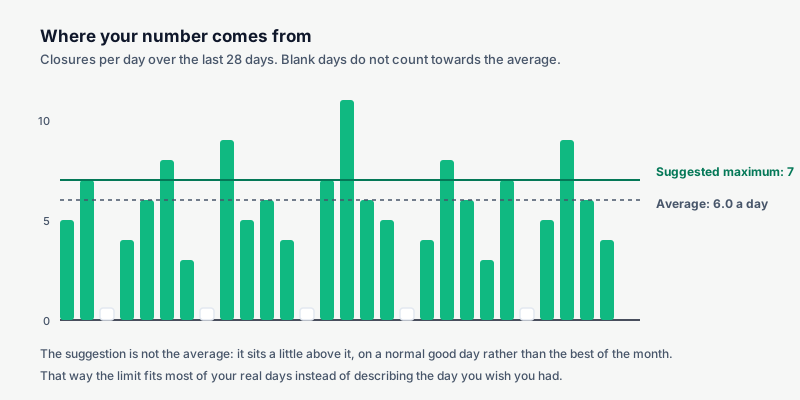
The obvious move is to use the average, and the average misleads from both sides. Include the blank days and you get an absurdly low number. Use only the active days and you get your median day, and a limit set there blocks half of your good days.
| Rule for picking the number | What you get | The problem |
|---|---|---|
| What you would like to do | A high, round number | It describes who you want to be, not who you are |
| Average across all days | A low number | Blank days drag everything else down |
| Average across active days | Your middle day | It stops half the days you could have handled |
| Your best day of the month | Your ceiling | It turns the exception into the rule, so it breaks |
| A normal good day | A number that fits nearly always | This is the one you can decide with in the morning |
| Copying someone else's | Anything at all | It has nothing to do with your life or your work |
The fifth row is the one to use: the number you want sits a little above your average and well below your record. In practice, sort the closures from your active days over the last month and keep the value that leaves a quarter of those days above it. There the limit does not block your good days, but it does stop the impossible ones.
Review it every few weeks. A new job, a baby or an exam season genuinely move the number, and holding on to an old one out of pride is a slow way of being overloaded every single day.
Six signs the day is coming in overloaded
The count is the first filter, but some signs show up before the number goes over. Nearly all of them can be fixed the same day.
| Sign | What it means | What to do today |
|---|---|---|
| You start four things and finish none | You are slicing the day too thin | Pick two and park the rest until tomorrow |
| You look at the list and cannot pick | There are more options than decisions left in you | Mark the first three and hide the rest |
| The same task has moved five days running | It never fits because the day is always full | Take it out of the day and decide it separately |
| You end up tired with nothing to point at | The day went into switching, not into tasks | Group the similar work into one block |
| You eat lunch with one eye on your phone | There is no slack, so you are stealing it from somewhere | Cut one thing before you cut your lunch |
| You stay up late to finish the day's list | The day did not fit and the night is paying for it | Lower the number tomorrow, not tonight |
The fourth explains why a day with few things on it can still flatten you. Leroy published work in 2009, in Organizational Behavior and Human Decision Processes, on attention residue: when you switch tasks, part of your attention stays on the previous one, especially if you left it unfinished. Seven things started weigh more than seven things closed.
The sixth is the expensive one. Sonnentag and Fritz described recovery experiences in 2007, in the Journal of Occupational Health Psychology: the ways people detach from work and come back with energy. A day that eats the night takes that recovery with it, and your real number drops on its own.
What to cut when it does not fit
Knowing the day is full is useless if you leave it as it is. Cutting is the part almost nobody does, and it goes better with a rule than with a mood.
| What you are looking at | What to do with it | Sign it is the right call |
|---|---|---|
| Task with someone else's deadline tomorrow | It stays | Removing it costs another person something |
| Task with a date you set yourself | Move it two days out | Nobody else notices that it moved |
| Task you have postponed for weeks | Out of the day, into the backlog | You already know today is not the day either |
| A ten-minute habit | It stays | It costs little and it holds the rest up |
| A big habit that will not fit today | Skip today, on purpose | A skipped day beats a failed one |
| Something you cannot explain | Delete it | If you cannot say why in one sentence, it is padding |
Two rules that save you from arguing with yourself every morning. Cut whole things, not slices of everything: five half-done tasks are the worst version of the day. And move to a specific day, never to "later": an undated task comes back into your head every couple of hours, and that is load too, even if it is not on the list.
If the same tasks keep sliding day after day, the problem is no longer today: we cover it in tasks you keep postponing. And if what is clogging the day is undecided ideas mixed in with real tasks, they belong somewhere else: where to write down ideas you might not do.
Weeks get overloaded too
There is a familiar trap: you cut from today, drop it on tomorrow, and Thursday ends up with fourteen things on it. The day is saved and the week is not. Look at the seven days together whenever you move something.
| How the week is laid out | What usually happens | The adjustment |
|---|---|---|
| Everything on Monday, because you start keen | By Tuesday you are already behind | Split Monday between Monday and Wednesday |
| Everything on Friday, to close the week | Friday is the worst day to load | Pull anything that depends on others to Wednesday |
| Five identical, full weekdays | No room left for the unplanned | Keep one day under the number on purpose |
| The weekend as a drain | Recovery goes, and the next week starts worse | Treat Saturday as a day with its own limit |
| One enormous day each month | It does not happen and it drags the rest | Split it across three dated days |
| A light week after a brutal one | That is compensation, not a plan | Raise the floor of the light one, lower the ceiling of the hard one |
The good version of this is not a perfect Sunday plan but a plan with gaps: we go through it in how to plan a realistic week, and the task count itself is in how many tasks to plan per day. And if the day is full because you just added several habits at once, the problem is not the tasks: it is how many habits to start at once.
How Monkway handles it
Monkway runs this count for you and shows it before the day starts. These are the pieces.
- The day's load, in plain sight. Today shows "Load 6/8": what is scheduled against your maximum, adding the day's habits and the tasks dated that day. It is exactly the count in this article.
- Three states, not one. Under 80% of the maximum the day is roomy; from there it is tight; above the maximum it is over. The middle state is what stops you finding out too late.
- The warning when you schedule. Send something to a day that is already full and you get "Thursday is already at the limit" and "That day has 8 of 8. Schedule it anyway?", with three options: Schedule anyway, Move to the first day with room, or Cancel.
- Your number, taken from your own record. Progress → Pace holds closures per day for the last 28 days, your average per active day and how many days had activity. Below it, Limits holds "Maximum things per day" with a Suggested value and a Use button: it comes from your active days, set on a normal good day rather than on your record.
- The week's load. The same block shows "This week's load" as "34 of 40 this week", so moving something from today to tomorrow does not hide the problem.
- Skip today instead of failing. When you pull a habit out of a full day, "Skip today" marks it as a decision rather than a gap, so the month's completion stays honest.
- The backlog for what is not today's. Anything that does not fit and has no date goes to the backlog, undecided: it stops competing for the day and it is still there when you look for it.
- The weekly review. Once a week it shows Closures, Planned and Consistency, plus four sections with one-tap decisions: Overdue tasks, Weak habits, Stalled journeys and Old backlog. That is where you clear whatever makes every day come in full.
If what you are carrying is a long goal broken into small pieces, the place for it is guided journeys. And if you keep habits in one app and tasks in another, the day's count will never add up: we cover that in an app for habits and tasks together.
Frequently asked questions
How many things in a day is too many?
There is no universal number. Yours comes out of your last four weeks: count what you close on the days you close something, and keep a normal good day rather than your record.
Do meetings and errands count?
Count anything that forces you to decide or to stop what you were doing. An hour-long meeting takes up the day just like a task, even though you did not put it there.
What if work fills the day and I cannot cut anything?
Adjust your own side: lower the maximum on those days and keep only the small habits. A full workday closed out with two ten-minute habits is a good day.
How much slack should I leave for surprises?
As a working rule, leave about a fifth of your number free. If your maximum is ten, plan eight and leave two unnamed gaps.
Is it better to cut things or to shrink them?
Cut first, shrink second. Five half-done tasks are more tiring than three finished ones, and a half-done day does not read as progress.
Should habits count the same as tasks?
In the count, yes, because they take up room and attention. The difference is what you cut: small habits stay, because they are cheap and they hold the rest up.
When should I run the count?
In the morning, before you start, and again whenever you schedule something for a future day. Running it at six in the evening only confirms what you already knew.
How often should I revisit my number?
Every four weeks, and whenever something big changes in your life. A number that no longer fits makes the warning meaningless, and you end up ignoring it.
Run the count tomorrow morning
Count what is scheduled, compare it with what you usually close, and cut what does not fit before you start. The hard part is not knowing the number: it is cutting the thing you already know will not fit.
If you want the count done for you, with your maximum worked out from your last four weeks and a warning when you schedule something on a day that is already full, Monkway is free to start, on iPhone and in the browser.