Quick answer. To keep a routine on rotating shifts, stop anchoring habits to a time on the clock and anchor them to a moment in the shift: before you leave, when you clock off, before you sleep. Switch anything that does not strictly have to happen daily to a number of times per week. Keep a different load for early days, late days, night days and rest days, and cap night days at two things. And track your 30-day completion instead of your streak: on a rotating rota the streak is broken by the roster, not by you.
This is an organisation guide, not health advice. If you are carrying sleepiness that puts your safety at risk while driving or working, if you have been sleeping badly for months after nights, or if you take medication whose timing depends on meals, talk to your occupational health service or a qualified clinician. Do not cut sleep to make a routine fit.
In this guide
- Why routines collapse when the shift changes
- Anchor habits to the shift, not the clock
- Which frequency each habit should have
- One routine per type of day
- The changeover day is the one that breaks you
- How much actually fits on a night day
- What to track when the calendar moves every week
- How Monkway handles it
Why routines collapse when the shift changes
Nearly every routine guide assumes you will wake up tomorrow at the same time you woke up today. On a rotating rota that assumption fails every few days, and it takes the whole routine with it. Six habits drop together that day, because all six were hanging off the same wake-up time.
There is a second reason. Apps, planners and templates are built for a week that repeats. Yours does not repeat: if your rota runs earlies, lates, nights and rest days, your real cycle might be six weeks long, not seven days.
The HSE's guidance for shift workers makes the same point from the safety side: a rota is not a schedule you adapt to once, it is a schedule that keeps moving, and the recovery around it has to be planned rather than hoped for.
Anchor habits to the shift, not the clock
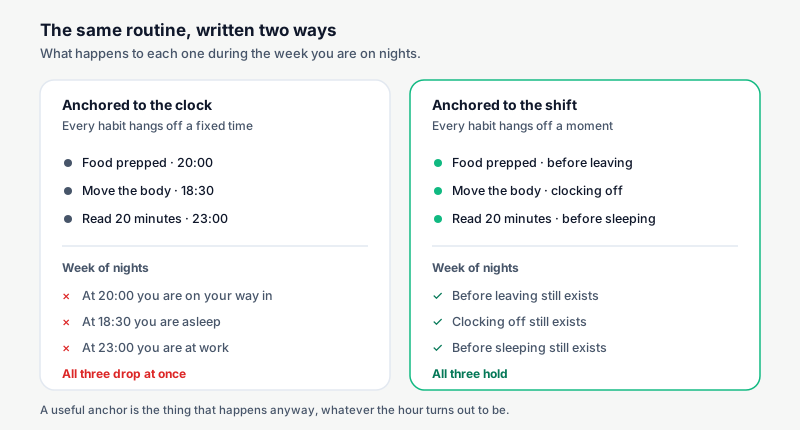
An anchor is the thing that happens anyway, and that you hang the habit on. With a fixed schedule the clock works fine as an anchor. Without one you need anchors that travel with you, and your shift gives you four.
| Anchor | When it happens | What holds up there | What not to put there |
|---|---|---|---|
| Before leaving the house | 05:40 or 20:40, depending on the shift | Packing food, the supplement, the gym bag | Anything over ten minutes |
| First minutes of the shift | At clock-in | Checking the day in the app, noting what to sort out later | Studying or reading |
| Clocking off | On the way home | A twenty-minute walk, the shop, calling home | The gym after a night shift |
| Before sleeping | At 23:00 or at 09:30 | Stretching, journalling, leaving the phone out of reach | Screens and work threads |
Written this way, "read 20 minutes before sleeping" works across all four shifts untouched. "Read 20 minutes at 23:00" works two weeks out of six. Be careful with the clock-off anchor: chaining the gym onto the end of a night shift is the fastest way to quit the gym. Save that one for earlies and lates.
Which frequency each habit should have
The second change is duller and fixes more: almost nothing you have set as daily needs to be daily. A daily habit forces you to tick it on the morning you finish a twelve-hour night. You will not tick it, and a month later you have a habit sitting at 60 % that makes you feel behind every time you look at it, when you were actually doing fine.
| Frequency | When to use it | What a bad day does | Shift examples |
|---|---|---|---|
| Daily | Only the short, non-negotiable things | No slack: you miss it or skip it | Medication, logging what time you went to bed |
| Fixed days | The day is set by the rota and known in advance | Only that day drops, the rest carries on | Big shop on a rest day, Sunday call home |
| N per week | The day does not matter as long as it happens | Move it to another day that week | Gym 3 per week, reading 4 per week |
| Monthly | Happens once and takes a slot | Moves at no cost | Checking next month's rota, paperwork |
The row that matters is "N per week": it is the only one that understands your calendar. It lets you do the gym on Tuesday, Thursday and Saturday this week, then Monday, Wednesday and Sunday next week, with neither counting as a miss.
Keep two habits at most on daily. Everything else goes to "N per week" with a number you can hit in your worst week of the cycle, not your best: if your worst week has three nights, the gym is 2 per week, not 4. Raising it in two months is easy; lowering it after missing for six straight weeks is not. If you are coming from starting too much at once, this connects with how many habits you should start at once.
One routine per type of day
Here is the bigger shift in thinking: you need four short routines, one per type of day. People who last years on rotating shifts keep a separate list per type of day, and the lists for the hard days are deliberately tiny.
| Type of day | How much fits | What goes in | What drops |
|---|---|---|---|
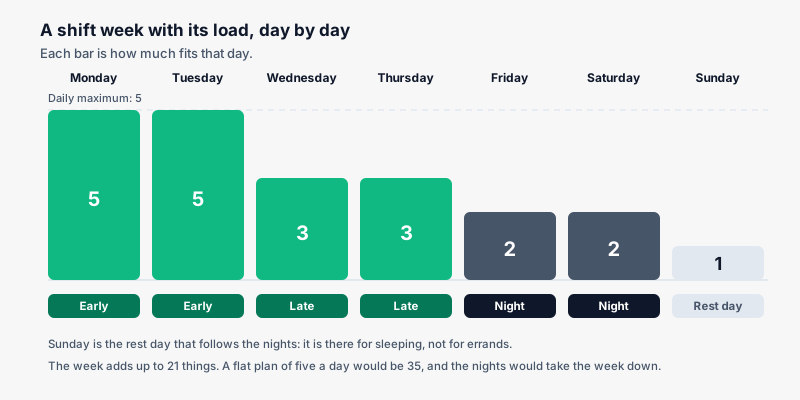
| Early | Four or five | Movement, food prepped, reading, errands | Almost nothing, this is your best day |
| Late | Three or four | The before-leaving and before-sleeping anchors | Errands that need office hours |
| Night | Two at most | Eating properly and sleeping | Everything else |
| Rest day after nights | One | Sleeping and recovering | Any plan that forces an early start |
| Normal rest day | Four or five | The week's backlog, big shop, seeing people | Nothing, it carries the week |
Look at the two rest-day rows. The most common mistake is treating the rest day after a run of nights like an ordinary Saturday and filling it with errands. That day is for sleeping, and if you fill it the following week starts in deficit. The HSE's Managing shift work guidance treats recovery time between shift runs as part of managing fatigue risk, not as spare time.
The changeover day is the one that breaks you
The day you abandoned your last routine was almost certainly a transition day: the first night after a run of lates, or the first early after a run of nights. There are two or three of them per cycle and they take months of work with them, so they deserve their own rules.
| Signal | What is happening | What to do that day |
|---|---|---|
| First night of the cycle is tomorrow | You will sleep in daylight without being tired then | Only the non-negotiables and a nap planned; start nothing new |
| You are coming off the last night | 12 to 24 rough hours ahead | One habit: sleep. Everything else skipped, not missed |
| First early after nights | You are up at a time you slept through all week | Recover only the before-sleeping anchor |
| Three days running of skipping everything | This is not a bad day, it is a bad run | Pause the habits instead of missing them one by one |
| Next month's rota changes pattern | Your "N per week" may no longer be realistic | Lower the number before it starts, not after you miss |
The difference between skipping and missing looks like an app detail and is not. Missing means "this was due and I did not do it". Skipping means "this was not due today". On a rotating rota most of your bad days are the second kind, and counting them as misses gives you a false picture of your own month. There is more on that in how to restart a habit you dropped.
How much actually fits on a night day
How many things can you take on for the day you clock in at ten at night? For most people, two: one about food and one about sleep. And plenty of people still arrive at that day with seven things on the list, because the list was written on Sunday, well rested.
What works is deciding the number in advance and letting the system hold you to it. If your daily cap is five and you drop it to two for night days, what happens on Tuesday at ten is no longer a willpower call: it is a rule you set while you were clear-headed. Three that hold up:
- One food thing. Having what you will eat at three in the morning already prepared keeps you away from the vending machine. The NHS pages on sleep and tiredness cover the basics on eating and winding down around night work.
- One sleep thing. Not "sleep eight hours", which is not under your control: "blackout blind down and phone silenced before I lie down".
- Zero improvement things. No language app, no course, no reading. A night day exists to avoid going backwards.
How to spot a day that is overloaded before it is too late is in how to tell if your day is overloaded.
What to track when the calendar moves every week
The streak is a poor measure for you, because the rota breaks it: if you work twelve nights a month, your maximum streak on a daily habit is a few days no matter what you do. Three things that do say something:
Completion over the last 30 days. A percentage over the days the habit was actually due. It spans more than one shift cycle, so it includes your good weeks and your bad ones and it is comparable month to month. A steady 70 % over three months is a better system than two twelve-day streaks with two abandonments between them.
The pattern by type of day. If the gaps in the last twelve weeks always cluster on the same dates, the habit is not the problem: you put it on a day where it does not fit. Change the anchor or lower the frequency.
Which habit is doing worst. A short weekly check stops you dragging five broken habits along for months. The decision is usually keep it, make it easier, or pause it until the cycle changes; leaving it failing quietly is not one of them. The full version is in how to create a weekly routine.
How Monkway handles it
Monkway has no shift mode. It has four pieces that, together, stop a rotating rota fighting the app.
Frequencies that are not daily. When you create a habit, Frequency offers Daily, Fixed days, N per week and Monthly. The one you want is "N per week": you set Times per week and the habit counts as done once you reach that number, whichever days they were. Gym at 3 per week is met just as well by Monday, Wednesday and Friday as by Tuesday, Saturday and Sunday.
A time per habit, or no time. Every habit has a Time field and a No time button. Shift-dependent ones go without a time and sit at the end of the day's list. The ones with a real time, like medication, fire their reminder. Settings → Notifications holds Habit reminders and the Daily reminder time, which is worth moving when you change run; how to set them up is in how to set habit reminders.
Skip today, and breaks for whole runs. Each row has Skip today, which marks the day as not due rather than missed, and Move to another day for tasks. When the gap is longer, the app asks on your return, Taking a break?, and lets you choose which habits stay paused. Paused habits do not count as missed over that stretch, so coming out of six nights does not leave your month in red.
A maximum of things per day. In Progress → Pace you set Maximum things per day. The app counts habits and tasks together and warns you when you schedule something on a day already at the limit, offering to move it to the next one. The same screen shows each habit's Completion over 30 days and its Last 12 weeks, which is where the gaps clustered by type of day become visible.
On top of that, the Weekly review has a Weak habits section for anything under 40 % over 30 days, each with Keep, Pause and Archive. That is the moment to drop a "4 per week" to "2 per week" when next month's rota looks worse.
Frequently asked questions
Is a fixed routine still better even on shifts?
Only for the part you can genuinely sustain. Holding one or two short things at a fixed time works; holding six habits at fixed times across earlies, lates and nights rarely survives a full cycle.
How many habits can I carry on rotating shifts?
Fewer than you would on a fixed schedule. Two daily plus three or four on a weekly frequency is a reasonable start. The ceiling is set by your worst week of the cycle, not your best.
How do I avoid losing my streak on night shifts?
Use Skip today rather than leaving the habit unticked, and pause whole runs when it is several days. And read the 30-day completion instead of the streak: on rotating shifts the streak measures the rota, not your consistency.
What do I do about the gym when my rota changes weekly?
Set it as "N per week" with a number you can hit in the week with the most nights, and pick the days at the start of each week from the rota.
What if I rotate every two or three days?
Then almost everything should go to "N per week", and the daily cap comes down for every day, not just nights. With rotations that fast, only very short habits anchored to before leaving and before sleeping survive.
How do I fit family life around a rota that moves?
Fixed days for anything that depends on other people, like a Sunday meal, and N per week for your own things. What involves others needs a date; what only involves you does not.
Should I change the system for a month of straight nights?
Yes, and before it starts. Lower the weekly numbers, keep two habits at most on working days, and pause what you know you will not touch. Raise them again when the run ends.
Start by changing the frequencies
If you only do one thing, open your habits and move everything currently set to daily, except the non-negotiables, over to "N per week". It takes two minutes and it stops the days your rota would not allow from being counted as misses.
Then lower your daily cap and pick your before-sleeping anchor. That is already a routine that survives a change of shift. Monkway is free to start, and the weekly frequencies are on the create-a-habit screen itself.