Quick answer. On a day packed with meetings, habits with a fixed time break because the calendar keeps moving. Tie them to moments that always happen instead: before your first meeting, when a call ends, or after the last one. Use five-minute versions for short gaps and save the longer habits for before or after work. On days with more than five meetings, keep three or four habits and move the rest.
What you'll find here
- Why habits vanish on meeting days
- What kind of gap you have and what fits in it
- Fixed time, no time, or tied to a meeting
- How many habits to keep based on your meeting count
- How to plan the day the night before in five minutes
- Signs the plan isn't working
- How Monkway handles it
Why habits vanish on meeting days
A normal day has gaps you don't notice. Between tasks you stand up, get water, step outside. A meeting day eats those gaps. One call ends at 10:58 and the next starts at 11:00. By evening you've done nothing of your own and you're tired.
There are three concrete reasons.
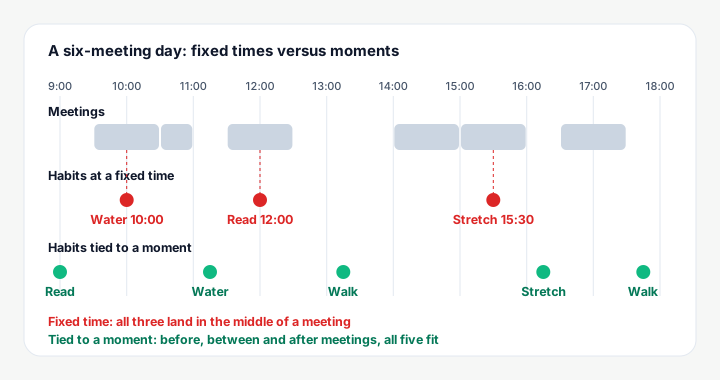
A fixed time collides with the calendar. If your ten minutes of reading are set for 12:00 and you have a meeting at 12:00, the reminder fires mid-call. You swipe it away and it doesn't come back.
The gaps are short and unpredictable. A meeting that ends early gives you fifteen free minutes. You didn't know you'd have them, so you don't know what to do with them. You end up in your inbox.
Fatigue builds up. Paul Graham described the difference between a manager's schedule and a maker's schedule in his essay Maker's Schedule, Manager's Schedule. For someone who needs long blocks, a single mid-afternoon meeting can wreck the whole afternoon. Habits behave in a similar way: after six calls, anything that needs a decision gets pushed back.
The fix isn't finding more time. It's not depending on a specific time.
What kind of gap you have and what fits in it
Before you move anything, look at tomorrow's calendar and sort the gaps. Most meeting days have the same four types. Each one suits a different kind of habit.
| Gap type | How long | What habit fits | Example |
|---|---|---|---|
| Before the first meeting | 15 to 45 minutes | Things that need a clear head | Reading, writing the day's plan, language practice |
| Between two meetings | 2 to 10 minutes | Something short and physical | Standing up, refilling your water, stretching your legs |
| A meeting that ends early | 10 to 25 minutes | Something you can cut off without losing anything | A short walk, clearing your desk, reviewing notes |
| After the last meeting | 20 minutes or more | Things that close the day | Checking tomorrow, going for a walk, switching off |
The right-hand column matters most. A five-minute gap isn't for reading. It's for standing up. If you squeeze a long habit into a short gap, you start it, cut it off, and count it as failed.
If you work from home, the gaps between calls are a good moment to move a little. There are concrete ideas in desk exercises while working.
This content is educational and is not medical advice. If you have an injury, pain, or a health condition, follow a healthcare professional's guidance before any movement routine.
Fixed time, no time, or tied to a meeting
A habit can have three kinds of "when." Picking the right one for each habit is half the work.
| Kind of "when" | How you phrase it | Works well if | Breaks if |
|---|---|---|---|
| Fixed time | "At 8:00 I read for ten minutes" | That time is free every day | Your calendar changes day to day |
| No time | "Today I drink two liters of water" | It can be done any time and in parts | Nothing reminds you and the evening arrives |
| Tied to a moment | "When I close my last video call, I go for a walk" | The moment happens every day, whatever the time | The moment doesn't exist that day |
On a meeting day, the third kind holds up best. The 11:00 meeting can move to 12:00, but "when I hang up" still exists.
There's evidence behind this. Peter Gollwitzer and Paschal Sheeran reviewed 94 studies on implementation intentions: plans of the form "when X happens, I'll do Y." They found these plans helped people reach their goals, with a medium-to-large effect (Advances in Experimental Social Psychology, 2006). The key is that the "when" is specific and actually happens.
If this sounds familiar, it's close to habit stacking. Here are habit stacking examples you can adapt to meetings.
Some moments that work well as anchors on meeting days:
- When you open your laptop in the morning, before checking email.
- When you hang up each call, before opening the next one.
- When you get back from lunch, before the first afternoon meeting.
- When you close the last meeting, even if it's 18:30.
How many habits to keep based on your meeting count
Not every day can be treated the same. A day with two meetings has room for your usual habits. A day with seven doesn't. If you keep the same habits on both, the seven-meeting day fails nearly all of them, and you feel worse than if you'd chosen.
These ranges are a starting point. Adjust them to what you see in your own weeks.
| Meetings that day | Habits that usually fit | What to do with the rest |
|---|---|---|
| 0 to 2 | All your usual ones | Nothing, it's a normal day |
| 3 to 4 | All of them, some in a short version | Move the long ones to before or after work |
| 5 to 6 | 3 or 4 | Skip today the ones that aren't core |
| 7 or more | 1 or 2 | Protect the one that keeps you steady and leave the rest for tomorrow |
| Travel or a full day away | 1 | Pick the smallest one and count the minimum version as done |
Skipping a habit on a day like this is not the same as failing it. You decide it in the morning, knowing the day has no room. Here's how to skip a habit day without breaking your streak.
The same applies to tasks. A day with six meetings has little room to finish things. If you usually plan eight tasks a day, plan three that day. Here's how many tasks to plan per day.
How to plan the day the night before in five minutes
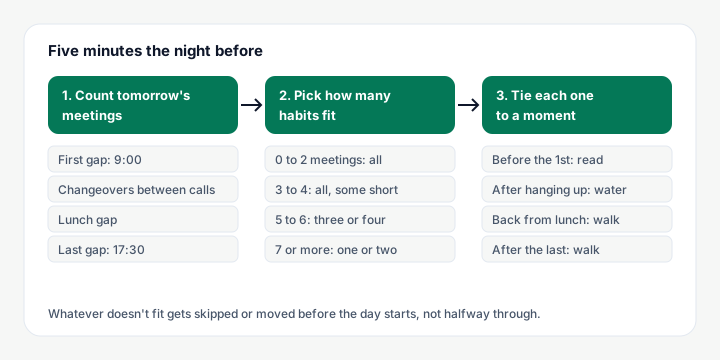
Deciding where each habit goes at 11:58, between two calls, doesn't work. You have to decide earlier, when your head is calm. Five minutes the night before or at the start of the day is enough.
- Look at tomorrow's calendar. Count the meetings and find the first gap, the last gap, and the changeovers between calls.
- Decide what kind of day it is. Use the table above to see how many habits fit.
- Pick the ones that stay. The ones that keep you steady, not the ones you feel like doing.
- Tie each one to a moment. "Before the first meeting, I read." "When I hang up the 12:00, I refill my water."
- Skip or move the rest. Whatever doesn't fit, take it off the day. Don't leave it "just in case": it'll end up on the failed list.
If reminders bother you mid-call, change them. A reminder at a time when you're always in a meeting only trains you to dismiss it. There's more detail in how to set habit reminders.
Keep in mind this takes time. Phillippa Lally and her team followed 96 people trying to build a new habit and found it took a median of 66 days to become automatic, with large differences between people (European Journal of Social Psychology, 2010). They also saw that missing a single day didn't change the outcome much. A seven-meeting day where you only do one habit doesn't undo the work.
Signs the plan isn't working
After two or three weeks you can tell whether the system holds. These are the most common signs and what to do about each.
| Sign | What it usually means | What to do |
|---|---|---|
| You dismiss the reminder without looking | The time lands in the middle of a meeting | Remove the time and tie it to a moment, or move the reminder to before work |
| You do your habits at 11 p.m. so you don't miss them | You're leaving them for the end by default | Move one or two to before the first meeting |
| You always miss on the same weekday | That day has more meetings than the others | Put the habit on fixed days and drop that one |
| The gaps between calls go to email | You hadn't decided what to do with them | Pick one physical thing for those gaps |
| You reach Friday with no energy for anything | You keep the same number of habits every day | Drop to three or four on the busiest days |
| Tasks pile up too | The day was full before it started | Check whether the day is overloaded, not just the habits |
If that last sign sounds familiar, see how to tell if your day is overloaded. And if you work remotely and the problem is that the workday never ends, there's a work from home routine without burning out.
How Monkway handles it
In Monkway you can see your meetings and your habits on the same screen, which is what you need to fit them together.
- Your events in Today. On iPhone, in Discover → Connections, the "Sync your calendars" card connects your phone's calendar and reminders. From then on, the Today screen shows a "Calendars" block with your upcoming events and their times, below your habits and tasks. You can see the gaps at a glance. Monkway only reads that data on your iPhone and doesn't upload it to its servers. It doesn't change your calendars either.
- You choose what shows. Under "Calendar and reminders" you choose whether to show events, reminders, and all-day events. If you have many, Today shows the first three and a "+ N events" link for the rest.
- Habits with no time. When you create or edit a habit, the Time field can stay as "No time." That's how you keep habits that don't clash with your calendar: they show up in Today and you check them off when their moment comes.
- Time and reminder per habit. For habits that do have a free slot every day, like before the first meeting, you can set a time so the reminder fires then and not mid-call.
- Skip today. On a seven-meeting day, use "Skip today" on each habit that doesn't fit. It doesn't count as a miss.
- The daily maximum. The "Load 5/8" indicator in Today counts habits and tasks together. In the browser you can change the maximum in Progress → Pace, and if you schedule a task on a day that's already full, Monkway warns you: "Tuesday is already at the limit."
Anything that doesn't fit today and has no date can go to the backlog with "Move to backlog." That way it doesn't hang around on a day that has no more room.
Frequently asked questions
How do I keep habits when I have meetings all day?
Tie them to moments that always happen, like before the first meeting or after the last one, instead of a fixed time. On the busiest days, keep three or four habits and skip the rest.
Is it better to give habits a time or leave them without one?
Only give a time to habits that land in a free slot every day, like before work starts. The rest work better with no time and tied to a moment, because a meeting calendar changes from day to day.
What habits fit between two meetings?
Short, physical ones: standing up, refilling your water, stretching your legs, or looking out the window for a couple of minutes. Reading or studying needs a longer block, ideally before or after work.
What should I do with reminders that go off during a meeting?
Move them or remove them. A reminder that always arrives mid-call teaches you to ignore it. Set it for a time that's almost always free, or leave that habit without a time.
How many habits should I keep on a day with seven meetings?
One or two. Pick the one that keeps you steady and skip the rest that day. Keeping all of them usually ends with nearly all of them missed.
Does skipping a habit on meeting days break the habit?
Not if you choose it and it's the exception. A study on habit formation found that missing a single day didn't change the outcome much. What does matter is missing it on every meeting day; if that happens, move the habit to fixed days that leave those days out.
When should I plan a day with lots of meetings?
The night before, or at the start of the day before opening email. It takes five minutes: count the meetings, choose the habits that stay, and tie each one to a moment.
Start with tomorrow
Look at tomorrow's calendar. Count the meetings, find the first and last gap, and decide which two or three habits go there. Take everything else off the day before it starts.
If you want to see your meetings and your habits together on one screen, you can try Monkway for free.