Quick answer. To skip a day without breaking your streak, mark it as skipped in your habit app before the day ends, or earlier, if you already know you won't manage it. A skipped day is treated like a day the habit wasn't due: it doesn't add to the streak, and it doesn't cut it either. If you'll be away three days or more, pause the habit instead of skipping each day, then resume it when you're back. And if you can do a two-minute version, do that: it counts as done, so there's nothing to skip.
What you'll find here
- What's the difference between skipping a day and missing it
- When skipping a day makes sense
- When a tiny version beats skipping
- How to skip a day you already know you'll miss
- What to do when it's several days in a row
- How to tell if you're skipping too much
- How Monkway handles it
- FAQ
If you're skipping because you're ill, rest and forget the streak. This guide is about organizing habits. If your routine includes medication, rehab or a plan from a healthcare professional, follow that plan before any counter.
What's the difference between skipping a day and missing it
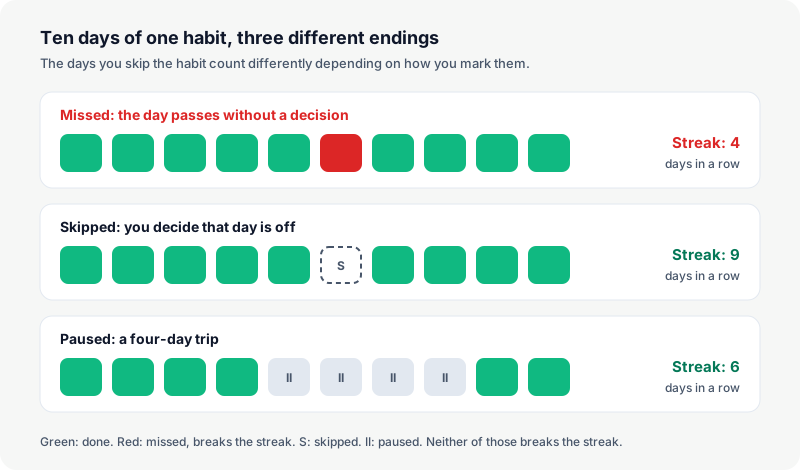
Both end the same way: you didn't do the habit that day. The difference is the decision. Missing means the day goes by and the habit stays undone, without you choosing it. Skipping means you decide, before or during the day, that today is off.
That difference matters because of how your log counts it. If your app only knows "done" and "not done", a three-day trip wipes your streak, exactly like three days of forgetting. And seeing a streak back at zero is more discouraging than it sounds. Jackie Silverman and Alixandra Barasch studied this across several experiments: when a streak is shown as broken, people become less likely to keep going with the activity, even when their past behavior was the same (Journal of Consumer Research, 2023).
Skipping keeps the days you chose not to do apart from the days that slipped. That way your streak and your completion rate still tell you something useful.
| What happens | Missing | Skipping | Pausing | Tiny version |
|---|---|---|---|---|
| When you decide | You don't, the day just passes | That day or before | Before a run of several days | That day |
| Effect on the streak | Breaks it | Neither breaks nor adds | Neither breaks nor adds | Adds to it |
| Effect on completion rate | Counts as not done | Not counted, the day wasn't due | Not counted while it lasts | Counts as done |
| How many days | One | One, here and there | Three or more in a row | One |
| When to use it | Never on purpose | A specific day you can't make | Trips, exams, a house move | Bad days when you still have five minutes |
When skipping a day makes sense
Skipping makes sense when the habit is impossible or unreasonable that day. It doesn't when you just feel less like it. The useful question is this: could I do a small version without forcing anything? If the answer is no, skip.
Some clear cases:
- You're traveling and have nowhere to do it. Say the habit is training at your local gym.
- You're ill or recovering.
- Something takes up the whole day: a wedding, a move, an on-call shift.
- The habit depends on something that isn't there that day: the garden in heavy rain, the pool closed.
- You've chosen to rest on purpose, like a day off training after a race.
| Situation | What to do | Why |
|---|---|---|
| One-day trip and the habit needs your home | Skip that day | There's no sensible version elsewhere |
| A week-long trip | Pause the habit for the week | Skipping seven days is more work and more noise |
| You're ill | Skip, or pause if it drags on | Rest is part of getting better |
| Packed day, but you have five minutes | Tiny version | It still counts and the streak grows |
| You can't be bothered | Tiny version, not a skip | Skipping out of laziness empties the data |
| The day isn't due for this habit | Nothing | The day doesn't count anyway |
| You forgot and it's already late | Tiny version if you can; if not, leave it as missed | An honest miss teaches you something |
The last case is the tricky one. If you forgot, it's tempting to mark it as skipped to save the streak. You can, nobody will stop you. But you lose the fact that something went wrong that day. If it keeps happening, you won't see it. There's more on that in how to find out why a habit keeps failing.
When a tiny version beats skipping
Many days that feel impossible aren't quite. You can't run for forty minutes, but you can walk for ten. You can't read a chapter, but you can read two pages. You can't meditate for twenty minutes, but you can take three slow breaths.
The tiny version is a shorter form of the same habit, decided in advance. It has to be small enough to do on the worst ordinary day you have. Decide it calmly, not at eleven at night.
| Habit | Normal version | Tiny version |
|---|---|---|
| Exercise | 40-minute workout | 10 squats or a 10-minute walk |
| Reading | One chapter | Two pages |
| Language practice | A full lesson | Review five words |
| Meditation | 15 minutes | Three slow breaths |
| Tidying | One room | Clear one surface |
| Journaling | One page | One sentence about the day |
Why not just skip? Because the tiny version keeps the link between the time of day and the habit alive. Phillippa Lally and her team followed people trying to build a new habit. They found that missing a single opportunity didn't noticeably hold back the process (European Journal of Social Psychology, 2010). So one day off doesn't ruin anything. Still, when you have five minutes, doing something costs little and keeps the day green.
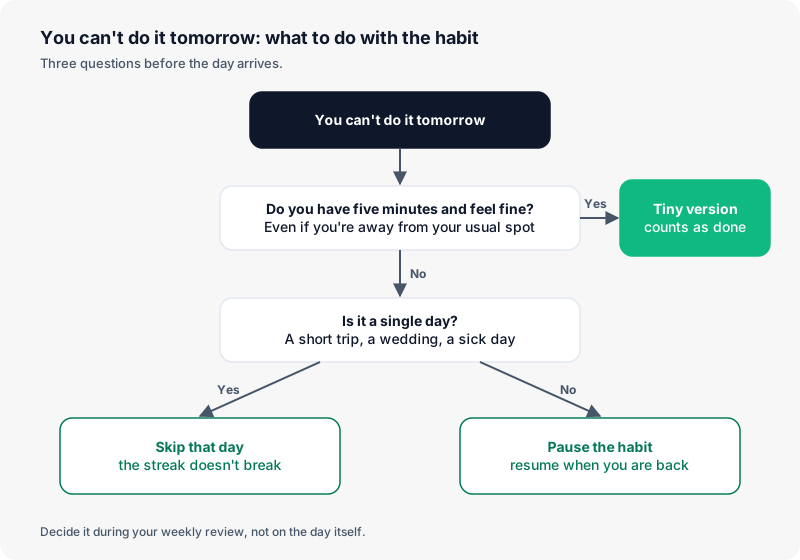
The rule of thumb: if you have five minutes and you feel fine, do the tiny version. If you don't have those five minutes or you're not well, skip without guilt.
How to skip a day you already know you'll miss
Most days you'll skip are known in advance. The trip is in your calendar. So is the wedding. Waiting until the day itself has one problem: on that day you're rushed, and you probably won't even think about the habit. The next morning you see the broken streak.
Do it earlier. A good routine is to look over the week on Sunday and spot the days you won't manage. For each one, choose one of three things:
- I'll move it. If the habit runs several times a week, do that session on another day the same week.
- I'll skip it. If there's no other slot, mark it as skipped now.
- I'll do the tiny version. If you'll have a moment that day, decide it now so you don't have to think about it.
This kind of plan works better written down and specific. Peter Gollwitzer called these implementation intentions: plans shaped like "when X happens, I'll do Y" (American Psychologist, 1999). Here it might be "on Thursday when I travel, reading is skipped, and on Friday I'm back at my usual time". If you want to set up that weekly check, see how to do a weekly review in 15 minutes.
What to do when it's several days in a row
Skipping is for single days. If you'll be away for a week, skipping seven days one by one is tedious and easy to forget. On top of that, every morning you'd see the habit waiting on your list, even though you know you won't do it.
That's what pausing is for. A paused habit disappears from your daily list and stops sending reminders. The days it's paused count neither for nor against you. When you're back, you resume it and the streak carries on where it was.
Times when pausing makes sense:
- Holidays where you don't want to keep certain habits going.
- Exam weeks or the end of a big project.
- Moving house.
- An injury that rules out that habit for a while.
- A change of shift at work that throws off your schedule. There's more on that in how to keep a routine on rotating shifts.
You don't have to pause everything. Choose which habits go on hold and which you keep, even as a tiny version. Drinking water or reading two pages travel well. Your local gym doesn't.
When the pause ends, don't try to make up for lost days by doubling up. Go back to your normal frequency on day one. If restarting is hard, the guide on how to get back into a routine after vacation has a day-by-day plan.
How to tell if you're skipping too much
Skipping is useful while it stays the exception. If you do it often, the streak stops telling you anything. And the habit probably doesn't fit the way you've set it up.
A quick way to check: count how many days you skipped last month and why. If nearly all have a clear reason, like a trip or an illness, that's fine. If many are "didn't feel like it" or "ran out of time", the habit needs changing.
| Sign | What it usually means | What to do |
|---|---|---|
| You always skip the same weekday | You have no slot that day | Remove that day from the frequency |
| You skip more than one day a week | The frequency is too high | Lower it, say from daily to four times a week |
| You skip for lack of time | The habit is too long | Make the tiny version the normal one for a while |
| You skip late at night to save the streak | You forget, rather than can't | Check the time and the reminder |
| You've skipped a habit for weeks | It isn't a priority right now | Pause it or decide whether to drop it |
| You skip several habits on the same day | You have too many habits at once | Shorten the list |
If you feel you skip a lot because your days are too full, the issue may be the number of habits. There's more on that in how many habits you should start at once. And if a habit hasn't been done in weeks, read how to decide which habit to drop.
How Monkway handles it
Monkway keeps skipped, paused and missed days apart. Each one is counted differently.
- "Skip today". In Today, open the habit and tap "Skip". On desktop it's also in the actions of the habit's row. The day is marked as skipped and doesn't count as missed. If you get it wrong, the same button turns into "Undo".
- Skipping ahead. The arrows at the top of Today let you go to tomorrow or another day this week and skip the habit from there. So you can sort it on Sunday, before the trip.
- "Move to another day…". If you'd rather do it on a different day than skip it, you can move it. If you complete it on the new day, it counts as done.
- Streak. The streak counts the days in a row you did the habit up to today. Skipped days, paused days and days the habit wasn't due don't break it. Today, still unchecked, doesn't break it either, because the day isn't over.
- Completion rate. The completion rate only looks at days the habit was due. A skipped day doesn't lower it. In the grid of recent weeks, in the habit's detail, skipped days show in a different color, so you can see how many you've had.
- "Pause" and "Resume". You can pause a habit from its menu. It leaves Today and the reminders until you resume it, and the streak doesn't notice.
- "Taking a break?". If you haven't opened the app for a few days, Today asks you. Answer "I'm back" and those days don't count, and you'll see "Streaks safe". Answer "Still on a break" and the habits you choose stay paused.
- Idle habit prompt. If a habit has gone seven due days without being done, skipped or paused, Today asks what to do: "Pause", "Make it easier" or "Keep going".
All of this is free. There's no cap on skipped days or breaks.
FAQ
Does skipping a day break my streak?
In an app that tells skipping and missing apart, no. The skipped day is treated as a day that wasn't due: the streak neither grows nor breaks. In an app that only logs done or not done, yes, it breaks.
How many days can I skip before it's a problem?
There's no fixed number. Skipping odd days for a clear reason, like a trip, is fine. If you skip more than one day a week for several weeks, review the habit's frequency.
Is it cheating to mark a day I forgot as skipped?
You can, but you lose information. If you forget often, you need to know so you can change the time or the reminder. Keep skipping for days you decided not to do it.
What's the difference between skipping and pausing a habit?
Skipping is for one day. Pausing is for several days in a row: the habit leaves your list and your reminders until you resume it. Both protect the streak.
Can I skip a day that hasn't happened yet?
Yes, if your app lets you go to that day. It's the best way not to forget: you mark it skipped during your weekly review, not on the day of the trip.
What should I do with a habit when I'm sick?
Rest. Skip the days you're unwell, or pause the habit if it lasts. When you come back, start with the tiny version for a few days before returning to the normal one.
Is a tiny version better than skipping?
If you have five minutes and feel fine, yes, because it counts as done and keeps the time of day in place. If you can't or you're not well, skipping is the right call.
Is the streak still worth watching if I skip often?
Less so. In that case look at the completion rate over recent weeks, which tells you how much of what was scheduled you actually did. There's more on that in how to use streaks without quitting.
Decide today what happens on the days you can't make
Open your calendar for this week. Find the days where a habit won't fit. For each one, choose: tiny version, move it, skip it, or pause it if it's several days. Mark it now, not on the day.
If you want an app that tells what you skip on purpose apart from what slips, you can try Monkway for free, on iPhone and in the browser.