Quick answer. A study routine for a long exam holds when you pick a number of hours you can repeat on a bad Tuesday, not the number you could manage in your best week. The weekly shape that survives months has three kinds of session: new material, review of what you already covered, and timed practice questions. You walk the syllabus in passes, each faster than the last, and the exam date decides how many fit. Start by defining the minimum session you will do even on bad days.
This is a guide to organising study, not a health guide. Cutting sleep to study more buys hours today and takes them back next week. If you have been exhausted for weeks in a way that rest does not fix, if your mood has dropped, or if physical symptoms persist, talk to a doctor. A better plan is not treatment.
In this guide
- Why long exam plans collapse after three weeks
- How many hours a day actually hold
- The shape of the week
- How to split the syllabus into passes
- Why review is not negotiable
- What is a habit and what is a task
- Six signs your plan needs changing
- How Monkway handles it
Why long exam plans collapse after three weeks
The usual plan gets written on a Sunday, with the syllabus open and the energy of starting. It comes out in round numbers: six hours a day, five topics a week, the whole syllabus in five months. It is a plan for your best possible week, written on the day you feel most like studying.
What breaks it is not a lack of discipline. It is three things that will happen in any exam you prepare for over months:
- One topic gets stuck. One in ten takes three times as long as planned, and in a linear plan that delay just piles up.
- A whole week disappears. Flu, a move, an extra shift. With no slack, that week pushes every other week back.
- Review arrives too late. A month in, September is gone. With no review built in, the first pass ends and you start close to zero.
All three have the same fix: fewer hours than you could manage, plus reserved room to review and to catch up. A plan at 70 % of your capacity gets followed; one at 100 % breaks in week two.
One thing works in your favour: for most professional and civil service exams, the syllabus and the date are published in advance. Before you split anything, have the exact number of topics and the expected date in front of you. A plan built on a guess about either one will need rewriting.
How many hours a day actually hold
The useful question is not how many hours you should study. It is how many you can repeat four days out of five for six months. That number is lower than a single motivated week suggests, and it is the only one you can plan with.
These ranges come from experience rather than a study. Treat them as a starting point you adjust with your own numbers.
| Your situation | Hours a day that usually hold | Study days a week | Sign you overshot |
|---|---|---|---|
| Full-time job | 2 to 3 on weekdays, 4 to 5 at weekends | 6 | You reach Thursday without one complete day |
| Part-time job | 4 to 5 | 6 | Saturday goes on catching up the week |
| Studying full time | 6 to 7, in blocks with breaks | 5 or 6 | The last two hours leave nothing usable |
| Full time plus classes | 4 to 5 of your own, plus class | 5 or 6 | No room left to review the previous class |
| Final four weeks | The same as always, swapping new material for review and practice | 6 | Hours go up and practice scores go down |
Two things matter more than the number itself.
The floor beats the ceiling. Define a minimum session you will also do on bad days: forty-five minutes, one topic. What carries a six-month stretch is the absence of zeros, not the occasional ten-hour day.
Hours in the chair are not the metric. Two hours of skim-reading are worth less than forty minutes writing an outline from memory. Measure closed sessions and topics covered. We go into this in how to build study habits.
The shape of the week
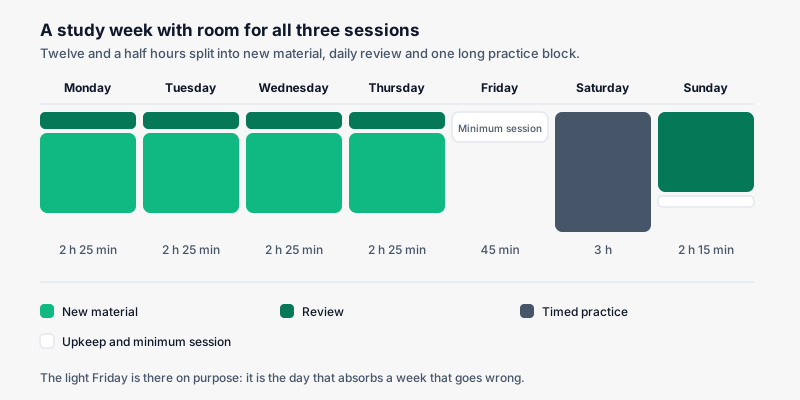
A study week has three separate jobs, and all three need a fixed place. With only new material you move fast and forget just as fast. With only review you never reach the end of the syllabus.
| Session type | What you do | Share of the week | Where it goes |
|---|---|---|---|
| New material | Read and write your own outline of the topic | 50 % | Your best hours of the day |
| Review | Recall a topic from days or weeks ago, from memory | 30 % | At the start of the session, before new material |
| Practice | Timed questions, cases or full written answers | 15 % | One long block at the weekend |
| Upkeep | Update the index, fix outlines, flag doubts | 5 % | A short slot, same day each week |
A week for someone with a job, studying two and a half hours on weekdays:
- Monday to Thursday: 25 minutes of review, then two hours of new material.
- Friday: off, or the minimum session.
- Saturday: three hours, half timed practice and half correcting what you got wrong.
- Sunday: two hours of review and fifteen minutes to lay out next week.
Look at Friday. Almost no plan includes a lighter day on purpose, and almost every plan ends up with one anyway. If your week falls apart every Wednesday, how to create a realistic weekly routine covers splitting a week without filling every day to the top.
How to split the syllabus into passes
The most expensive mistake in a long plan is walking the syllabus once, slowly and thoroughly. By the time you reach topic 80, topic 4 is gone. The alternative is several passes, each faster and with less reading than the last.
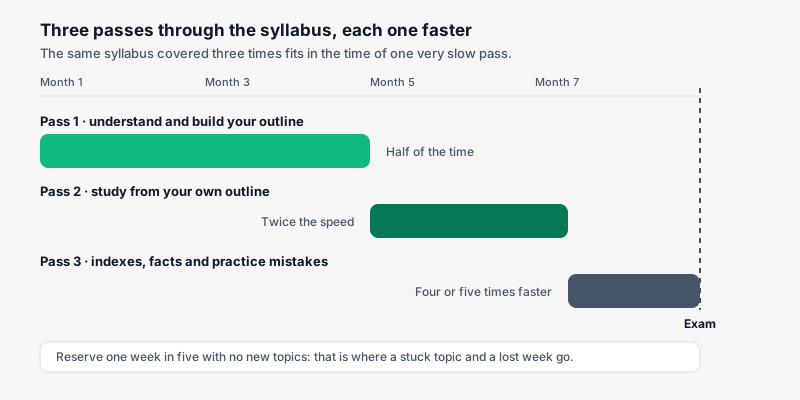
- First pass: you understand the material and build your own version of it. It is the slowest and takes about half the available time. The output of each topic is your outline, not a highlighted textbook.
- Second pass: you study from your outline and add only what was missing. It usually runs at twice the speed.
- Third pass: indexes, hard facts, and whatever you keep getting wrong in practice. Four or five times faster than the first.
Divide the topics across the weeks of the first pass, then reserve one week in five with no new topics. That is where the stuck topic, the lost week and the pending review go.
If the date is not published yet, plan against a provisional date twelve months out and revisit it monthly. Breaking a months-long goal into daily pieces is covered in how to break a long goal into habits.
Why review is not negotiable
When the week gets tight, review is the first thing people drop: you do not advance a topic and you do not tick anything new. It is exactly the part that decides how much you know on exam day.
Two findings from learning research line up with what a long exam needs:
- Spacing beats cramming. Cepeda and colleagues published a meta-analysis of the spacing effect in Psychological Bulletin in 2006: spreading repetitions over time produces better retention than bunching them together.
- Trying to recall teaches more than rereading. Roediger and Karpicke described test-enhanced learning in Psychological Science in 2006: testing yourself on material retains more over the long run than reading it again.
Dunlosky and colleagues reviewed ten common study techniques in a 2013 paper in Psychological Science in the Public Interest and rated distributed practice and practice testing among the most useful, above highlighting and summarising.
In your week that means something concrete: start each session with the book closed, writing the index of the topic due for review from memory. Five minutes. What does not come out is what needs reviewing.
A simple review calendar: each topic the next day, a week later, a month later, and once in the final pass. Four contacts, each shorter than the one before.
What is a habit and what is a task
Mixing the two in one list is what makes a long study plan unreadable within a fortnight. The practical split: anything that repeats with no date of its own is a habit; anything you do once and never again is a task.
| Goes in as a habit | Goes in as a task | Why |
|---|---|---|
| Daily study session | Study topic 34 | The session repeats; the topic closes and never returns |
| Five minutes of index from memory | Redo the outline for topic 12 | One is a start-up routine; the other is a specific job |
| Twenty practice questions a day | Saturday's full timed mock | The daily one keeps pace; the mock is an event |
| Ten minutes reviewing mistakes | Request the certificate for registration | Paperwork is never a habit |
| A half-hour walk | Buy the updated textbook | Rest repeats; the purchase happens once |
With that split your day is two or three fixed habits and two or three tasks that change. If you still end up with lists of fifteen items, how many tasks to plan per day has the criteria for cutting.
There is a third category that should stay out of the day: what occurs to you while studying. Switch textbooks, find a different course, try a new technique. That gets written down somewhere else and decided on Sunday, not at eleven at night on a Tuesday. Where to write down ideas you might not do covers that whole problem.
Six signs your plan needs changing
These are the signals worth checking once a week, and what to change for each.
| Signal | What it usually means | What to change this week |
|---|---|---|
| The same topic carries over three weeks | The topic is longer than planned, or you lack the base | Split it into three small tasks on different days |
| You complete fewer than 40 % of days | The daily hours are above what your week gives | Halve the daily session for two weeks |
| Practice scores drop while you advance | Review has been squeezed out | Swap one new-material day for a review day |
| You study but remember nothing next day | You are rereading instead of recalling | Start each session writing the index from memory |
| Weekends go on catching up the week | There is no slack in the daily plan | Reserve one week in five with no new topics |
| You sleep less to study more | You are paying for hours with next week's | Give the hour of sleep back and drop a topic |
Weeks that go wrong are part of the plan. The rule that prevents quitting: a bad week gets marked as skipped and is not made up in full. You return on Monday to the point you were due at, and the loss gets absorbed by the slack week. If you are coming back from a long gap, how to restart a habit you dropped covers returning without dragging the debt along.
How Monkway handles it
In Monkway a long exam fits as a path: a goal with a date, holding its daily habits and its syllabus tasks, with a day view that only shows today.
- One path for the exam. You give it a name, a line under "What for" and the exam date. The path shows Progress, 30-day consistency and "N days left", which is the number that orders the syllabus split.
- Fronts separate the three sessions. Each habit and task can carry a front: Material, Review, Practice. You can see you have closed nothing under Review for two weeks, without creating three separate paths.
- Habits carry a time and a frequency. The daily session, the five minutes of index and the short practice set repeat on their own, Monday to Saturday, and disappear on Sunday.
- The syllabus goes in as dated tasks. Each topic is a task inside the path. When one gets stuck you move it to another day, and the app counts how many times you have postponed it: three is usually the signal to split it.
- The daily load stops the optimistic plan. Today shows "Load 6/7", counting habits and tasks together. Schedule four topics on a Tuesday that is already full and it warns you, then offers the first day with room. You set the maximum in Progress → Pace.
- Skip the day instead of failing it. A week of flu is marked as a skip, and the month's completion stays honest. That avoids the usual "I broke the streak" exit.
- 30-day completion shows the weak day. You see what percentage you complete and which weekday you miss most. If it is always Thursday, you change Thursday and not the whole plan.
- The path's backlog holds the ideas. Whatever occurs to you mid-session goes in with no date and stops competing with today's studying.
- The weekly review acts as a tutorial. It shows overdue tasks, weak habits, paths with no closures in 14 days and an old backlog, with a one-tap decision for each.
If you would rather start from something already set up, the guided paths come with the habits already distributed and can be changed once you are inside.
Frequently asked questions
How many hours a day should I study for a long exam?
As many as you can repeat four days out of five for months. With a full-time job that is usually two or three on weekdays; studying full time, six or seven in blocks. A number that cannot survive a bad Tuesday is no use for planning.
Is it better to study in long stretches or spread it out?
Spread it out. Cepeda's meta-analysis on the spacing effect points to distributed repetitions retaining better than bunched ones. The last hours of a very long block also return very little.
How many passes through the syllabus do I need?
Three is the usual reference: one to understand and build your material, one to study from your own outline, and a final one for indexes and hard facts. If the syllabus is short or familiar, two well-reviewed passes are enough.
When should I start doing practice questions?
From the first pass, on the topics you have already closed. Waiting until the end turns practice into a surprise exam instead of a review tool.
What do I do if I lose a whole week?
Mark it as skipped and return on Monday to the point you were due at. The loss gets absorbed by the slack week you reserved. Cramming a full week back in usually costs you the next one.
Should I study at weekends?
Yes, and that is where long practice blocks fit if you have a job. What to avoid is the weekend becoming the drain for everything that did not fit on weekdays: if that happens, the daily split is wrong.
When do I stop adding hours and start worrying?
When hours go up and practice scores go down, or when weeks pass without rest restoring you. The useful change there is better distribution, not more; and if the exhaustion persists, talk to a doctor.
Start with the minimum session
Pick two things today: the minimum session you will do even on bad days, and the date, provisional or not, you are splitting the syllabus against. That gives you a plan you can follow and revise.
If you want the split to hold on its own and to see every Sunday what has stalled, Monkway is free to start, on iPhone and in the browser.