Quick answer. Your weekly number comes from multiplying what you finish on a normal day by the days you actually have, then subtracting a margin for whatever comes up. With an office job, that usually lands between 30 and 40 things a week, counting habits and tasks together. Before you add any tasks, subtract what your habits already take: four daily habits are 28 of those 40. And don't pile it all onto Monday. Spread it so no single day goes over your daily limit.
What you'll find here
- Why you're already behind by Wednesday
- How much fits in a week, depending on your situation
- How to work out your weekly number
- How much your habits take before you start
- How to spread the week across the days
- Signs you've overdone it
- What to do on Wednesday if you're already behind
- How Monkway handles it
Why you're already behind by Wednesday
On Sunday evening the week looks huge. You have seven days ahead and none of them has gone wrong yet. So you write down everything you want to get done, and it all seems to fit.
Then Monday happens. A meeting runs long. A request shows up that wasn't on the list. You sleep badly on Tuesday. Everything you don't finish moves to the next day, and the next day was already full. By Wednesday you're carrying Monday and Tuesday, and the whole week feels lost.
There's a name for this. Roger Buehler, Dale Griffin and Michael Ross studied why people misjudge how long their own projects will take, and called it the planning fallacy (Journal of Personality and Social Psychology, 1994). In their experiments, people focused on how the plan would go and set aside what had happened to them in the past. Planning your week on a Sunday is the textbook case: you decide with the best-case version of the week in your head.
The fix isn't a better plan for the ideal week. It's a number that comes from your real weeks.
How much fits in a week, depending on your situation
There's no universal number. There are reasonable ranges to start with, depending on how much free time your week leaves you. Count as a "thing" any scheduled habit or any task with a date. Every time something shows up on a day, it takes a slot.
| Your situation | Active days | Things per day | Things per week | What usually goes wrong |
|---|---|---|---|---|
| Office job with lots of meetings | 5 | 4 to 5 | 20 to 25 | Planning as if the meetings weren't there |
| Office job with focused mornings | 5 or 6 | 6 to 8 | 30 to 45 | Loading Monday and Tuesday, leaving Friday empty |
| Freelance or your own project | 6 | 7 to 9 | 40 to 50 | Not leaving a single day off |
| Studying full time | 6 | 6 to 8 | 35 to 45 | Counting "study" as one thing |
| Caring for someone or young kids | 7 | 2 to 4 | 15 to 25 | Copying the plan of someone without those duties |
| A week with a move, exams or a deadline | 7 | 2 to 3 | 10 to 20 | Not lowering the bar and missing everything |
Use this as a starting point for your first week. Your real number comes from measuring, which is the next step.
How to work out your weekly number
The weekly number is built from the bottom up, from what you actually finish in a day. If you already know your daily number, you're halfway there. If you don't, here's how to work out how many tasks to plan per day.
- Start from your real daily number. What you finish on an ordinary Tuesday, not your best day. If you've tracked a week, use the median.
- Count your active days. The days you'll really work through your list. If Sunday is for doing nothing, leave it out. If you do half as much on Saturday, count it as half a day.
- Multiply. Eight things a day times five days is 40. Eight times five and a half is 44.
- Subtract a 10 to 20% margin. That's the room for whatever comes up: an extra request, an afternoon at the doctor, a bad day. From 40 you get 32 to 36.
- Review the number once a week. If you finish three weeks in a row with plenty of room, go up a little. If you carry things over every week, go down.
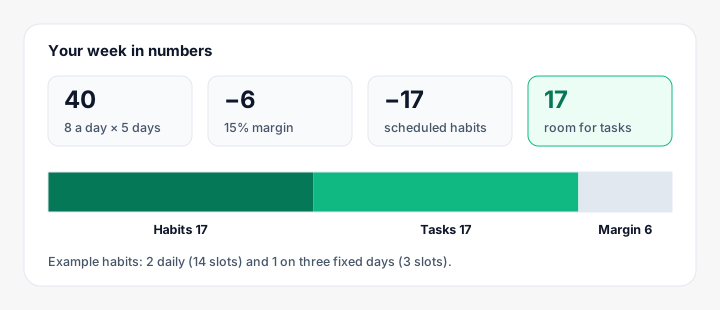
The margin isn't wasted time. It's what stops a single surprise from pushing the whole week back. Without it, anything new pushes something else out, and that something ends up on the next day.
How much your habits take before you start
This is the most common mistake when planning a week. You think about tasks and forget about habits. But a daily habit shows up seven times. It takes seven slots in your week before you've written down a single task.
| Your habits | Slots per week | Left from a limit of 40 | What it means |
|---|---|---|---|
| 2 daily habits | 14 | 26 | Plenty of room for tasks |
| 4 daily habits | 28 | 12 | Fewer than two tasks a day |
| 6 daily habits | 42 | None | Already over without any tasks |
| 2 daily and 2 on three fixed days | 20 | 20 | A balanced split |
| 3 on weekdays and 1 on three fixed days | 18 | 22 | Good if you rest at the weekend |
The practical takeaway is simple. If you have many daily habits, there's not much room left for tasks. You can accept that, or you can move one or two to three fixed days a week, which is often enough to keep them going. If you're just starting out, it also helps to know how many habits to start at once.
Do this sum before you plan. Add up the slots your habits take, subtract them from your weekly number, and what's left is the real room for tasks. A lot of the time, that one number explains why your week felt crushing.
How to spread the week across the days
Fitting the total isn't enough. A week of 36 things can go fine or badly depending on how they're spread. The classic mistake is front-loading: fourteen things on Monday, twelve on Tuesday and an almost empty Friday. When Monday goes wrong, the rest of the week pays for it.
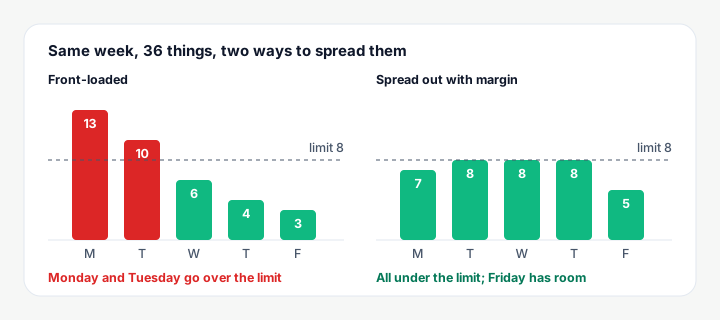
A few rules that work:
- No day above your daily limit. If Monday is already full, the new task goes on Tuesday or Wednesday, not on top.
- A slightly lighter Monday. It's the day that picks up what was left on Friday and whatever arrived over the weekend.
- Some room on Friday. It lets you finish what moved during the week without pushing it into the next one.
- Long tasks on days without meetings. If Thursday has three meetings, give that day habits and short tasks.
- Anything without a real date stays off the calendar. If you don't know when you'll do it, write it down somewhere else. Here's where to write down ideas you might not do.
| Spread | What it looks like | What happens when something goes wrong |
|---|---|---|
| Front-loaded | 14, 12, 8, 4, 2 | Monday overflows and pushes everything back |
| Flat | 7, 7, 7, 7, 7 | Holds up, but leaves no room for surprises |
| Flat with margin | 6, 7, 7, 7, 5 | Whatever moves fits on Friday |
| Back-loaded | 3, 5, 7, 9, 11 | You reach Friday with everything still to do |
"Flat with margin" tends to hold up best. What matters is that there's a gap somewhere in the week for things that move to land in.
Signs you've overdone it
You don't need to wait until next Sunday to know whether the week was overloaded. Some signs show up early, and each one has a specific response.
| Sign | What it usually means | What to do |
|---|---|---|
| By Wednesday you've moved more than three tasks | Monday and Tuesday were above your daily limit | Rearrange the rest of the week, don't just shift things |
| Habits start slipping from Thursday on | Tasks are eating the room your habits need | Drop one habit to a minimum version for the week |
| The same task has been on the list for three weeks | It's an open decision, not a task | Do it, split it, or take it off the calendar |
| Your weekend fills up with what you didn't do | The total didn't fit in your active days | Lower your weekly number next week |
| You finish Fridays with everything done and energy left | You aimed too low | Raise the number a little at a time |
If what you're seeing is today overflowing, rather than the week, here's how to tell if your day is overloaded.
What to do on Wednesday if you're already behind
If you're behind halfway through the week, pushing everything back one day fixes nothing. It just moves the problem to Thursday. What works is stopping for ten minutes and deciding again.
- Look at what's left. Count what's still pending between now and Friday and compare it with the slots you have. If it's more, something has to go.
- Sort by type. Anything with a real date, like a deadline or an appointment, stays. Anything that got a date "just because" is the first to move.
- Take out what doesn't belong to this week. No need to delete it. Move it to next week, or to wherever you keep things that don't have a date yet.
- Protect two or three habits. The ones that keep you going. The rest can drop to a short version until Monday.
- Write the decision down. It helps to decide when you'll do each thing. E. J. Masicampo and Roy Baumeister found that making a specific plan for an unfinished goal reduced the way that goal interfered with another task (Journal of Personality and Social Psychology, 2011). You don't have to finish it. You just need to know when it's coming.
If what's piled up are tasks from previous weeks, the step is different: see what to do with a pile of overdue tasks.
How Monkway handles it
In Monkway, the daily and weekly numbers live in the same place, and the app does the counting for you.
- Your limits, in Progress → Pace. In the browser version, the Pace card has a Limits section with two fields: "Maximum things per day" and "Per week". They start at 8 and 40. Next to them you see how many things you've closed per day over the last 28 days, and the app suggests a daily maximum based on that real pace. You accept it with one tap on "Use".
- Habits and tasks count together. A daily habit counts on all seven days. A habit on fixed days counts only on those days. An "N per week" habit counts every day, because it can land on any of them; if you want it to weigh less, give it fixed days. Tasks count on the day they're due.
- The week's load, in Today. The "Load 7/8" indicator on the Today screen shows how the day is going, on iPhone too. In the browser, tapping it opens "This week's load": one bar per day, Monday to Sunday, with your daily limit as a reference line, and the total below, for example "32 of 40 this week". Bars turn amber when a day gets close to the limit and red when it goes over.
- A warning when you schedule onto a full day. If you put a task on a day that's already at the limit, Monkway tells you: "Tuesday is already at the limit". You can schedule it anyway, move it to the first day with room that the app suggests, or cancel.
- The weekly review. Once a week, the review shows you what went past its date, weak habits, stalled journeys and anything that's been sitting in the backlog. That's the moment to adjust your number if you need to. If you've never done one, there's a guide to doing a weekly review in fifteen minutes.
Anything without a date goes to the backlog and doesn't count toward the load. So you can write down everything that comes to mind on Sunday without filling up the week.
FAQ
How many things should I schedule in a week?
For someone with an office job, between 30 and 40 things a week, counting habits and tasks. Your exact number comes from multiplying what you finish on a normal day by your active days and subtracting a 10 to 20% margin.
Do habits count toward the weekly number?
Yes. Every time a habit shows up on a day, it takes a slot just like a task. A daily habit is seven slots a week, and four daily habits already add up to 28.
Is it better to plan the week on Sunday or Monday?
The day matters less than planning with your number in front of you instead of a wish list. Many people prefer Sunday so Monday starts with the plan ready, but planning on Monday before you open your email works just as well.
Should I count the weekend?
Only if you really work through your list on those days. If Saturday is half an active day, count it as half. If Sunday is for rest, schedule nothing and leave it out of the sum.
What if one week has much more work than usual?
Lower the number for that week before it starts, not halfway through. Keep two or three habits in a short version and move anything without a real date to the following week.
What if I finish the week with room to spare?
That's a good sign. If it happens three weeks in a row, raise your number gradually, two or three at a time. If it only happens once, leave it as it is.
How often should I change my weekly number?
Once a week at most, during your weekly review. Changing it midweek is usually a way of justifying that you went over.
Start with next week
You don't need a new system to try this. This Sunday, add up what your habits take, subtract it from your number, and spread what's left so no day goes over your daily limit. If you want a fuller plan for the week, there's also how to create a weekly routine that holds up.
And if you'd rather have the app keep count and warn you when a day can't take any more, you can try Monkway for free, on iPhone and in the browser.