Quick answer. A pile of overdue tasks goes away by deciding them, not by doing them all. Set aside half an hour, filter by overdue, sort oldest first, and give every task one of five destinations: do it now if it fits in ten minutes, move it to today, schedule it with a real date, send it to the backlog, or delete it. Ten seconds each, no re-reading and no justifying. More than half usually ends up in the backlog or the bin, and the next morning you open the list without flinching.
In this guide
- Why you stop opening a list with forty overdue items
- How many you have and which clean-up you need
- Why deleting everything fails within a week
- The thirty-minute clean-up
- The five destinations for an overdue task
- How to decide in ten seconds
- Keeping the pile from coming back
- How Monkway handles it
Why you stop opening a list with forty overdue items
An overdue task asks for two things at once: that you do it, and that you decide what happens to it. Forty of them ask for eighty. Opening that screen in the morning means starting the day with a decision meeting nobody called, so your brain does the sensible thing and closes it.
There is a well-documented effect underneath. When options multiply, people do not choose better, they choose less often: Iyengar and Lepper showed it in 2000 with a jam display, where the table with twenty-four flavours sold less than the one with six. A list of forty overdue tasks works the same way. The number is what stalls you, not a lack of discipline.
And what you left half done does not sit quietly. Masicampo and Baumeister described in 2011 how unfulfilled goals keep intruding on unrelated thinking, and how the effect settles once you make a concrete plan for them rather than once you finish them. That is exactly what a clean-up is for: not doing the forty, but giving each one a plan, even when the plan is to delete it.
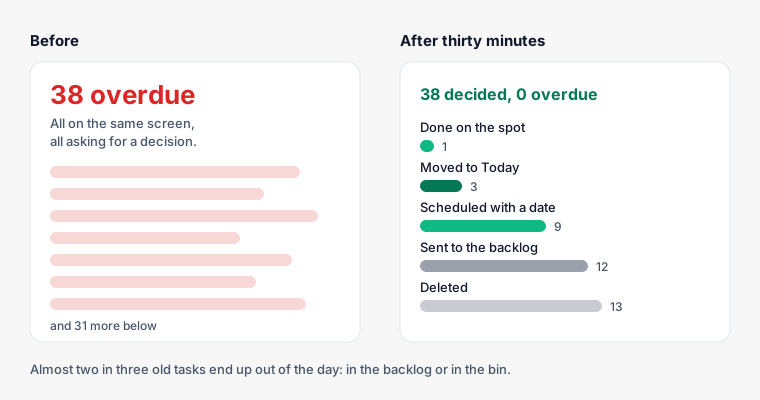
There is a more practical effect too. While the pile is there, it poisons today. If your day holds seven things and the screen shows you forty-seven, you can no longer tell today apart from March. It is the same problem as not knowing whether your day is overloaded, multiplied by weeks of leftovers.
How many you have and which clean-up you need
Not every pile needs the same treatment. Count yours before you pick an approach.
| Overdue | What it usually means | Time to clear | How to do it |
|---|---|---|---|
| 1 to 5 | One bad week, nothing more | 5 minutes | Decide them right now, one by one |
| 6 to 15 | Two or three weeks of putting in more than fits | 15 minutes | One session, oldest first |
| 16 to 40 | Your list stopped matching your life a month ago | 30 minutes | Timed session, ten seconds per task |
| 41 to 100 | Months of capturing without deciding | Two 30-minute sessions | Clear everything over 60 days in bulk, then the rest |
| Over 100 | It now works as a historical archive | 20 minutes | Send the lot to the backlog and start today with three tasks |
The last row surprises people because it has the shortest clean-up. Past a hundred, going one by one costs more than the value inside. Send them to the backlog unopened, start clean, and pull back only what you actually miss. Nothing is destroyed: they stay searchable if one of them turns out to matter.
Why deleting everything fails within a week
The usual reaction to the pile is select all, delete. It feels good for two days. It fails for two separate reasons.
The first is that among forty old tasks there are almost always three or four that did matter: the insurance that lapses, the return with a deadline, the call you have been avoiding and genuinely need to make. A bulk delete throws those out with the rest, and they tend to come back more expensive.
The second is that deleting does not touch the cause. If the pile formed because you put twelve tasks into a day that holds seven, the list is full again in three weeks. The clean-up is half the job; the other half is lowering what goes in.
| What you usually do | What happens | What to do instead |
|---|---|---|
| Select all and delete | The three that mattered go too | Bulk-review only what is over 60 days old |
| Move them all to today | Today becomes impossible and you drop it | Rescue three to today at most |
| Move them all to tomorrow | Tomorrow holds the same pile with a new date | Spread them across real, different dates |
| Leave them and look away | Every morning costs you the dodge | Half an hour once and it is done |
| Reorganise into folders | You tidy the pile without shrinking it | Decide a destination, not a category |
There is one case where the bulk delete is the right answer: when everything is more than three months old and none of it rings a bell. If something has been overdue for ninety days and you have not missed it once, you already decided. All that is left is writing it down.
The thirty-minute clean-up
The session works better with a timer running. The time limit is what pushes you to decide instead of re-reading.
| Minute | What you do |
|---|---|
| 0 to 2 | Filter by overdue and sort oldest first |
| 2 to 5 | Scroll to the bottom and bulk-delete anything over 90 days you do not recognise |
| 5 to 25 | One by one, ten seconds each, no re-reading and no editing titles |
| 25 to 28 | Look at today and trim it: three rescues maximum |
| 28 to 30 | Check that nothing is left overdue and close |
Three details change the outcome quite a bit.
Oldest first, not newest. Old tasks are the easy calls, because time has already answered for you. Starting there builds momentum and shrinks the pile fast. Start with yesterday's and you walk into the hard ones with the whole list still in front of you.
Do not edit titles during the clean-up. Rewriting a task so it makes sense is useful work, but it belongs to another day. Start rewriting and you will get through three of forty and abandon the session.
Today has a ceiling. Rescuing twenty old tasks into today swaps one pile for another. Three is a number that holds, and it fits what you already know about how many tasks to plan per day.
The five destinations for an overdue task
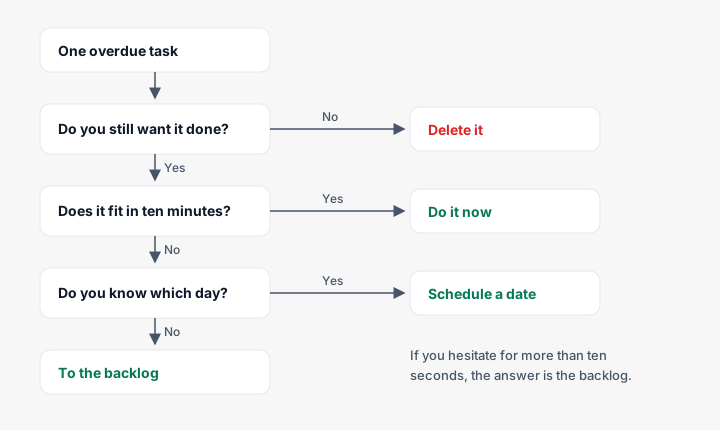
Every overdue task fits into one of five places. There is no sixth, and that is the point: the decision closes.
| Destination | When it goes there | What happens next |
|---|---|---|
| Do it now | It fits in ten minutes and you have the ten minutes | It leaves the list on the spot |
| Today | It genuinely matters and fits in what is left of the day | It counts towards the day's load, three maximum |
| Schedule | You know which day you will do it and that day has room | It comes back on its own that day, not before |
| Backlog | You want it but not yet, or it is not up to you | It waits with no date and no nagging |
| Delete | Reading it you think "I should", not "I want to" | Gone. If it mattered, it comes back |
The most underused destination is the backlog, and it is the one that helps most. An undated task that shows up in your day every morning wears you down; in a separate place it waits without bothering anyone. If you have never kept one, here is the whole idea of where to write down things you might not do.
The most overused is scheduling. Putting a far-off date on something looks a lot like postponing in nicer handwriting, and it only counts if you know why that day and not another.
How to decide in ten seconds
Asking yourself whether something is important gets you nowhere: almost everything looks important once it is written down. Use this instead: do I want this done, or do I think I ought to?
If reading the task produces "I should", it is a candidate for deletion. If it produces "I want to" or "this has to happen", it goes to Today or Schedule. If it produces "maybe", it goes to the backlog. You can hear the difference in the sentence, and it takes two seconds, not ten.
When you still hesitate, look at the age. It is the most honest number you have.
| Age | What it tells you | Default destination |
|---|---|---|
| Under 7 days | Still recent, still yours | Today or Schedule |
| 7 to 30 days | It has slipped past you a couple of times | Schedule on a day with real room |
| 30 to 90 days | It survived a month of choices and you still did not do it | Backlog |
| Over 90 days | You already dropped it, you just never wrote that down | Delete |
| Legal deadline or money | Age is irrelevant | Today, whatever it is |
That last row is the one exception worth keeping. A fine, a renewal or a return with a deadline is not decided on feeling. Find those first, pull them out of the pile and do them, even if it means pausing the clean-up.
If deciding reveals that something was never a task but a whole project, do not force it into one of the five. Set it up separately and break it down, the way turning a long goal into habits describes.
Keeping the pile from coming back
Clearing the list without changing anything else puts you back here in a month. Three adjustments prevent most relapses.
Put dates on fewer things. Giving a task a date is a promise that you will do it that day. Use dates for "I would like to get to this around then" and you will miss most of them and manufacture overdue items every week. Anything without a clear day goes to the backlog from the start, not afterwards.
Say when and where. Tasks that name a time and a place get done considerably more often than tasks that only name the what. Gollwitzer and Sheeran published a meta-analysis on implementation intentions in 2006 with a consistent effect across hundreds of studies. In practice: "call the bank" gets postponed; "call the bank Tuesday at 10, from the car" gets done.
Review once a week. Fifteen minutes on Friday or Sunday, looking only at what is overdue and what has been sitting undecided. With a weekly review the pile never passes ten, and ten is a coffee's worth of work.
| Cause of the pile | How you spot it | Adjustment |
|---|---|---|
| You put in more than fits | Most days end with tasks untouched | Lower the day's maximum by one or two |
| You use dates as wishes | Lots of overdue items from days you never really chose | Date only what has real room; backlog the rest |
| You have no backlog | Everything you capture ends up with a date | Create the place for undecided things |
| Projects mixed with tasks | Huge lines that never get completed | Set it up as a journey with its pieces |
| You never review | You find out about the pile once it is unmanageable | Fifteen fixed minutes a week |
If what piles up is missed habits rather than tasks, that is a different problem with a different fix: there you want the thirty-day completion rate instead of the streak, as in how to restart a habit you dropped.
How Monkway handles it
In Monkway the clean-up is not a ritual you have to invent. It lives in two places in the app.
- The Overdue filter, in Tasks. It separates what went past its date from everything else, so you can run the session without seeing anything else. When nothing is left, the screen says so: "Nothing overdue. Nice."
- The Overdue tasks section of the Weekly review. Each week the app gathers what went past its date undone and shows it with four buttons on every line: Today, Schedule, To backlog and Delete. Next to each task you see how long it has been sitting there, as "Yesterday" or "23 days ago".
- The postponement counter. Every task carries its own "Postponed 3 times". That is the number that turns a vague feeling into a fact, and it is usually what makes the delete decision easy.
- The day's load. Today adds up habits and tasks and shows how full the day already is, so as you rescue old tasks you can see the moment the day stops taking more.
- The backlog. What you park there waits with no date. When you know what to do with it, you tap Decide and pick today, another date, or turn it into a habit. Progress shows how many things you have left undecided, so the backlog does not quietly become another pile.
The weekly review ends with a button. Closing it returns you to Today with the list already clear, which is the state you need in order to open it again without hesitating.
Frequently asked questions
How many overdue tasks is too many?
Past fifteen it changes how you use the list: you start avoiding it. Under ten the clean-up is a one-minute routine; over forty it is worth booking half an hour with a timer.
Is it wrong to delete tasks I never did?
No. Deleting is a decision, the same as doing it. A task three months overdue was dropped in practice long ago; deleting it just puts that in writing.
Should I move everything to today or spread it over dates?
Spread it, and only onto days with genuine room. Moving forty tasks to today makes the day impossible, and an impossible day gets abandoned whole, including the parts that mattered.
What about overdue tasks that depend on someone else?
Turn them into "chase X again" with a specific date, or send them to the backlog. A task you cannot start on your own should not be taking up space in your day.
How often should I run the clean-up?
Once a week, fifteen minutes. Done weekly you never reach the pile, because what turns up each week is five or six things rather than forty.
What if they pile up again after I clear them?
Then the thing to adjust is what goes in, not the clean-up. Lower your daily task maximum by one or two, and send anything without a clear day to the backlog from the start.
Do overdue tasks break habit streaks?
No. Habits and tasks are counted separately: a task going past its date does not affect the consistency of your habits, only the load of your days.
Is archiving better than deleting?
Yes, as long as the place you archive to never shows up in your day. That is why the backlog works: it stores things with no date and no reproach, and they are still there if it turns out you wanted them.
Start with anything over ninety days
You do not need the full session to feel the difference. Open the list, sort by date, scroll to the bottom and decide the ten oldest. Nearly all of them will be deletes or backlog, and the pile halves in five minutes.
If you would rather the app set the clean-up up for you each week, with the overdue items gathered and four buttons on every line, Monkway is free to start, on iPhone and in the browser. And if the day keeps filling past what it holds once you are done, the next step is deciding the tasks you keep postponing.