Quick answer. A monthly habit slips because about thirty days pass between one time and the next, and nothing reminds you. Give it a fixed day from 1 to 28, ideally tied to something that already happens each month, like payday. Set it for the time you can actually do it, with a reminder at that time. Keep the steps in a note so you do not have to work them out again, and if you miss the day, do it the next day instead of waiting a month.
What you will find
- Why things you do once a month get forgotten
- What is worth treating as a monthly habit
- Which day of the month to pick
- What time to set the reminder
- How to make it easy every time
- What to do if you miss the day
- How Monkway handles it
Why things you do once a month get forgotten
A daily habit reinforces itself. You do it today, tomorrow and the day after, and repetition settles it in. Lally and her team followed people trying to build a new habit and found that automaticity grew with each repetition. That study looked at daily behaviours. A monthly task repeats twelve times a year. With so few repetitions, it is unlikely to ever run on its own.
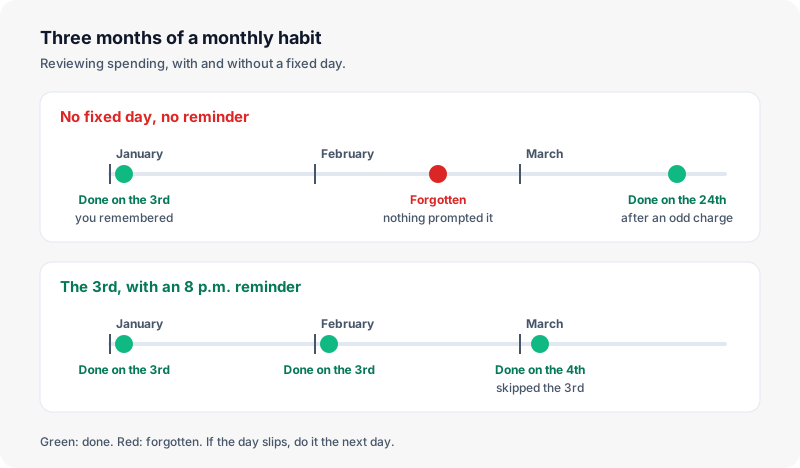
So monthly habits depend almost entirely on an outside reminder. Your memory has nothing to hold on to. On the 3rd you remember you "need to check your spending". By the 20th you do not. The following month it does not cross your mind until a strange charge shows up on your account.
| Frequency | Times a year | How you remember | Risk of forgetting |
|---|---|---|---|
| Every day | 365 | The repetition itself and the time of day | Low once it is settled |
| Several times a week | 100-250 | The week has a rhythm that repeats | Medium |
| Once a week | 52 | The day of the week (Sunday, Monday) | Medium |
| Once a month | 12 | Almost only with an outside reminder | High |
| Once a quarter or year | 1-4 | Only with a calendar | Very high |
The practical takeaway is simple. Do not expect a monthly habit to become automatic. Set up a system that puts it in front of you on the right day, with everything you need to get it done in a few minutes.
What is worth treating as a monthly habit
Anything that repeats each month and costs you something if you forget. Money, time, an appliance that breaks, or a relationship that cools. If it repeats and has a cost, it deserves its own habit rather than a loose note.
Some common examples:
- Review last month's spending and subscriptions.
- Clean the dishwasher, extractor hood or air conditioner filter.
- Back up your phone or computer.
- Call a relative who lives far away.
- Check the tyre pressure on your car or bike.
- Move the month's photos to a folder and delete duplicates.
- Go over your goals or your list of pending ideas.
| Monthly habit | Day that usually fits | Rough time | Why that day |
|---|---|---|---|
| Review spending and subscriptions | Two or three days after payday | 20 minutes | Last month is already closed at the bank |
| Clean household filters | A fixed day like the 6th, or the first Saturday | 15 minutes | You need some unhurried time |
| Back up your devices | The 1st | 10 minutes | Easy to remember and to check |
| Call a relative | A day with a free evening, like the 10th | 30 minutes | It does not clash with work |
| Check tyre pressure | The day you usually pass the petrol station | 10 minutes | You are already there |
| Review your goals | Last weekend of the month | 20 minutes | You can see the whole month |
A useful rule: if it takes more than an hour, split it. A long monthly habit is easy to put off "until I have an afternoon".
If something repeats but you are not sure yet whether you will keep it, do not make it a habit on day one. Write it down somewhere for ideas and decide later. There is more on that in where to write down ideas you might not do.
Which day of the month to pick
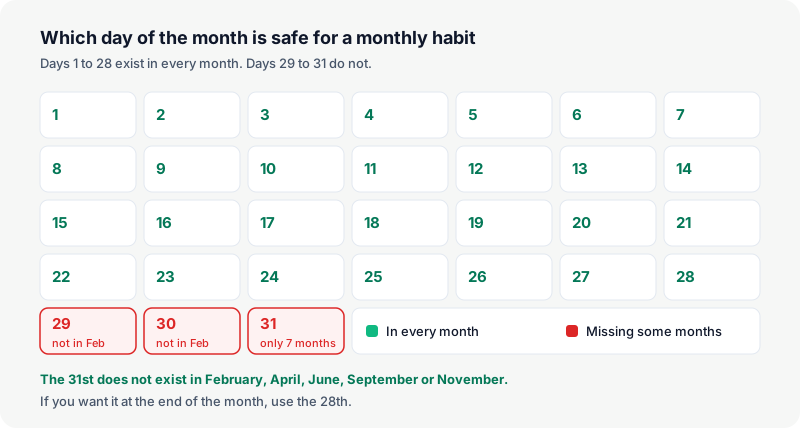
Pick a day from 1 to 28. Those days exist in every month. The 29th, 30th and 31st do not: February has no 30th or 31st, and outside leap years no 29th either. The 31st is also missing in April, June, September and November. If your habit falls on the 31st, there are five months a year when it does not show up, and depending on the tool you use, it may not remind you at all.
Within 1 to 28, look for a day that already means something to you. Gollwitzer showed that plans of the form "when X happens, I will do Y" help people follow through on what they intend. For monthly habits, X can be something that already happens every month:
- Payday, or two days after.
- The day a fixed bill comes out.
- The 1st of the month, if that is easy for you to remember.
- A day near something on your calendar, like a monthly meeting.
| Option | Upside | Downside | When to use it |
|---|---|---|---|
| The 1st | Easy to remember | Often a busy day | Short jobs under ten minutes |
| Payday or two days after | Fits money reviews | Changes if you change jobs | Spending, savings, subscriptions |
| A plain day between the 5th and 25th | Quieter part of the month | No built-in anchor | Cleaning, upkeep, calls |
| The 28th | Closes the month | Some months it falls on a weekend | Reviews and check-ins |
| The 29th, 30th or 31st | None worth having | Missing in some months | Avoid it |
What time to set the reminder
Set the reminder for the time you can actually do it. An alert at 9 a.m. as you walk into work does little: you see it, think "later", and the day is gone. An alert at 7 p.m., when you are home, catches you with time to spare.
Before choosing the time, ask what you need to do the job. Reviewing spending needs your laptop or banking app. Cleaning a filter needs you at home with the cleaner. Calling someone needs them to be free.
| Type of monthly habit | What you need | Time that usually works |
|---|---|---|
| Money review | Laptop or banking app, 20 minutes | Evening, after dinner |
| Cleaning or upkeep | Being home, supplies at hand | Weekend morning or a free evening |
| Backup | Wi-fi and a charger | Night, while your phone charges |
| A call | The other person being free | The time they usually pick up |
| Goal review | Some quiet time | Sunday morning |
If you need to prepare something first, like buying the filter cleaner, keep it out of the same reminder. Create a separate task for a day or two before. That way the habit's day does not arrive with you unable to do it.
One well-placed reminder beats several badly placed ones. To set the rest of your reminders with the same logic, see how to set habit reminders.
How to make it easy every time
Monthly habits are forgotten in the details as well as the date. Which account did you check? Where was the filter? Which folder did you use for photos? Every time you have to work that out again, the habit costs more and the urge to leave it for another day grows.
The fix is to write the steps once and keep them attached to the habit. Next time you just follow them.
For example, for "Review spending":
- Open the banking app and filter by last month.
- Look at any charge over 30 in your currency.
- Go through your subscriptions and cancel what you do not use.
- Write the total in this month's note.
Four steps. Ten or fifteen minutes. No thinking about where to start.
Two more things help:
- Keep the supplies in one place. The filter cleaner, the backup cable, the spending notebook. If you have to hunt for it, you put it off.
- Write down what you found. One line: "Cancelled the video subscription", "Filter very dirty, clean it earlier next month". Next month you read it and know where you left off.
If starting is the hard part, hook it to something you already do that day. "After dinner on the 3rd, I review spending." There are more examples like this in habit stacking examples.
What to do if you miss the day
Do it in the next few days. Do not wait for next month. If you miss the spending review on the 3rd, the 4th is still a good day. If you leave it until next month, you will have two months piled up and even more reason to skip it again.
If you know in advance you cannot do it that day, because you are travelling or busy, skip it on purpose and add a task for another day that week.
| Sign | What it usually means | What to do |
|---|---|---|
| The alert goes off and you leave it for later | Wrong time | Move it to when you are home or free |
| You do it, but several days late | Wrong day | Move it to a quieter day |
| You open it and do not know where to start | Missing steps | Write them in a note on the habit |
| You put it off because it is long | Too big | Split it into two shorter habits |
| You miss it two months running | It matters less than you thought, or the timing is off | Decide whether to pause, change or drop it |
| You do it every month without trouble | It works | Leave it alone |
If a monthly habit fails a few times, do not beat yourself up. Look at which part is failing: the day, the time, the steps or the size. It is nearly always one of those four. If you want a method to find it, see how to find out why a habit keeps failing.
How to tell whether you are keeping it
With a daily habit, a streak tells you a lot. With a monthly one, the streak grows once a month and takes a long time to say anything. Look instead at completion over several months: how many times did you do it out of the times it was due?
A simple way to check is to review your monthly habits every three months. That is three chances per habit. If you did it all three times, it is going well. If you did it once or not at all, something needs to change. You can fold this into the weekly review at the end of each quarter. There is a quick way to do that in how to do a weekly review in 15 minutes.
And if short streaks get you down, read streak tracker without quitting. With monthly habits, regularity matters more than the streak.
How Monkway handles it
Monkway has a real monthly frequency. It shows you the habit on the day it is due and leaves it out of the way the rest of the month.
- "Monthly" frequency with "Day of month". When you create the habit you pick "Monthly" and tap the day on a grid from 1 to 31. You can select more than one day if you do it twice a month, for example the 1st and the 15th.
- It appears in Today only on that day. The rest of the month it takes up no space in your list. On the day, you see it next to your daily habits and tasks.
- Time and reminder. You set the time you will do it, and the alert fires on that day of the month at that time. The 29th, 30th and 31st do not exist in every month, so in those months the habit does not show up. It is better to pick from 1 to 28.
- A note on the habit. "Note" sits in the habit's actions. You can keep the steps there and write down what you found each month. In Notes you can filter by habit to read everything you wrote about it.
- "Skip today". If you know you cannot make it on the day, skip it from the habit's actions. A skipped day does not count as missed in your completion rate.
- Tasks for the day after. If you miss it, create a task dated tomorrow or another day that week. Habits and tasks live on the same screen. There is more on this in an app for habits and tasks together.
- Completion in Progress. In Progress you see how many times you did it out of the times it was due, which is the number that matters for monthly habits.
The app does not do the habit for you. It puts it in front of you on the right day, with your notes beside it, so it does not depend on your memory.
Frequently asked questions
What is the best day of the month for a monthly habit?
One from 1 to 28, because it exists in every month. Within that range, pick one that already means something to you, like payday or the day a fixed bill comes out. That gives you an anchor as well as the reminder.
Why should I not set a monthly habit on the 31st?
Because the 31st does not exist in February, April, June, September and November. In those months the habit may not appear or remind you. If you want it at the end of the month, use the 28th.
Is a monthly habit better than a repeating task?
If you will repeat it every month with no end date, use a habit. It lets you see your completion and keep notes on each time. A task fits better for something you do once or that changes each month.
How many monthly habits can I have?
As many as you can do without them piling up on the same day. Spread them across different days so none lands in a busy week. Four or five well spread out are usually manageable.
What do I do if I cannot do it one month?
Skip it on purpose and add a task for another day that week. If that month is out entirely, leave it skipped and carry on next month. One skipped month does not ruin the habit.
How do I remember what I need to do each time?
Write the steps once and keep them in a note on the habit. Next month, open the note and follow them. Add a line about what you found so you know where you left off.
Is a streak useful for a monthly habit?
Not much at first, because it only goes up once a month. Look at completion over the last three or six months instead. It tells you more about whether the habit is working.
Give it a day and a time today
Pick one habit that keeps slipping. Give it a day from 1 to 28, a time when you are free, and a reminder. Write its steps in a note. Next month you will only have to follow them. If your daily habits slip too, how to track habits may help.
If you want monthly habits to show up only on the day they are due, you can try Monkway for free, on iPhone and in your browser.