Quick answer. To spread household chores across the week, first sort them by how often they really need doing: every day, once a week, or once a month. Then give each weekly chore a fixed day, or set it to "twice a week" if the day doesn't matter. Keep it to one or two chores per workday, around 15 to 20 minutes each, on top of the daily basics. Occasional jobs, like cleaning the oven, go on a separate list and get scheduled when there's room.
What you'll find here
- Why doing it all on Saturday backfires
- Which chores are daily, weekly or monthly
- Fixed day or times per week: which one for each chore
- How to spread the week without overloading one day
- How many chores fit into a workday
- What to do with occasional chores
- Signs your chore plan isn't working
- How Monkway handles it
Why doing it all on Saturday backfires
Cleaning the whole place on Saturday feels efficient. In practice, three things go wrong.
Saturday fills up with other plans. A lunch, a trip, a birthday. If you don't clean that day, you don't clean all week. The next Saturday has twice as much.
Four hours in a row wear you out more than four separate hours. By the last chores you've run out of steam. You rush them or leave them for "later".
The house slides during the week. By Tuesday there's laundry to fold and the bathroom needs a wipe.
Spreading chores doesn't remove work. It moves it into short blocks that fit into normal days. And if one day falls apart, you lose one chore, not the whole week.
If you're curious how much time people spend on their homes, the U.S. Bureau of Labor Statistics measures it every year in the American Time Use Survey. Housework shows up there as an everyday activity, next to work and sleep, and not as a weekend thing.
Which chores are daily, weekly or monthly
Start with the full list. Write down everything you do at home, however small. Next to each item, note how often it really needs doing.
This table is a guide for an average-sized apartment. Adjust it to your home and how many people live there.
| Chore | Usual frequency | Rough time | How to schedule it |
|---|---|---|---|
| Washing up or loading the dishwasher | Every day | 10 to 15 minutes | Daily, no set time, after dinner |
| Clearing the kitchen and the table | Every day | 5 to 10 minutes | Daily, tied to dinner |
| Running a load of laundry | 2 or 3 times a week | 10 minutes plus hanging | Times per week |
| Folding and putting away clothes | Twice a week | 15 minutes | Times per week |
| Vacuuming or sweeping | Once or twice a week | 20 to 30 minutes | Fixed day |
| Mopping the floor | Once a week | 20 minutes | Fixed day, after vacuuming |
| Cleaning the bathroom | Once a week | 20 to 30 minutes | Fixed day |
| Changing the bed sheets | Weekly or every other week | 15 minutes | Fixed day |
| Taking out trash and recycling | On collection day | 5 minutes | Fixed day, the pickup day |
| Big grocery shop | Once a week | 45 to 60 minutes | Fixed day |
| Cleaning the fridge | Once a month | 20 minutes | Monthly |
| Cleaning the oven or the windows | Every month or two | 30 to 45 minutes | Separate list, scheduled when there's room |
Look at the last column. Almost none of these chores need Saturday.
Fixed day or times per week: which one for each chore
There are two ways to repeat something weekly. Picking the right one for each chore prevents half the misses.
| Option | How you'd phrase it | Works well for | Breaks when |
|---|---|---|---|
| Fixed day | "I clean the bathroom on Wednesday" | Chores tied to something external, or ones you want on the same day every week | That weekday often goes sideways |
| Times per week | "I run two loads of laundry a week" | Chores where the day doesn't matter, only the count | You leave them all for Sunday and do them back to back |
| Daily | "After dinner, I clear the kitchen" | Things that pile up overnight | You give it a clock time that keeps changing |
| Monthly | "On the 1st, I clean the fridge" | Things you only need a few times a year | There's no reminder and it slips |
A simple rule: if the chore depends on something that happens on a specific day, use a fixed day. Trash goes out on collection day. The big shop happens on the day you have the car. If it depends on nothing, "times per week" lets you pick whichever day suits you.
Daily chores work better tied to something you already do than given a clock time. "After dinner" happens every day, whether at seven or at nine. Peter Gollwitzer and Paschal Sheeran reviewed 94 studies on "when X happens, I'll do Y" plans and found they helped people reach their goals with a medium-to-large effect (Advances in Experimental Social Psychology, 2006). You'll find more ideas in these habit stacking examples.
Monthly chores have a different risk. So many days pass between one time and the next that you forget. Here's how to keep a monthly habit from slipping.
How to spread the week without overloading one day
With the list done and each chore given a frequency, it's time to place them. The method is the same for any home.
- Place the fixed-day chores you can't move first. Trash on collection day. The shop on the day you can go.
- Put the long chores on the days with more time. If you finish early on Tuesdays, the bathroom goes on Tuesday. If Thursdays run late, Thursday gets nothing long.
- Spread "times per week" chores across separate days. Two loads of laundry work better on Monday and Thursday than on Saturday and Sunday.
- Leave one day free of chores. On that day, catch whatever slipped during the week. If nothing did, you rest.
- Count how many chores each day has. If a day has three or more, move one to a lighter day.
Here's what a spread-out week looks like next to the all-on-Saturday version:
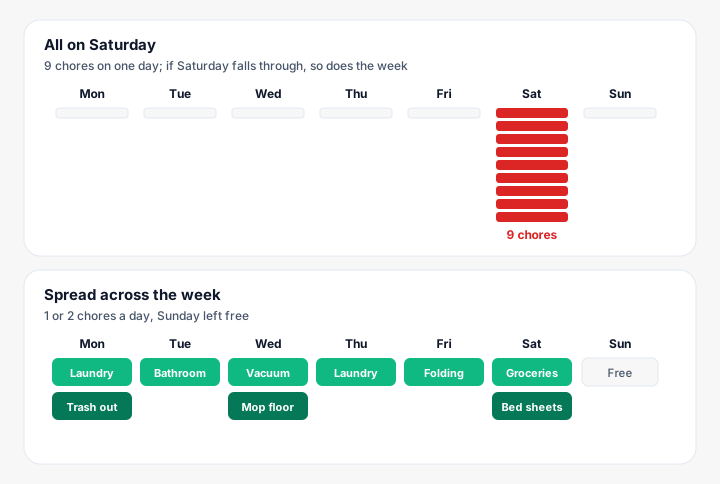
Daily chores, like washing up, aren't in the drawing because they're on every day.
If planning the week in general is the harder part, not just the house, here's how to create a weekly routine that holds up.
How many chores fit into a workday
A workday already has its load: work, meals, maybe kids or a habit of your own. If you pile on too many chores, the thing that drops is usually yours.
These ranges are a starting point. Check them against your own weeks.
| Kind of day | Chores that usually fit | Which ones to pick |
|---|---|---|
| Normal workday | 1 or 2, plus the daily basics | One short (laundry, folding) and at most one medium (bathroom, vacuuming) |
| Long workday or travel day | Only the daily basics | Nothing new; move whatever was due |
| Day with a free afternoon | 2 or 3 | The ones that take longest: groceries, bathroom, floors |
| Saturday or Sunday | 2 or 3, not everything | The ones that need daylight or a long stretch, like windows |
| Week with guests or someone sick at home | Only the essentials | Trash, dishes and laundry; the rest waits |
The useful question isn't how many chores there are. It's how many things fit in your day, counting everything. We explain that count in how many tasks per day, and for the whole week in how many things to schedule in a week.
What to do with occasional chores
Some chores have no rhythm: cleaning the oven, sorting the storage room, descaling the coffee maker. On a fixed day, they show up when they're not needed. Without writing them down, they're forgotten.
What works is a separate list, with no dates, of "house things to do". Add anything occasional the moment you notice it. Once a week, look at the list and pick one or two for the following week, on a day with room.
This diagram sums up where each chore should go:
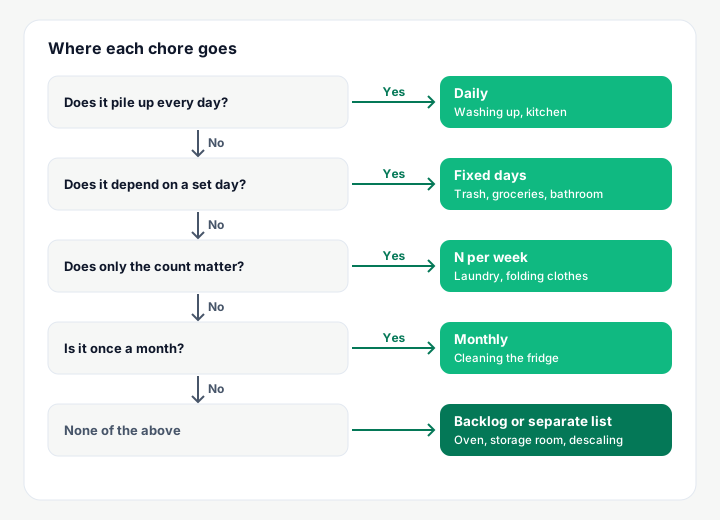
A few minutes on Sunday or Monday is enough to check that list. If you already review your week, add this step. The full process is in how to do a weekly review in 15 minutes.
Signs your chore plan isn't working
After two or three weeks you'll see whether the plan holds. Phillippa Lally and her team followed 96 people building a new habit: it took a median of 66 days to become automatic, with big differences between people, and missing a single day didn't change the outcome much (European Journal of Social Psychology, 2010). Don't expect the first month to be perfect. Watch for the signs and adjust.
| Sign | What it usually means | What to do |
|---|---|---|
| You always miss the same chore on the same day | That weekday has less time than you thought | Move it to another fixed day or switch it to times per week |
| "Times per week" chores all happen on Sunday | They have no anchor during the week | Give them a fixed day or tie them to something you already do |
| Saturday fills up again | Whatever slips during the week lands there | Let missed chores be skipped, not moved to Saturday |
| Some chores never get done and nothing happens | The frequency is higher than you need | Lower it: weekly to every other week, or onto the separate list |
| The occasional list keeps growing | You add more than you pick each week | Always pick one, even a small one, and delete what no longer matters |
| On chore days you do nothing for yourself | The day was already full before the house | Count the whole day, not just chores, and drop to one |
If that last sign sounds familiar, read how to tell if your day is overloaded. Often the problem isn't the house. It's everything else already on that day.
How Monkway handles it
Monkway puts habits and tasks together on the Today screen, so chores sit alongside the rest of your day and count toward the same load.
- Every repeating chore is a habit. When you create a habit, you pick a Frequency: Daily, Fixed days, N per week or Monthly. On your phone, the quick-create sheet shows them as "Daily", "Specific days" and "Times a week". "Clean the bathroom" can be Fixed days with Wednesday ticked. "Run a load of laundry" can be N per week set to 2. "Clean the fridge" can be Monthly with a day of the month.
- A category to group them. Habits have a Category field. Put "Home" on all of them and you can tell house habits from your own at a glance.
- Time or no time. Daily chores work well with "No time": they show up on Today and you tick them off after dinner. The ones that need a nudge, like taking out the trash, can have a time and a reminder.
- The day's load. The "Load 5/8" indicator on Today counts habits and tasks together. If you schedule a task on a day that's already full, Monkway warns you with "Tuesday is already at the limit" and offers to move it. In the browser you can see the week's load and change the maximum in Progress → Pace.
- Skip or move. If a day can't take the chore, "Skip today" doesn't count as a miss. For a one-off task, "Move to another day…" sends it to the day you pick.
- The backlog for occasional chores. Cleaning the oven or descaling the coffee maker go into the backlog, with no date. When there's room, you send it to Today or pick a day. If something in the backlog keeps coming back, you can turn it into a habit with "Every day", "3 times a week" or "Customize…".
The weekly review shows what didn't get done and lets you decide what to keep, pause or send to the backlog. It's the moment to adjust your chore plan.
Frequently asked questions
How do I split cleaning across the week?
Sort chores by how often they're needed and give each weekly one a specific day. Keep one or two chores per workday, on top of daily basics like washing up, and leave one day free to catch anything that slipped.
How much time a day should I spend on household chores?
It depends on your home and how many people live there. A starting point is 15 to 30 minutes on workdays, split between daily basics and one weekly chore. Watch two or three weeks and adjust.
Is it better to clean a little every day or all at once?
For most people, a little every day holds up better. If one day falls through, you lose one chore, not the week. Doing it all at once only works if that day is free every single week.
Which chores should be done every day?
The ones that pile up if you skip them: washing up or running the dishwasher, clearing the kitchen and putting dirty clothes where they go. They're short and easy to tie to something you already do, like dinner.
What if I don't have time for the chore I planned today?
Skip it today and wait until it comes round again. If it can't wait, move it to the next lighter day. What doesn't help is pushing everything to Saturday.
How do I remember chores I only do once a month?
Give them a monthly frequency with a day of the month and a reminder. If they have no fixed rhythm, like cleaning the oven, keep them on a separate list and check it once a week.
How do we split chores when several people live together?
Make the full list and hand out the fixed-day chores first, based on who has time that day. Split the occasional ones during the weekly review, with each person picking one or two. In Monkway, each person keeps their own chores in their own account.
Start with the list
This week, write down every chore you do at home and note how often each one is needed. That's enough to place the fixed-day ones and spread the rest.
If you'd like your chores on the same screen as your habits, with a warning when a day fills up, you can try Monkway for free.