Quick answer. If you only have one free hour a day, decide what goes in it before the hour starts, not once you are already in it. Give it to one thing, not three. If several things matter to you, spread them across the days of the week instead of squeezing them all into the same hour. Anything that doesn't fit today goes into one fixed place, so it stops pulling at you while you do what you picked.
What you'll find here
- Why the hour slips away
- How much actually fits in one hour
- How to choose what gets the hour
- How to share the hour across the week
- What to do on days you arrive with nothing left
- What to do with everything that doesn't fit
- How Monkway handles it
Why the hour slips away
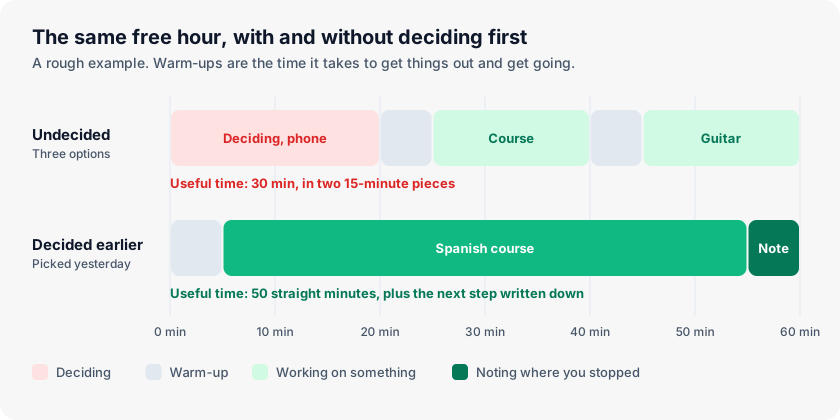
You finish work, eat, or get the kids to bed. At last you have an hour. You pick up your phone to work out where to start. When you look up, twenty minutes have gone and nothing has started.
The problem is usually that the hour arrives undecided. You have five things that matter to you: the course, the guitar, the side project, the paperwork, the run. Each one pulls at you. Choosing between them cold, tired and against the clock is hard. So you don't choose. Scrolling is what happens when you don't choose.
There's a second problem: the hour is short and the plans are not. Roger Buehler and colleagues described the planning fallacy in 1994: people tend to predict that tasks will take less time than they end up taking, even when they have been wrong before. If you walk into the hour planning three things, the first one will probably eat most of it. You leave feeling you did nothing, even though you did something.
| What usually happens | Why | What prevents it |
|---|---|---|
| The first 15 or 20 minutes go on deciding | The hour starts with no plan | Deciding earlier, in the morning or the night before |
| You start two things and finish neither | You assume there's time for everything | One thing per hour |
| You do the easy thing, not the one that matters | The easy thing needs no decision | Having written down what that day is for |
| You keep thinking about what you're not doing | The rest isn't written down anywhere | Capturing it all in one place |
| You arrive exhausted and do nothing | The hour sits at the end of a full day | A short version for those days |
How much actually fits in one hour
One hour holds one thing done properly. Sometimes two, if they are small and similar. Three almost never.
Part of the reason is switching. In 2009 Sophie Leroy studied what she called attention residue: when you move from one task to another without finishing the first, part of your attention stays behind and you do worse on the second. In a short hour, every switch costs you a slice of time and a slice of focus.
Each thing also has a start-up cost. Getting the guitar out and tuning it. Opening the course and finding your place. Changing into running gear. That warm-up tends to take five to ten minutes, depending on the activity. Do one thing and you pay it once. Do three and you pay it three times, with little left for the thing itself.
| How you use the hour | Warm-ups you pay | Real time on each thing | How it feels after |
|---|---|---|---|
| One thing | One | About 50 minutes | You moved something forward |
| Two similar things (reading and taking notes) | One and a half | About 25 minutes each | Usually works |
| Two different things (guitar and course) | Two | About 20 minutes each | Both left half done |
| Three things or more | Three or more | Under 15 minutes each | Nothing got done |
| No decision beforehand | One, plus the deciding | Whatever is left | Depends on the day |
The minutes are rough. What matters is the shape: the more you add, the less each thing gets.
If the struggle is sizing your whole day, not just this hour, there's more in how many tasks to put on your day.
How to choose what gets the hour
You have more things than hours. You can choose with a rule instead of with whatever you feel like at 10 p.m.
Ask these about each candidate:
- Is this the only time I can do it? Replying to messages, paying a bill or ordering groceries fit in five-minute gaps during the day. Don't spend the hour there.
- Does it need regular contact? A language, an instrument or exam prep move forward when you touch them often. Once a month doesn't work.
- Does it move me toward something I actually want? Not something you feel you "should" want. If you haven't touched it in months and don't miss it, maybe it isn't for now.
- Can I do a useful chunk in 50 minutes? If it needs three uninterrupted hours to make progress, this hour isn't its home. Split it, or find it a weekend slot.
Whatever passes all four is a candidate for your hour. Whatever doesn't goes into another slot or gets written down for later.
| Kind of thing | Does it belong in your free hour? | Where it fits best |
|---|---|---|
| Something you're learning (language, instrument, course) | Yes, it gains most from repetition | The hour, several days a week |
| A personal project (writing, coding, a side business) | Yes, if you break it into one-hour steps | The hour, with the next step already written |
| Exercise | Yes, if there's no other slot | The hour or before your day starts |
| Admin and errands | No | Short 5 or 10 minute gaps |
| Personal messages and email | No | Work breaks or the commute |
| Tidying the house | Sometimes | Weekend blocks work better |
| Resting on purpose | Yes, if you choose it | The hour, some days of the week |
If you decide one evening is for reading for fun or watching a show, that counts as a decision too.
How to share the hour across the week
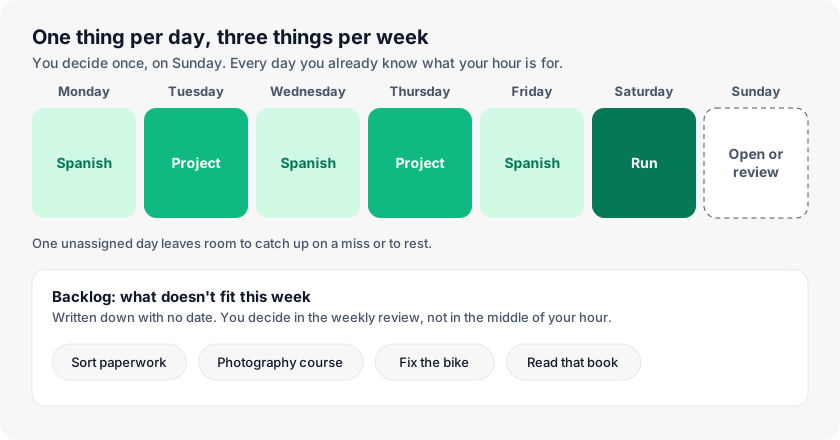
If three things matter to you, the temptation is to fit all three into the same hour every day. You've seen that it doesn't fit. The alternative is to share: each day of the week gets its own thing.
An example with three things and seven hours a week:
- Monday, Wednesday and Friday: the Spanish course.
- Tuesday and Thursday: the side project.
- Saturday: a run, with more time.
- Sunday: a real free hour or a look back at the week.
Each thing moves forward several times a week, and every day you know what it's for. You decide once, on Sunday, instead of seven times with a tired head.
To make the plan hold, it helps if each day has a clear "when". Peter Gollwitzer summed up the evidence on implementation intentions: plans shaped like "when X happens, I will do Y" get carried out more often than general intentions. Here that would be: "when I've cleared up after dinner, I open the course". The "when" has to be something that happens on every day the thing is planned.
Two rules that keep the split working:
- No more than three things a week in the hour. With four or five, each one shows up once and you never feel it move.
- Leave one day unassigned. It lets you catch up on a missed day or just rest. Without that slack, one surprise knocks the whole week over.
If one of those things is a big goal, like finishing a course or training for a race, it helps to break the goal into habits before you spread it across the week.
What to do on days you arrive with nothing left
Some days the hour shows up and you don't. You slept badly, work was rough, or you are simply done. Plan for those days before you need to.
The idea is a minimum version of whatever that day was for. If it was the Spanish course, ten minutes of vocabulary. If it was the project, reread the last thing you wrote and note the next step. If it was a run, a twenty-minute walk. The thing stays alive and the streak of contact holds.
| How you arrive at the hour | What to do | What to avoid |
|---|---|---|
| With energy | The day's thing, in full | Adding a second thing "because there's time" |
| Tired but clear-headed | The day's thing, short version | Swapping it for something easier without deciding to |
| Exhausted | Ten minutes of the minimum version, or skip the day | Forcing it and feeling worse |
| Something urgent eats the hour | Skip the day and move the thing to the open day | Trying to make up everything the next day |
| Several drained days in a row | Scale down the week's plan | Keeping the same plan and missing it |
If you have been arriving at that hour exhausted for weeks, the problem may not be the hour. Check whether the rest of your day is too full. How to tell if your day is overloaded has concrete signs to look for. And if tiredness or sleep keep affecting you, this content is educational and not a substitute for medical or psychological advice: talk to a professional.
What to do with everything that doesn't fit
When you pick one thing per day, the rest is left out. It doesn't disappear. If you don't write it down, it comes back right in the middle of your hour.
E. J. Masicampo and Roy Baumeister published a set of experiments on this in 2011. In their study, unfinished goals interfered with other tasks. That interference dropped when participants wrote a specific plan for those goals, even without completing them. Writing down what isn't for today, with some idea of when you'll look at it, leaves your head freer for what is.
What to write down, and where:
- Ideas you're not sure you'll do. Into a backlog or idea list, no date. The full method is in where to write down ideas you might not do.
- Things you will do, just not this week. Give them a date in another week.
- Things meant for today that didn't happen. Move them to another day on purpose instead of dragging them along.
- Where you stopped. When the hour ends, one line: "next step is…". Tomorrow you start in a minute instead of ten.
How Monkway handles it
Monkway keeps what's on today, what doesn't fit and the week's plan on the same screen. This is how the approach in this article looks in the app.
- One thing per day, with fixed-day habits. Create each thing as a habit and set its Frequency to Fixed days. Spanish on Monday, Wednesday and Friday. The project on Tuesday and Thursday. Each day, Today shows only what belongs to that day. The decision is already made when the hour arrives.
- The habit's time as your "when". In Edit habit you set the Time. In the phone app, the reminder arrives at that time and respects the days you chose. The details are in how to set habit reminders.
- A daily limit so the hour doesn't get crowded. The top of Today shows the load, for example "Load 5/6": what's scheduled against your Maximum things per day, counting habits and tasks together. If you try to add something to a full day, the app warns you and offers to move it to the first day with room. You change that maximum in Progress, under Pace.
- The backlog for what doesn't fit. Whatever comes up during the hour goes into the Backlog with "Jot something down…" and Enter, no date. Later you tap Decide and pick Today, Tomorrow, Pick a day or Turn into a habit.
- A journey for each long effort. If your hour goes to a long goal, create a journey. It groups that goal's habits and tasks and shows progress, consistency and days remaining. Each journey has its own backlog, with "Jot something down for this journey…".
- Notes for the next step. In Today, every habit has a Note action. Use it when you finish to write where you stopped. It's right there before you start tomorrow.
- Skip today when you can't make it. On a day you can't, Skip today records it as a choice, not a miss. Your completion rate stays honest.
- The weekly review for the split. Once a week, the review shows your Weak habits and Old backlog items. That's where you adjust which thing goes on which day. The walkthrough is in how to do a weekly review in 15 minutes.
Frequently asked questions
Is it better to use the hour for the same thing every day or to rotate?
If one thing matters a lot more than the rest, give it the hour every day. If two or three matter, spread them over fixed days of the week. What doesn't work is deciding day by day on the spot.
What if my free hour doesn't land at the same time each day?
Tie the thing to a moment in your day instead of a clock time. For example, "when the kids are in bed" or "when I get home from work". What matters is knowing what's next before the gap opens.
Can I split the hour into two half hours for two things?
You can, if the two things are similar or have very short warm-ups. If they're very different, each half hour shrinks to about twenty useful minutes. Giving one the full hour and the other the next day usually gets you further.
How many different things can I keep going with one hour a day?
With seven hours a week, three things is a sensible ceiling. With more, each shows up once or twice a week and progress is hard to feel. For more on this, see how many habits to start at once.
Does it count as well spent if I use it to rest?
Yes, if you chose it. Resting one evening a week on purpose is part of the plan. What leaves a bad taste is ending up on the sofa without having decided to.
What if I miss the hour half the time?
Scale the plan down. Fewer days a week, or shorter versions. A four-day plan you keep beats a seven-day plan you miss three times.
Pick tomorrow's thing today
One hour a day is enough to move your own things forward if you arrive at it with the decision already made. Tonight, before bed, pick what tomorrow's free hour is for and write the rest down.
If you want the weekly split, the daily limit and the place for what doesn't fit all in one app, Monkway is free to start, on iPhone and on the web.