Quick answer. If your habits only stick on weekends, the habit was most likely built for a Saturday, not a Tuesday. On Saturday you have time, energy and open hours. On weekdays, work takes over the slot you picked, you get home tired and the habit asks for more minutes than you have. The fix is usually one of three: move the weekday time, make a shorter weekday version, or set the frequency to the days that actually work.
What you'll find here
- Why Saturday works and Tuesday doesn't
- How to confirm this is your pattern
- The usual reasons habits fail on weekdays
- What to change for each reason
- When two versions of the same habit make sense
- If it happens the other way round
- How Monkway handles it
Why Saturday works and Tuesday doesn't
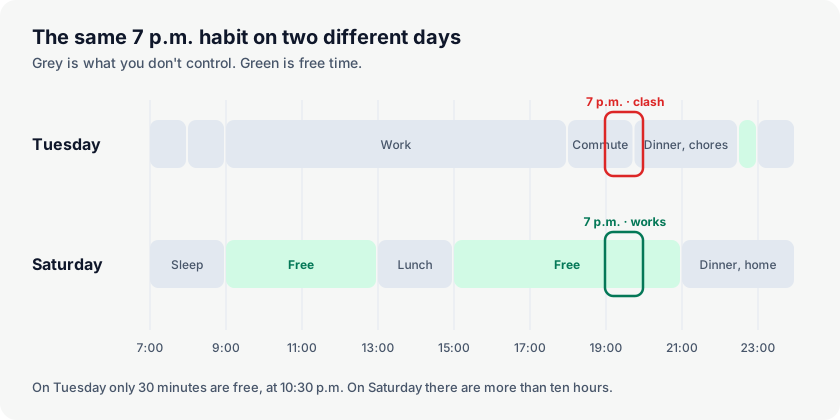
Habits lean on context. Wendy Wood and David Neal described this in 2007 in a review of how habits and goals interact: habits are triggered by cues like a place, a time of day or whatever you just did. When the context changes, the cue goes away, and the habit goes with it.
Your week has two very different contexts. Monday to Friday, work, commuting and other people's plans are in charge. On Saturday and Sunday, you are. A habit you plan on a calm Sunday afternoon tends to fit that Sunday. On Monday it meets a different day.
Energy matters too. At 7 p.m. on a Wednesday you've been making decisions for ten hours. At 7 p.m. on a Saturday, you haven't. The same habit costs more on some days than on others.
| What changes | A normal Tuesday | A normal Saturday |
|---|---|---|
| Free time | Short, scattered gaps | Long blocks |
| Evening energy | Low after work | Close to your morning level |
| Who sets the schedule | Work, commute, other people | Mostly you |
| The cue for the habit | Buried under meetings and rushing | Clear, because the day is open |
| Pending tasks | Many, with deadlines | Few, and flexible |
| What the habit asks for | The same 30 minutes | The same 30 minutes |
The last row explains most of it. The habit asks for the same thing seven days a week. Your week offers very different things.
How to confirm this is your pattern
Before you change anything, check that the pattern is real. Sometimes it feels like you miss "the whole week" when you actually miss two specific days.
You need at least four weeks of history. Put it in a grid: one column per week and one row per weekday. If the Monday to Friday rows are mostly empty and the Saturday and Sunday rows are mostly full, the pattern is clear.
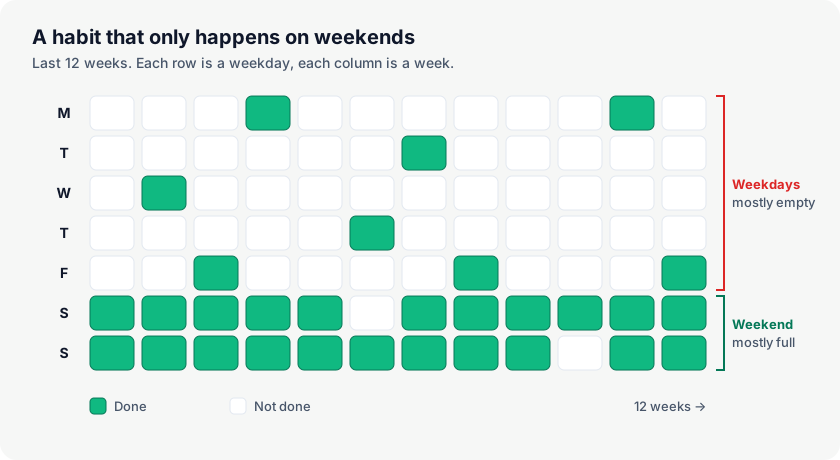
Look at three details:
- Which weekdays fail most. If Monday and Friday sometimes work, the trouble sits in midweek, when your load is highest.
- Whether the pattern started on a date. Going back to the office, a new schedule or a new course can create it.
- Whether it affects one habit or all of them. If every habit fails on weekdays, your workdays are too full. If only one fails, that habit is the issue.
That last point matters. If you see it across the board, check whether your day is overloaded before touching any habit. If you see it in one habit, keep reading.
The usual reasons habits fail on weekdays
When someone keeps a habit on weekends and misses it Monday to Friday, the reasons tend to repeat. Here are the most common ones and how to spot them.
| Reason | What it looks like | Typical note on a missed day | What to try first |
|---|---|---|---|
| The time clashes with work | You do it late or never at that time | "Still on the train at 7" | Move it before or after work |
| Too big for a workday | You start it and don't finish | "Only had ten minutes" | A short weekday version |
| Low energy late in the day | You miss it at night, not in the morning | "Got home wiped out" | Move it to the morning or lunch break |
| No weekday cue | You remember when it's too late | "Forgot" | Tie it to something fixed in your workday |
| Packed workdays | You miss several things the same day | "Had a hundred tasks" | Cut the total number of things per day |
| It needs something you lack | No gear, place or company | "The gym closes at 9" | Change the place or the form on weekdays |
To find yours, write one line each day you miss it, for two weeks. It's the same method as in how to find out why a habit keeps failing. Read the notes together and one reason usually shows up far more than the rest.
If the reason that keeps coming back is tiredness, and it lasts for weeks, don't treat it only as a scheduling problem. This content is educational and does not replace medical or psychological advice. If tiredness, sleep or mood keep affecting you, talk to a professional.
What to change for each reason
Change one thing at a time and give it two weeks. If you change the time, the size and the days all at once, you won't know what worked.
If the time clashes. Find a slot in your workday that doesn't depend on anyone else. It's usually at the start: before you open the laptop or before you leave home. The end of the day is the first thing work eats.
If the habit is too big. Make a ten-minute weekday version. Ten pages instead of an hour of reading. A fifteen-minute walk instead of forty-five. In the first months, what matters is repeating it in the same context. In Phillippa Lally's study at University College London, participants took a median of 66 days to make a new behavior automatic, with big differences between people. A small version you repeat gets you further than a big one you do twice a week.
If the cue is missing. Give it a specific "when". Peter Gollwitzer reviewed the evidence on implementation intentions: plans shaped like "when X happens, I'll do Y". On weekdays, X has to be something that happens every workday. "When I close the laptop" or "when I get home and drop my keys". There are more examples in habit stacking.
If the days are packed. Remove things before touching the habit. A habit won't beat eight tasks with deadlines.
If workdays can't be rescued. Accept that this is a weekend habit and give it only those days. A two-day habit you always keep does more for you than a daily one you miss five times.
| Frequency option | When to use it | What happens to workdays |
|---|---|---|
| Daily, same time | Once you've moved the time somewhere that works | They still count and need to happen |
| Fixed days: Saturday and Sunday | When weekdays are impossible because of work or schedules | They disappear and don't count as misses |
| Fixed days: weekend plus one weekday | When one weekday is calmer than the rest | You test one workday before adding more |
| A number of times per week, no fixed days | When your free days change every week | You pick the days as the week unfolds |
| Two habits: short and long version | When you want it every day, just at different sizes | The short one runs Monday to Friday |
When two versions of the same habit make sense
Many people do well by splitting the habit in two. One for weekdays, small and with a clear cue. One for weekends, longer.
Say "Run 40 minutes" only happens on Saturdays. You split it into:
- "Walk 15 minutes after work", Monday to Friday.
- "Run 40 minutes", Saturday and Sunday morning.
Each version gets its own history. You can see whether the weekday one holds up without the weekend one hiding it. And if one fails, you know which.
It makes sense when all three are true:
- The habit matters enough that you want something every day.
- The short version is still useful on its own, even if it's small.
- The weekday cue is different from the weekend one.
If any of them fails, keep a single version on the days that work. Two habits are more than one, and each extra habit adds load. To decide how many to carry at once, see how many habits you should start at once.
If it happens the other way round
The opposite is common too: you keep it Monday to Friday and it vanishes on weekends. That happens when the habit is tied to your work routine. The alarm, the shower before you leave or the coffee break act as the cue. On Saturday none of that exists.
| Pattern | What it usually means | What to try |
|---|---|---|
| Kept on weekends, missed on weekdays | The habit asks more than a workday gives | New time, short version or only the days that work |
| Kept on weekdays, missed on weekends | The habit depends on your work routine | A cue of its own for Saturday and Sunday |
| Missed on Monday and Friday | The edges of the week are different | Drop those two days or shrink the habit |
| Missed on one weekday | Something fixed takes that day | Fixed days without that day |
| Missed for whole weeks | Trips, busy periods, seasons | Pause those weeks instead of failing them |
If your weeks are irregular, for example with changing shifts, the article on keeping a routine on rotating shifts shows how to build habits that don't depend on a fixed schedule.
How Monkway handles it
In Monkway you can see the pattern, note the reason and change the frequency without leaving the habit.
See the pattern. Tap the habit to open its detail. You'll see Streak, Best streak, Completion and Last 12 weeks. That grid runs Monday to Sunday, so a weekend-only habit is easy to spot: the last two rows full and the rest mostly empty. In Progress, the Habits tab stacks the grid for all your habits, so you can check whether the pattern belongs to one habit or to all of them. In Summary, your habits are grouped into Holding up, Halfway and Slipping, the last being those under 40% over 30 days.
Note the reason. In Today, every habit has a Note action. Write one line on the day you miss it: "still on the train", "only had ten minutes". Later, in Notes, filter by that habit and read them together. If a day doesn't count for a reason you know about, use Skip today so it isn't logged as a miss.
Change the frequency or the time. In Edit habit, Frequency offers Daily, Fixed days, N per week and Monthly. With Fixed days you pick only Saturday and Sunday, or add one calm weekday. With N per week you decide as the week goes. You change the Time in the same place. In the mobile app, reminders use that time and follow the frequency. The details are in how to set habit reminders.
Check your weekday load. If all your habits fail Monday to Friday, go to Progress, open Pace and adjust Maximum things per day. The app warns you when you schedule more than fits in a day.
Each week, the weekly review shows your Weak habits, the ones under 40% over 30 days. That's where you decide whether to keep, change or pause them. The step by step is in how to do a weekly review in 15 minutes.
Frequently asked questions
Is it bad to have weekend-only habits?
No. A habit you do two days every week, without missing, holds up. What doesn't work is setting it as daily and missing it five days out of seven. That gives you a low completion rate and the feeling that you can't do it.
How many weeks do I need to see if I only miss weekdays?
Four weeks is enough to see it. With fewer, one odd week can mislead you. If you want to see whether the pattern changed over time, look at twelve weeks.
What if I don't even have ten minutes on weekdays?
Try a two or three-minute version you can do anywhere. If that doesn't happen either, keep the habit for weekends only. That's better than missing it every day.
Should I change the time or make a shorter version?
It depends on your notes. If they mention being somewhere else or remembering too late, change the time. If they mention lack of time or tiredness, shrink the size.
Should I move my weekday habits to the morning?
It works for many people, because work hasn't taken over the day yet. But only if your morning is yours. If you rush out of the house, adding something there can create a new miss.
Doesn't having two versions of one habit make things complicated?
It adds one more habit to your list, so count it in your load. In return, each version has its own history and you can see which one fails. If it confuses you, keep one version on the days that work.
Why is Monday harder than Friday for me, or the other way round?
Everyone has heavier and lighter days. Some people hit Monday with the whole week ahead. Others reach Friday with no energy left. Your grid tells you which one you are better than any general rule.
Do I have to log a miss when I already knew I couldn't do it that day?
If you knew in advance, skip it instead of missing it. If it happens on the same day every week, remove that day from the frequency. That way your completion rate reflects what you actually try.
Start by looking at your grid
You don't need to rebuild your whole routine. Pick the habit that only happens on weekends and look at its last few weeks by weekday. Then change one thing: the time, the size or the days. Give it two weeks and look again.
If you want the grid, the notes and the frequency for each habit in one place, Monkway is free to start, on iPhone and in the browser. And if you want to plan the whole week with different days for different things, continue with how to create a weekly routine.