Quick answer. With young kids, your habits have to survive days that someone else decides. Keep two or three at most. Set them as times per week instead of fixed days, and without a set time. Give each one a two-minute version for bad days. When a day falls apart, skip it on purpose instead of counting it as a miss.
This guide is about organizing your days. If lack of sleep leaves you exhausted for weeks, or you notice low mood or anxiety that does not lift, talk to your doctor, midwife or health visitor. That is not a habit problem.
What you'll find
- Why habits break when you have young kids
- How many habits you can keep right now
- Fixed days or times per week
- How to hook habits onto what already happens every day
- What to do on the days everything goes wrong
- How to share the day with household tasks
- How Monkway handles it
Why habits break when you have young kids
Most habit advice assumes you control your time. "Meditate at 7 a.m." "Train Monday, Wednesday and Friday." With a baby or kids under six, that assumption breaks. One bad night, a fever or a nap that never comes is enough to wipe out the plan.
The problem is rarely motivation. The plan is tied to a time and a day that are no longer yours. When the time slips, the habit slips with it. Because it slips often, you start to believe you have no willpower.
Wood and Neal explained in 2007, in Psychological Review, that habits lean on context cues that repeat: a place, a moment, a previous action. With young kids, clock time is an unreliable cue. Other cues do repeat every day, like breakfast, bath time or putting them to bed. Those are the ones to hook your habits onto.
| What typical advice says | What happens with young kids | What to do instead |
|---|---|---|
| Do it at the same time every day | The time depends on naps and feeds | Hook it to a moment that always happens |
| Don't break the chain | The chain breaks every week | Count times per week, not days in a row |
| Start with a full morning routine | Mornings are the most chaotic part of the day | One habit, in the gap that actually shows up |
| If you miss, restart on Monday | Mondays are not calmer | Carry on the next day with the small version |
| Do it for 30 minutes | You rarely get 30 minutes in a row | Have a two-minute version and a long one |
How many habits you can keep right now
Two or three. With a baby of a few months, one may be enough. That is not a medical rule. It is what tends to hold up when your day keeps breaking. Each extra habit is one more thing left undone on a bad day.
Pick what keeps you going, not what you "should" do. Something that gives you energy, something that clears your head and, if there is room, one home habit that saves you work later. The rest can wait until the kids sleep better or start school.
| Stage | Reasonable number of habits | Example |
|---|---|---|
| Baby of a few months | One | Walk with the stroller 3 times a week |
| One to three years | One or two | Walking, and reading five pages at night |
| Three to six years | Two or three | Exercise, reading, and laying out tomorrow's clothes |
| Times of change (back to work, moving house) | One fewer than you had | Keep only the one that looks after you most |
If you had lots of habits before kids, do not delete them. Pause them. When this stage changes, you bring them back with their history. There is more on choosing in how many habits to start at once and how to decide which habit to drop.
Fixed days or times per week
For almost everything, times per week. "Walk three times a week" survives a lost Tuesday: you do it on Wednesday. "Walk Monday, Wednesday and Friday" does not: a sick day leaves Wednesday marked as missed even if you catch up later.
Fixed days only make sense when they depend on something that really happens that day. For example, if your partner takes the kids every Saturday morning, that is your swimming day.
| Frequency type | When to use it | Risk with young kids |
|---|---|---|
| Every day | Two-minute habits (water on waking, one page of a book) | Low if very short; high if it takes more than ten minutes |
| Specific days | When you have help or a safe gap on that day | One surprise that day and the habit is lost |
| Times per week | Exercise, longer reading, tidying, calling someone | Low: you can move it to the next day |
| Once a month | Checking spending, swapping seasonal clothes | Low if it has a reminder |
The same goes for times of day. A habit set for 9 p.m. will ping you in the middle of the bath-time battle. That alert does not help. It just tells you that you are behind. Leave most habits without a time, and only add a reminder where you have a stable moment. To tune them calmly, see how to set habit reminders.
How to hook habits onto what already happens every day
Look for moments that always happen, whatever the day brings. With young kids there are several: the first bottle or breakfast, daycare drop-off, the nap, bath time, the bedtime story. You do not know when they will happen. You know they will.
Gollwitzer showed that "when X happens, I will do Y" plans help turn intentions into action. With kids, X has to come from their day, not yours.
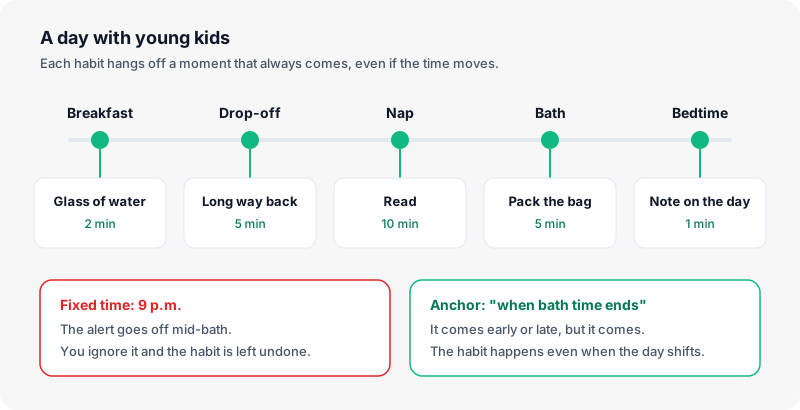
Some examples that tend to work:
- When they fall asleep for the nap, I read for ten minutes before any housework.
- When I get back from daycare drop-off, I take the long way and walk five more minutes.
- When bath time ends, I pack the bag and lay out tomorrow's clothes.
- When I turn off the light in their room, I write one line about the day.
Order matters. If you start the nap with housework, the nap ends before you reach your habit. Put the habit first and the housework after. There are more examples in habit stacking examples.
What to do on the days everything goes wrong
This will happen every week. Two tools change how it feels: the small version and the skipped day.
The small version is the habit at its tiniest. Read one page. Do ten squats while the milk warms. Step onto the balcony for two minutes. It counts as done. Its job is to keep the habit alive on bad days.
Skipping the day means saying "not today" on purpose, before the day ends. It is different from missing. A day skipped for a reason (a trip to the ER, a fever, a sleepless night) says nothing about your consistency. A day that just slips by leaves you feeling you have given up.
Lally and colleagues found in 2010, in the European Journal of Social Psychology, that missing one opportunity did not materially affect habit formation. One lost day does not send you back to the start.
| What the day looks like | What to do with the habit |
|---|---|
| Very bad night, but the day is normal | Small version |
| Sick kid at home | Skip today, no guilt |
| An unexpected long gap | Full version |
| Three or four days skipping the same habit | Lower its frequency or make the small version easier |
| A whole week out (trip, chickenpox, moving house) | Pause your habits and come back with one |
If a habit has not happened for weeks, it is not a willpower problem. It is almost always set at a time or in a shape that does not fit. There is a way to find out in how to find out why a habit keeps failing.
How to share the day with household tasks
With kids, the task list never ends. Doctor's appointments, groceries, laundry, daycare forms, birthday parties. If all of that lands on the same day as your habits, the habits always lose.
The fix is a ceiling. Decide how many things fit in a normal day, counting habits and tasks together, and do not schedule more. What does not fit goes to another day or to a "when possible" list. With young kids, a ceiling of five or six things is usually more realistic than ten.
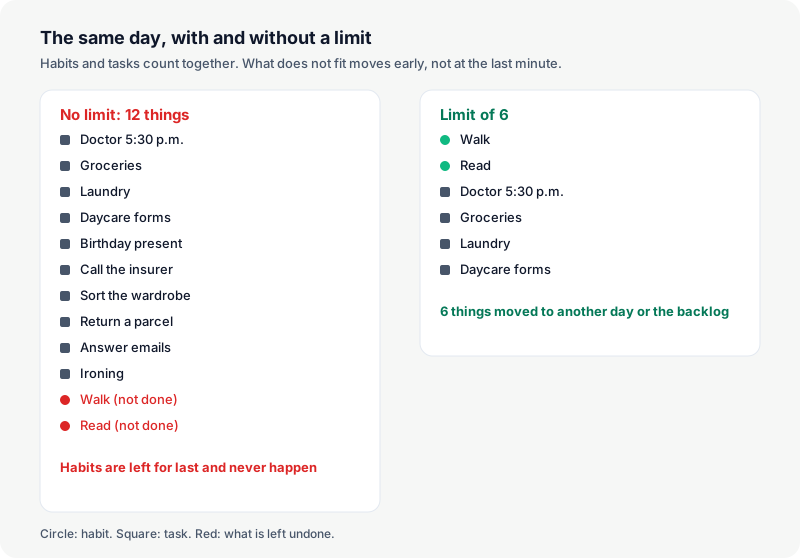
Three things that help:
- Turn fixed chores into habits. Groceries on Monday or towels in the wash every Saturday repeat anyway. Treated as weekly habits, they stop taking up space in your head.
- Keep a backlog for things with no date. "Look at after-school clubs", "sort summer photos". They do not go on any day until you decide.
- Review once a week. Ten minutes on Sunday to move what did not happen and see what fits next week. There is a guide to a weekly review in 15 minutes.
If you suspect you are always above what fits, there are concrete signs in how to tell if your day is overloaded.
How Monkway handles it
Monkway puts habits and tasks on the same Today screen, and has a few pieces that fit days you do not control.
- "Times per week" as a frequency. When you create a habit you choose how many times a week. You can pick days only if you want: the app says "Pick days only if you want to. It is not required." You see "Done this week" with your count against the target.
- Habits with no time. When you create a habit, the time reads "No time" until you choose one. If you never choose one, there is no alert going off at the wrong moment. You add reminders only to habits with a stable moment.
- "Skip today" on every habit. It sits in the habit's actions. A skipped day does not count as missed in your completion rate, and the habit's progress shows it in a different colour from missed days.
- "Maximum things per day". You set it in Progress → Pace. If you schedule something on a day that is already full, the app warns you that the day "is already at the limit" and offers to move it.
- The backlog. Anything without a date goes "To backlog". From there you can give it a day or turn it into a habit when you decide.
- A break for lost weeks. If you go three days or more without checking anything off, Today asks "Taking a break?". Tap "I'm back" and those days count as a pause, so your streaks are not broken.
- "Make it easier". If a habit has gone seven scheduled days without being done, Monkway asks what to do with it: "Pause", "Make it easier" or "Keep going".
- A note on each habit. You can write down the habit's small version right on it, so you do not have to think about it on a bad day.
None of this makes a day with kids calmer. It just stops the app from showing you in red things that were never up to you.
Frequently asked questions
How many habits can I keep with a baby?
One, or two if they are very short. Pick the one that looks after you most, like walking or reading. Pause the rest until nights get better.
Should I do my habits before the kids wake up?
Only if you are getting enough sleep. Getting up at 5 a.m. after broken nights rarely lasts. It usually works better to hook the habit to a moment that already exists, like the nap or bath time.
What happens to my streak if my child is sick for a week?
If your app lets you pause or mark a break, use it and the streak stays as it was. If not, let the streak break and look at times per week instead. Your history is still there.
Should I set reminders for my habits?
Only for those with a stable moment. An alert that goes off mid-bath or mid-feed ends up ignored. Leave the rest without a time and check them when you open the app.
How do I exercise with young kids?
With a weekly frequency and short versions. A walk with the stroller, ten minutes in the living room during the nap, or one fixed day when you have help. Three times a week with no set days holds up better than a daily plan.
What if my partner and I work different hours?
Find one slot per person per week that the other protects. For example, Saturday morning for one of you and Sunday morning for the other. That slot can be a fixed day.
When should I add habits back?
When the ones you have happen on their own for two or three weeks in a row. Add one, not three. If it coincides with a big change, like going back to work, wait a little longer.
Is a two-minute habit worth anything?
Yes. It keeps the habit alive on bad days and makes it easier to pick up again. On good days you do the long version.
Keep it small and flexible
Pick one habit today. Set it to times per week, with no time of day, and write down its two-minute version. Hook it to something that always happens, like the nap or bath time. If a day does not work, skip it and carry on tomorrow. If free time is scarce in general, what to do with one free hour a day may help.
If you want an app that understands uneven weeks, Monkway is free to start, on iPhone and in your browser.