Quick answer. To plan tomorrow the night before, set aside ten minutes at the end of the afternoon or evening. Start with what is already fixed tomorrow: meetings, appointments and habits. Then pick no more than three tasks that fit in the time left, and write down the first action of the most important one. Everything else goes to another day or to an undated list, so it stops competing with tomorrow.
What you'll find here
- Why plan tomorrow the night before instead of in the morning
- What to check before you write anything
- Five steps to plan tomorrow in ten minutes
- How many things to put on tomorrow
- What to do with what doesn't fit
- How to write down the first action
- Signs your evening plan isn't working
- How Monkway handles it
Why plan tomorrow the night before instead of in the morning
Plenty of people plan the day in the morning, over coffee. That works when mornings are calm. When they aren't, this happens: you open your inbox, an urgent message lands, and by ten you still haven't decided what to work on.
The night before, you have something the morning doesn't give you: you know how today went. You know what didn't get done, what you promised someone and what no longer matters. By morning, that is harder to recall.
There is also a known effect around unfinished tasks. In 2011, E. J. Masicampo and Roy Baumeister published a set of experiments in which unfinished goals kept coming back to mind while people worked on something else. When participants wrote a specific plan for that goal, those intrusions dropped, even though the goal itself was still undone (Journal of Personality and Social Psychology, 2011). Having tomorrow decided makes it easier to let go of today.
| Planning the night before | Planning in the morning | |
|---|---|---|
| What you know about today | Fresh: what got done, what's left, what changed | Half-remembered |
| Interruptions | Few: the day is over | Many: email, messages, rushing |
| First hour of the day | Starts on something already decided | Spent deciding |
| Main risk | Planning while tired and overfilling | The day starts before the plan does |
| Time it usually takes | Ten minutes | The same, if nobody interrupts |
| Works best if | Your evening has a regular free moment | Your mornings are calm and predictable |
Neither is right for everyone. If your mornings are chaotic, the night before usually wins.
What to check before you write anything
Before you decide what to do tomorrow, look at what you can't move. Plan without it and you end up putting three big tasks on a day that already had five hours of meetings.
Check four things, in this order:
- Tomorrow's calendar. Meetings, a doctor's appointment, picking someone up. Count the hours that are actually free.
- The habits due tomorrow. The gym, reading, taking the bins out. They take time even if you don't think of them as tasks.
- What didn't get done today. Decide here what moves to tomorrow and what doesn't. If you keep carrying the same thing day after day, read what to do with tasks you keep postponing.
- What's due tomorrow or the day after. A deadline, a payment, a call you said you'd make.
Now you know how much room you have. The rest is deciding how to use it.
Five steps to plan tomorrow in ten minutes
This is the whole process. Do it every evening and within a week or two it becomes almost automatic.
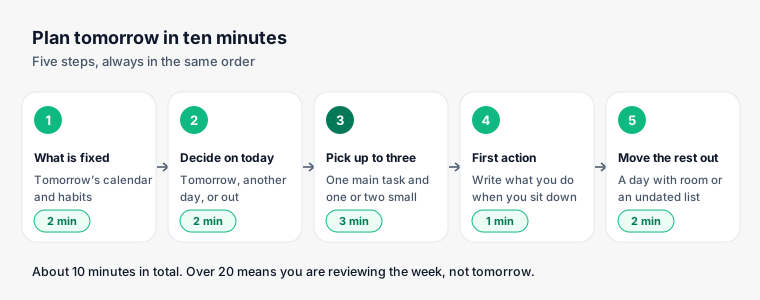
Step 1. Check what's fixed (2 minutes). Tomorrow's calendar and habits. Note how many free hours are left.
Step 2. Decide on today's leftovers (2 minutes). Each thing you didn't do goes to tomorrow, to another day, or out. Don't roll it to tomorrow by default.
Step 3. Pick up to three tasks (3 minutes). One main task and one or two small ones. The main task is the one that would make the day worth it if it were the only thing you did.
Step 4. Write the first action (1 minute). For example, "open the doc and write the outline" instead of "report". More on this below.
Step 5. Move the rest out of tomorrow (2 minutes). Whatever doesn't fit goes to a day with room or to an undated list.
Do it at the same time and in the same place every day, such as when you close your laptop or after dinner. Tie it to something you already do and you won't need to remember it. Our simple night routine has ideas for where it fits in your evening.
How many things to put on tomorrow
What matters is how many tasks fit. A day with six hours of meetings can't hold what a free day can.
This table is a rough guide. Use it as a starting point and adjust it to what you see over a few weeks.
| What tomorrow looks like | Rough free hours | Tasks that usually fit | What to prioritise |
|---|---|---|---|
| Free or nearly free day | 5 or more | 3 tasks, one of them big | The task that moves the important thing forward |
| Normal workday | 2 to 4 | 1 main task and 1 or 2 small ones | One thing that closes something |
| Day full of meetings | Under 2 | 1 small task | Something under 30 minutes |
| Travel day or a known disruption | Almost none | Nothing new, just minimum habits | Ending the day without new debts |
| Day after a bad night | Whatever there is, with less energy | 1 easy task | Something you can do tired |
Count your habits inside those numbers. If tomorrow has the gym, reading and meditation, that's already part of the day.
If you want a method to set your own number, how many tasks per day walks through it step by step. And if you notice while planning that tomorrow is full before it starts, see how to tell if your day is overloaded.
What to do with what doesn't fit
The hard part of planning tomorrow is leaving things out. If they have nowhere else to go, they end up back on tomorrow "in case there's time". There usually isn't.
Each thing that doesn't fit has a place, depending on what it is:
| What it is | Example | Where it goes |
|---|---|---|
| Has a date and can't wait | Hand in a report on Thursday | The nearest day with room before the deadline |
| Matters but has no date | Review your car insurance | An undated list, to choose from in the weekly review |
| Repeats | Call your parents on Sundays | A habit with its own day, not a task you copy every week |
| An idea you might not do | Learn to bake bread | The ideas list, no commitment |
| No longer matters | Reply to an email that sorted itself out | Delete it |
The undated list needs a regular look, or it turns into a junk drawer. Once a week is enough: we explain it in how to do a weekly review in 15 minutes. For ideas you're not sure you'll act on, see where to write down ideas you might not do.
How to write down the first action
A task written as "project" or "report" doesn't tell you what to do when you sit down. In the morning you have to think it through again, and that's where the time you wanted to save goes.
Write the task as the first physical action. Something you can start in two minutes without deciding anything else:
- "Report" becomes "open the doc and write the five section headings".
- "Gym" becomes "leave at 7:30 with the bag I put by the door".
- "Call the bank" becomes "call the helpline at 9:00 with my account number ready".
Peter Gollwitzer called these implementation intentions: plans of the form "when X happens, I will do Y", with a specific moment and action. His 1999 review covers studies in which this kind of plan helped people start what they had set out to do (American Psychologist, 1999). You don't need to write it in that exact format. It's enough for the task to say when, and what you do first.
Only do this for the main task. Writing the first action for everything turns ten minutes into half an hour.
Signs your evening plan isn't working
After two weeks you can tell whether the plan holds. When it doesn't, it's almost always one of these:
| Sign | What it usually means | What to change |
|---|---|---|
| By morning the plan is already useless | You plan without checking the calendar | Always start with what's fixed |
| You never finish all three tasks | You list what you want to do, not what fits | Drop to one main task and one small one |
| The main task rolls to tomorrow every day | It's too big or too vague | Split it and write the first action |
| Planning takes more than 20 minutes | You're reviewing everything, not just tomorrow | Only look at tomorrow; the rest belongs in the weekly review |
| You forget to plan | It isn't tied to any moment | Tie it to something fixed, like closing your laptop |
| You go to bed going over tomorrow | You leave things open with nowhere to go | Give everything a place: another day, the list or the bin |
The last sign deserves a note. In a study by Michael Scullin and colleagues, 57 young adults wrote for five minutes before bed: some listed what they still had to do over the next few days, others listed what they had already done. Those who wrote the to-do list fell asleep faster, and the more specific the list, the faster they fell asleep (Journal of Experimental Psychology: General, 2018). It's a small study, so treat it as a hint rather than a rule.
This content is educational and is not a substitute for medical or psychological advice. If you've been sleeping badly for weeks, or the next day makes you very anxious, talk to a professional.
The first hour, with and without a plan
The difference shows most at the start of the day. Without a plan, the first hour goes on lists and messages. With one, you start on what you already decided.
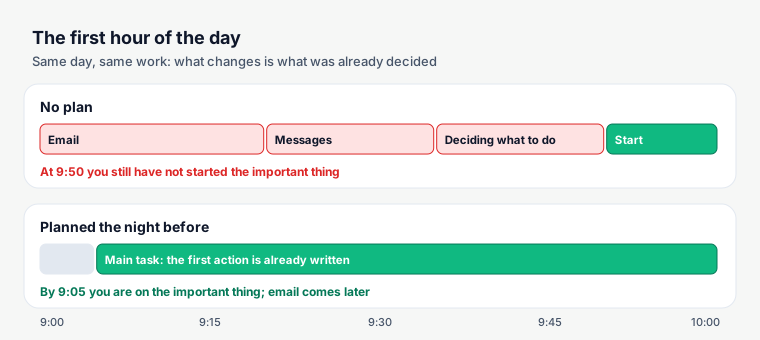
The first hour doesn't have to be perfect. It just needs to start on something already decided.
How Monkway handles it
Monkway keeps habits and tasks together on the Today screen. That means you can do tomorrow's count in one place, without switching between apps.
- Tasks dated for tomorrow. When you create a task, Date offers Today, Tomorrow, Other day or Backlog. To prepare tomorrow, pick Tomorrow. You can add a time, a Priority (Low, Medium or High) and a note with the first action.
- Today's leftovers in one tap. A task for today has "Move to tomorrow" and "Move to another day…". If a task has been moved several times, the app shows "Postponed 3 times", which helps you decide whether to split it or drop it.
- The full-day warning. Habits and tasks count together in the day's load, against a maximum you choose. Send something to a full day and you get a warning such as "Thursday is already at the limit", with "That day has 8 of 8. Schedule it anyway?". You can schedule it anyway, move it to the first day with room, or cancel.
- The backlog for what doesn't fit. Anything without a date goes to the backlog. From there, Decide moves it to Today, Tomorrow, This weekend or Pick a day…, or turns it into a habit with "Every day" or "3 times a week".
- Habits are already in place. Habits on fixed days show up on their own on the right day, so when you plan you only decide the tasks.
- The weekly review. Once a week it shows overdue tasks and old backlog items, with one-tap decisions. That keeps the undated list from growing out of control.
If tomorrow's plan is part of a longer goal, you can group its tasks and habits into a journey. And if your days are mostly meetings, how to fit habits around a day full of meetings has a version of this plan for those days.
Frequently asked questions
How long should planning the next day take?
Ten minutes is usually enough if you only look at tomorrow. If it takes more than twenty, you're probably reviewing the whole week. That works better as a separate weekly review.
What time is best to plan the next day?
When you finish work or after dinner, once you know how the day went. Avoid doing it right before getting into bed if it winds you up. What matters most is doing it at the same moment every day.
How many tasks should I plan for tomorrow?
On a normal workday, one main task and one or two small ones. On a heavy meeting day, one small one. Count the habits due that day too.
What if the plan is useless by morning?
It happens: something urgent comes up. Move the main task to the next day with room and don't try to cram everything into the afternoon. If it happens every day, start your plan by checking the calendar.
Does planning the night before help you sleep?
A small 2018 study found that writing a to-do list before bed helped people fall asleep faster. That's not a guarantee. If you sleep badly on an ongoing basis, talk to a professional.
Is it better to plan on paper or in an app?
It depends on what you do with the plan. Paper is fine for a short list. An app helps if you want tasks that don't fit to move to another day and habits to show up on their own.
What do I do with tasks that don't fit tomorrow?
Give them a place: a day with room if they have a deadline, an undated list if they don't, a habit if they repeat. Anything that no longer matters, delete.
Do I need to plan weekends too?
Not really. If the weekend has fixed plans, a quick look on Friday is enough. Planning Monday on Sunday evening does tend to help.
Start tonight
Tonight, before you wrap up the day, look at tomorrow's calendar and pick one task. Write its first action. That's your morning already started.
If you'd like to prepare tomorrow in the same place you track your habits, with a warning when a day fills up, you can try Monkway for free.