Quick answer. When a busy stretch is coming, like exams, a project deadline or a move, don't try to keep every habit and don't drop them all. Pick two or three that keep you going, such as a regular bedtime or a short walk, and shrink them to a minimum version. Pause the rest before the busy period starts, so they don't pile up as missed days. Write down the date it ends, and from then on resume your paused habits one at a time, not all on the same Monday.
What you'll find here
- When to pause a habit and when to keep going
- Which habits to pause and which to keep
- How to scale down to a maintenance version
- How to set up the pause before the busy period starts
- How to come back when the busy period ends
- How to tell if a pause is turning into quitting
- How Monkway handles it
- FAQ
This guide is about organizing habits. If the hard stretch comes from a health problem, or if work has been hurting your sleep or mood for weeks, talk to a health professional. If your routine includes medication or a rehab plan, don't pause it without asking whoever prescribed it.
When to pause a habit and when to keep going
Pausing makes sense when you know that for a specific period you won't be able to do a habit, or not at its usual level. The key is that the period has an end you can name: the last exam, the launch date, the day you get the keys.
If you can't say when it ends, you're asking a different question. Maybe the habit doesn't fit your life right now, and you need to decide whether to change it or drop it.
You have four options, and each one does a different job:
| Option | What you do | When to use it | What happens to the streak |
|---|---|---|---|
| Keep going | The habit stays at its normal level | It's cheap and helps you get through the busy weeks | It keeps growing |
| Minimum version | You do a very short form of the habit | You have five minutes on most days | It keeps growing |
| Pause | The habit leaves your list until you resume it | It won't fit for weeks, but you want it back | It stays where it was |
| Drop | You archive or delete it | You no longer care about it, busy or not | It stops mattering |
There's a fifth option that most people fall into without choosing it: leaving the habit on the list and missing it every day. It's the worst one. Every morning you see something you already know you won't do. And when the busy period ends, your history says you failed for three weeks, when really you decided not to do it.
If it's only one or two scattered days, you don't need to pause. Skipping the day is enough, and it's covered in how to skip a habit day without breaking your streak.
Which habits to pause and which to keep
Habits don't weigh the same under pressure. Some take time you no longer have. Others are exactly what lets you perform: if you cut your sleep to study more, the studying usually gets worse.
A simple way to sort them: for each habit, ask whether it gives you energy or takes it. The ones that give energy, or protect you, stay, even in a minimum version. The ones that take time and focus get paused.
| Habit type | Examples | During a busy period | Why |
|---|---|---|---|
| Rest | A regular bedtime, no phone in bed | Keep | Without rest you do worse at the thing that's keeping you busy |
| Short movement | A 10-minute walk, stretching | Keep in a minimum version | Costs little and clears your head |
| Long training | An hour at the gym, a 45-minute run | Scale down or pause | It's the one that takes the most time |
| Side learning | A language app, an online course | Pause | It competes for the same attention as work |
| Home | Tidying a room, batch cooking | Minimum version | If you stop completely, it piles up and weighs on you |
| Logging | Journaling, tracking spending | One-line minimum version | One sentence a day is enough to keep the thread |
| Personal projects | Writing a book, learning an instrument | Pause | They need long blocks you don't have right now |
As a rule of thumb, keep two or three habits active during the busy period. More than that and your list fills up with things you won't do again. If you've never thought about how many habits to run at once, there's more in how many habits should you start at once.
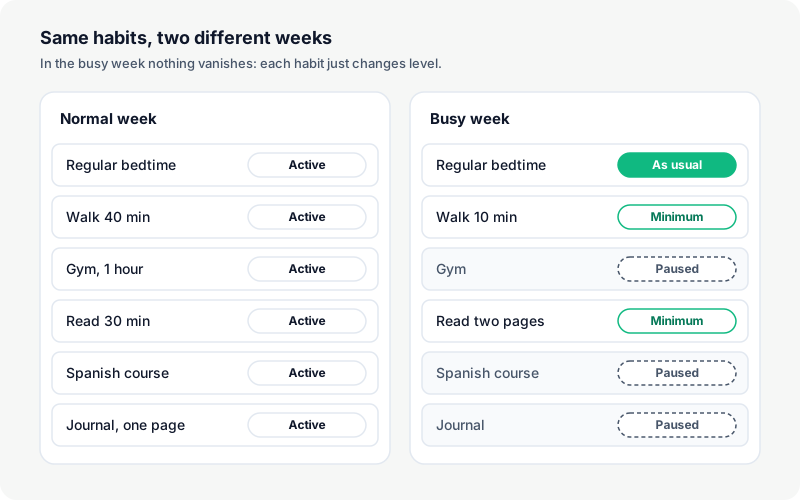
How to scale down to a maintenance version
A maintenance version is the habit cut down to the smallest form that still makes sense. Its goal isn't progress. It's keeping the habit in its slot in your day, so you don't start from zero when the busy period is over.
This matters because of how habits work. Wendy Wood and David Neal describe habits as triggered by context: the place, the time, what you did right before (Psychological Review, 2007). If you keep that moment of the day, even with two minutes, the trigger stays in place.
| Habit | Normal version | Maintenance version |
|---|---|---|
| Walking | 40 minutes | 10 minutes around the block |
| Reading | 30 minutes | Two pages before bed |
| Working out | An hour at the gym | 10 squats and 10 push-ups at home |
| Meditating | 15 minutes | Three slow breaths when you sit down to work |
| Journaling | A full page | One sentence about the day |
| Cooking at home | Prepping the week's meals | One easy dinner ready in the fridge |
| Tidying | A whole room | Clearing your desk at the end of the day |
Decide these versions before the busy period starts. If you wait for the bad day, you'll be bargaining with yourself at 11 p.m. The habit usually loses.
A quick test for whether the version is small enough: picture the worst day you expect in those weeks. If you could do it that day without forcing anything, it works. If not, shrink it again.
How to set up the pause before the busy period starts
Most busy periods are visible in advance. Exams have dates. So do deadlines and moving day. Use that, and set the pause up ahead of time.
A setup that fits in fifteen minutes:
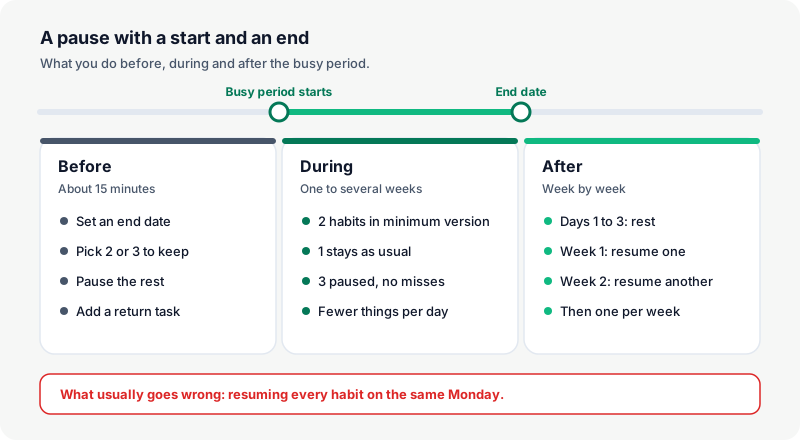
- Set an end date. The last exam, the launch, the move. If there's no exact date, pick an estimate and check it later.
- Go through your habits one by one. For each one, decide: keep as is, minimum version, or pause. Use the table above as a guide.
- Pause the ones that need it. Do it now, not on the first busy day.
- Adjust the ones you keep. Rename them or edit the description so it says the minimum version. If the time of day is changing, move the reminder too.
- Write down the return. Create a task on the end date that says something like "resume habits". That way it doesn't depend on your memory.
Plans like this work better when they're specific. Peter Gollwitzer called them implementation intentions: plans of the form "when X happens, I'll do Y" (American Psychologist, 1999). Here that would be something like "until the 20th, the gym is paused and I walk for ten minutes after lunch".
Look at the rest of your day too. If your daily list was already tight, it will overflow in those weeks. Lowering the number of things you plan per day keeps the busy period from turning into a pile of overdue tasks. There are warning signs for that in how to tell if your day is overloaded.
If the busy period is a long study stretch, like preparing for a licensing or civil service exam, the approach changes. It isn't a stretch anymore, it's your life for months. In that case, a study routine for a long exam will help you build something that lasts.
How to come back when the busy period ends
The most common mistake at the end is resuming everything on the same day. You come out of weeks of pressure, tired, and suddenly eight habits are waiting. In the first week you miss half of them and it feels like starting over.
Come back in stages:
- Days 1 to 3: rest. Keep the habits you didn't pause and add nothing. The first nights after a deadline or the last exam are usually for sleeping.
- First week: resume one. The one you miss most, or the one that's hardest to rebuild. Start with the minimum version for a few days.
- Second week: resume another. And bring the first one back to its normal version if it's going well.
- After that, one more per week until they're all back, or until you decide one isn't coming back.
That last part matters. A pause is a good test of what you actually miss. If after a month you haven't needed a habit, maybe you don't need it. There's a guide for that decision in how to decide which habit to drop.
Don't try to make up for lost time by doubling up either. Phillippa Lally and her team followed people forming a new habit and found that missing a single opportunity didn't noticeably slow the process (European Journal of Social Psychology, 2010). Their study didn't measure long pauses, so don't read too much into it. But it does suggest that what counts is getting back to your normal frequency, not compensating.
If coming back is harder than expected, how to restart a habit you dropped goes into the first few days in more detail.
How to tell if a pause is turning into quitting
A pause has an end date. Quitting doesn't. The trouble is you can't see the difference from the inside: the busy period ends, the habit stays paused, and weeks go by without a decision.
| Sign | What it usually means | What to do |
|---|---|---|
| The end date passed and nothing is resumed | The return wasn't written down | Resume one today, in its minimum version |
| You extend the pause every week with a new reason | The busy period has become your normal | Redesign the habit for your life as it is now |
| You resumed it and keep missing it | It was too big to come back to all at once | Go back to the minimum version for a few weeks |
| You don't miss the habit | It's not a priority anymore | Archive it without guilt |
| You miss it but can't find a slot | Your day has a different shape now | Give it another time or another trigger |
| You have more paused habits than active ones | Pausing has become a way to avoid deciding | Do a review and drop the ones that won't return |
One routine that helps: during your weekly review, look at your paused habits. For each one, decide whether it stays paused, comes back, or goes. If you don't do a weekly review yet, here's how to do a weekly review in 15 minutes.
How Monkway handles it
In Monkway, pausing is an action on the habit, and paused days count neither for nor against you.
- "Pause" and "Resume". From the habit's menu, or from the Habits screen, tap "Pause". The habit disappears from Today and stops sending reminders. The streak stays where it was. Whenever you're ready, tap "Resume" and it's back in your day.
- The "Paused" tab. The Habits screen has three tabs: "Active", "Paused" and "Achieved". "Paused" shows everything you've put on hold at a glance.
- A pause has no end date. It lasts until you resume it. That's why it helps to create a task on the day the busy period ends, reminding you to resume.
- "Taking a break?". If three days go by without anything checked off, Today asks you. You can answer "I'm back", and those days won't count as missed. Or "Still on a break", and with "Choose habits" you decide which ones stay paused. While it lasts, you'll see a notice like "2 habits on a break" with a "Resume" button.
- Idle habit notice. If a habit has gone seven scheduled days without being done, skipped or paused, Today asks what to do: "Pause", "Make it easier" or "Keep going".
- "Weak habits" in the Weekly review. The review lists habits under 40% over the last 30 days. For each one you choose "Keep" or "Pause".
- "Maximum things per day". In Progress → Pace you can lower how many things you plan per day during the busy period. If you schedule a day that's already at the limit, the app warns you first.
FAQ
Does pausing a habit break the streak?
Not in an app that understands pauses. Paused days don't count as missed, so the streak stays where it was and keeps growing once you resume. In an app that only tracks done or not done, every undone day breaks it.
How long can I keep a habit paused?
There's no fixed limit, but the pause should have an end date you can name. If several weeks pass after that date and you still haven't resumed it, decide whether to redesign it or drop it.
Should I pause all my habits or just some?
Just some. Keep two or three that help you get through it, like a regular bedtime or a short walk, in a minimum version. Pausing everything makes the comeback harder, because no part of your day stays in place.
What's the difference between pausing and skipping a day?
Skipping is for a single day. Pausing is for several days or weeks in a row: the habit leaves your list and your reminders until you resume it. If it's three days or more, pausing is usually easier than skipping day by day.
Which habits shouldn't I pause during exams?
The ones that help you perform: a regular bedtime, moving a little every day, and eating something decent. Shrink them to a minimum version if you need to, but keep them. The ones that compete for your attention, like another course or a side project, can be paused.
How do I get back to my habits after a big deadline?
Give yourself a day or two to rest. Then resume one habit per week, starting with its minimum version. Bringing them all back on the same day usually ends in a string of misses.
What if the busy period never ends?
Then it isn't a busy period, it's your current situation. Instead of stretching the pause, adapt your habits to that pace: lower frequency, shorter versions or fewer habits. Check again when something changes at work.
Do I need to pause my tasks too?
Tasks work differently. The ones that aren't urgent can move to after the end date or sit in a separate list for later. What matters is that each day's list only holds what you'll actually do in those weeks.
Set up the pause before it starts
Look at your calendar and find your next busy stretch. Write down when it ends. Pick the two or three habits you'll keep in a minimum version, pause the rest, and create a task for the day you come back.
If you want an app that can tell a pause from quitting, you can try Monkway for free.